Sourdough French Poulard Cheese and Roasted Walnut Crackers
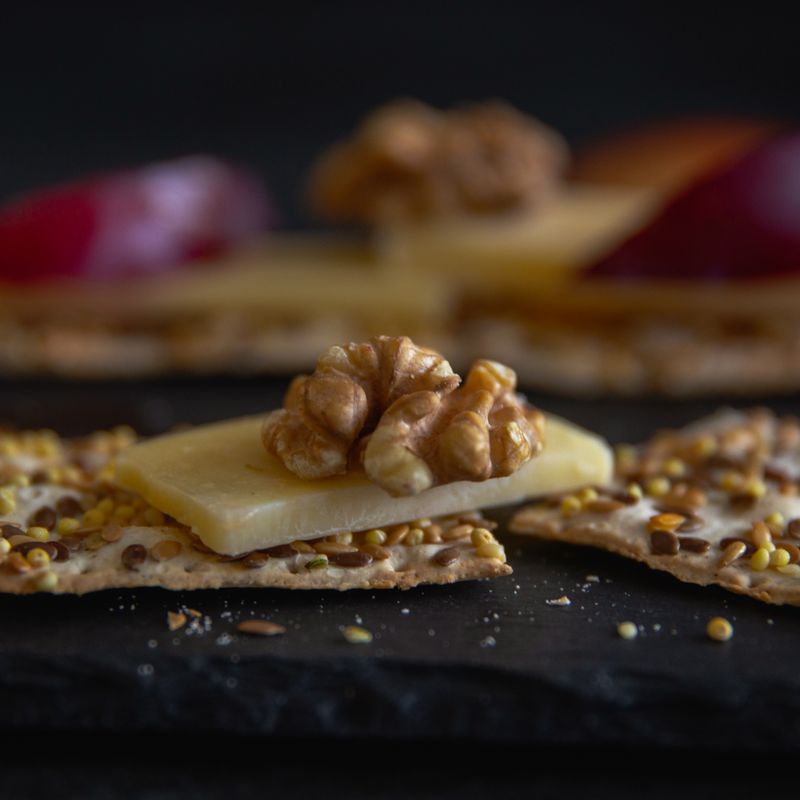
Crispy, buttery crackers made with sourdough discard and studded with tangy Poulard cheese and toasted walnuts. These French-inspired crackers are naturally leavened and finished with fleur de sel and fresh thyme for an elegant, savory bite. Perfect for cheese boards, appetizers, or snacking.
- Prep
- 20 min
- Cook
- 22 min
- Wait
- 15 min
- Total
- 57 min
- Makes
- 24 crackers (about 6 ounces / 170 g)
Steps
Before you start
- Toast the walnuts to bring out their flavor, then let cool before using
- Preheat oven to 425°F (220°C) about 15 minutes before baking
- Have parchment paper ready for both the rolling and baking surfaces
- Use sourdough discard at room temperature for easier mixing
Toast walnuts
- Heat a small saucepan over medium heat.
- Add the 0.75 cup (85 g) raw walnut halves and toast, stirring frequently, for 4–5 minutes until fragrant and lightly golden.
- Watch carefully to avoid burning.
- Tip into a plate to cool for 5 minutes, then roughly chop.
- Set aside.
+ Show details− Hide details
Ready when: Walnuts are fragrant and light golden brown
Tip: Don't skip toasting—it deepens flavor and removes any raw taste. Stir constantly to prevent burning.
Mix dough base
- In a large bowl, combine 1 cup (240 ml) sourdough discard, 1 cup (125 g) all-purpose flour, 3.5 oz (100 g) cold butter cubes, and 0.25 tsp (0.5 g) black pepper.
- Using your fingertips, work the butter into the flour and discard until the mixture resembles coarse breadcrumbs with pea-sized butter pieces still visible.
- The mixture should be crumbly and cool to the touch.
+ Show details− Hide details
Ready when: Mixture resembles coarse breadcrumbs with visible pea-sized butter pieces
Tip: Keep butter cold; this creates layers and a flakier texture. Work quickly so butter doesn't warm.
Add cheese and herbs
- Stir in 0.75 cup (75 g) grated Poulard cheese and 1 tbsp (3 g) fresh chopped thyme.
- Add the cooled chopped walnuts.
- Fold gently with a spatula until evenly distributed throughout the dough, being careful not to overwork it.
- The dough will be shaggy but cohesive.
+ Show details− Hide details
Ready when: Cheese and walnuts are evenly distributed; dough is shaggy but cohesive
Tip: Fold gently to keep the dough from becoming tough. Overworking will make crackers dense instead of crispy.
Form dough disc
- Lightly flour your work surface and transfer the dough.
- Gently press it together with your hands into a rough disc about 1 inch (2.5 cm) thick.
- Don't knead; just bring the pieces together.
- If the dough is warm, chill it in the refrigerator for 10 minutes to make rolling easier.
+ Show details− Hide details
Ready when: Dough is formed into a 1-inch disc and is cool to the touch
Tip: A 10-minute chill prevents the dough from sticking and makes rolling cleaner. This step prevents gluten overdevelopment.
Roll out dough
- Place the dough between two sheets of parchment paper.
- Using a rolling pin or glass, roll it out to a thickness of 1/8 inch (3 mm), working from the center outward.
- Aim for a rough rectangle about 12×10 inches (30×25 cm).
- If dough springs back, let it rest for 2 minutes and roll again.
+ Show details− Hide details
Ready when: Dough is evenly 1/8 inch thick with no thick or thin patches
Tip: Rolling between parchment prevents sticking and keeps your work surface clean. Uniform thickness ensures even baking.
Cut crackers and transfer
- Remove the top sheet of parchment.
- Using a pastry wheel or sharp knife, cut the dough into 24 squares (each roughly 1.5×1.5 inches / 4×4 cm) or rectangles.
- Transfer the parchment with the crackers to two large sheet pans (16×12 inches / 40×30 cm), dividing evenly.
- Work gently so crackers don't break.
+ Show details− Hide details
Ready when: Dough is cut into 24 uniform pieces and arranged on parchment
Tip: Keep pieces a consistent size so they bake evenly. If the dough cracks at the edges, press gently with a knife.
Brush and season
- Beat 1 egg with 1 tablespoon water to make an egg wash.
- Using a pastry brush, lightly brush the top of each cracker with egg wash, being careful not to use too much (which can make them soggy).
- Sprinkle each with a tiny pinch of fleur de sel (use about 0.5 tsp / 3 g total across all 24 crackers).
- Let the crackers sit for 2 minutes while the oven preheats.
+ Show details− Hide details
Ready when: Each cracker is lightly glazed and topped with a small amount of salt
Tip: Less egg wash is better—a light coat ensures crispy crackers, not soggy ones. Salt just before baking for best flavor.
Bake crackersOven 425°F / 220°C
- Preheat oven to 425°F (220°C).
- Bake the crackers on the two prepared sheet pans for 18–22 minutes, rotating the pans halfway through (at about 11 minutes) to ensure even browning.
- The crackers are done when the edges are golden brown and the surface feels dry and crispy to the touch.
- They should sound hollow when tapped.
+ Show details− Hide details
Ready when: Edges are golden brown, surface is dry, and crackers sound hollow when tapped
Tip: Rotate pans halfway through to prevent uneven browning. Thinner crackers bake faster, so watch carefully after 16 minutes.
Cool and crisp
- Remove the sheet pans from the oven and let the crackers cool on the pans for 5 minutes.
- Transfer them to a cooling rack and let rest for 10 minutes.
- As they cool, they will continue to firm up and become crispier.
- They should be completely cooled and crispy before storing.
+ Show details− Hide details
Ready when: Crackers are completely cool and snap cleanly when broken
Tip: Don't skip the cooling time—crackers continue to firm up as they cool. This is when they achieve their final crispy texture.
Good to know
Tips
- Sourdough discard doesn't need to be fed or active for this recipe—even 'spent' discard works well, as the crackers rely on butter for richness and the oven for leavening, not wild yeast activity.
- For extra crispy crackers, reduce oven temperature to 400°F (200°C) and bake 2–3 minutes longer. This gives more even browning and a crunchier bite.
- These crackers pair beautifully with soft cheeses, charcuterie, or a French aperitif. They're also excellent for dipping in soups or serving alongside cheese boards.
- If your dough feels too sticky to roll, let it rest in the fridge for 15 minutes between attempts. Cold dough is much easier to work with and produces better texture.
Make ahead
You can make the dough up to 1 day ahead. After mixing (step 3), cover it tightly with plastic wrap and refrigerate. Let it come to room temperature for 15 minutes before rolling out. You can also roll and cut the crackers, then freeze them on the sheet pans for up to 2 weeks; bake from frozen, adding 2–3 minutes to the baking time.
Storage & reheating
Store cooled crackers in an airtight container at room temperature for up to 5 days. They will stay crispy if kept dry. For longer storage, freeze in an airtight container or freezer bag for up to 3 weeks. To refresh slightly stale crackers, warm them in a 300°F (150°C) oven for 3–4 minutes.
Substitutions
- Poulard cheese (or French aged cheese like Comté or Gruyère), finely grated → Comté, Gruyère, or aged Cheddar (finely grated). Poulard is a traditional French cheese, but any firm, aged cheese with similar tangy notes works well. Comté gives a nuttier flavor.
- raw walnut halves → Toasted hazelnuts or almonds (roughly chopped). Hazelnuts add an earthier note; almonds are milder. Toast the same way for best results.
- fresh thyme leaves → Fresh rosemary or a mix of Herbes de Provence (1 tbsp / 2 g). Rosemary is more peppery; Herbes de Provence adds complexity. Use the same amount.
- fleur de sel (French sea salt) → Kosher salt or maldon sea salt. Fleur de sel has delicate crystals that dissolve slightly on the tongue. Kosher salt and Maldon are good substitutes for a slightly different texture.