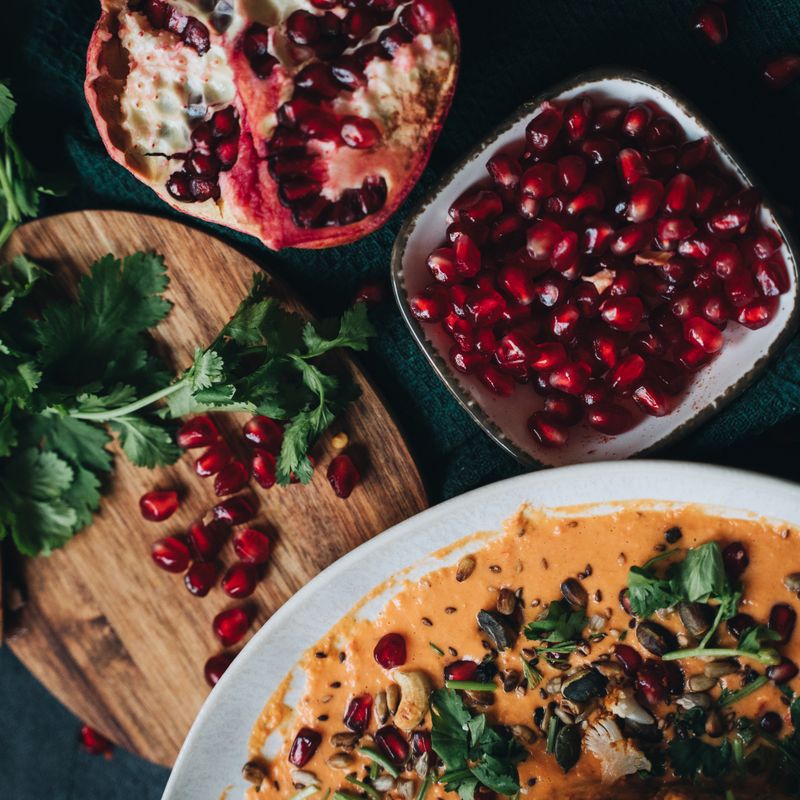
Sourdough Discard Cilantro and Pomegranate Seed Flatbread
A Middle Eastern-inspired skillet flatbread made with sourdough discard, studded with fresh cilantro and jewel-like pomegranate seeds. The dough is tangy from the discard, tender from a long rest, and finished with a drizzle of olive oil and fleur de sel. Perfect warm from the pan as an appetizer, side, or base for dips.
- Prep
- 25 min
- Cook
- 12 min
- Wait
- 1 hr 30 min
- Total
- 2 hr 7 min
- Makes
- 4 flatbreads (8 inches each)
Steps
Before you start
- Have your sourdough discard at room temperature
- Remove pomegranate seeds and pat them dry to prevent excess moisture
- Finely chop fresh cilantro and set aside
- Have your skillet ready and a clean kitchen towel at hand
Mix dough
- In a large bowl, combine the sourdough discard (1 cup / 240 ml), warm water (¼ cup / 60 ml), and all-purpose flour (1½ cups / 190 g).
- Mix with your hand or a spoon until a shaggy dough forms, with no dry flour visible.
- Add the fine sea salt (¾ tsp / 4.5 g) and olive oil (2 tbsp / 30 ml), then knead gently in the bowl for 1 minute until the salt and oil are fully incorporated.
- The dough should be soft, slightly sticky, and cohesive.
+ Show details− Hide details
Ready when: Dough is soft, slightly sticky, and forms a cohesive mass with no dry flour visible
Tip: Don't overwork the dough—a loose, sticky dough will yield a tender flatbread. If it feels stiff, add 1 tbsp of warm water.
Bulk rise
- Cover the bowl loosely with a damp kitchen towel or plastic wrap.
- Let the dough rise at room temperature (68–72°F / 20–22°C) for 60–90 minutes.
- The dough should increase in volume by 50–75% and feel airy when gently pressed.
+ Show details− Hide details
Ready when: Dough has increased by 50–75%, feels airy, and shows small bubbles on the surface
Tip: Warmer kitchens will speed up fermentation; cooler kitchens will slow it. A 60-minute rise is the minimum; 90 minutes is ideal for full flavor development.
Fold in cilantro and seeds
- Gently deflate the dough by pulling the edges toward the center a few times.
- Sprinkle the chopped cilantro (½ cup / 12 g) and pat-dry pomegranate seeds (¾ cup / 120 g) over the dough.
- Using a dough scraper or your hand, gently fold the dough in half twice, incorporating the cilantro and seeds as evenly as possible.
- The dough will be slightly loose; that is fine.
+ Show details− Hide details
Ready when: Cilantro and pomegranate seeds are evenly distributed throughout the dough
Tip: Dry the pomegranate seeds well—wet seeds will release juice and make the dough soggy. Fold gently to avoid crushing the seeds and releasing more liquid.
Divide and rest dough
- Using a dough scraper or bench knife, divide the dough into 4 equal portions.
- Gently shape each portion into a loose ball without pressing hard.
- Place the balls on a clean, lightly floured surface and cover with a damp towel.
- Let rest for 10–15 minutes.
+ Show details− Hide details
Ready when: Dough portions are soft and slightly puffed
Tip: Resting the dough makes it easier to stretch without tears and gives it a more open crumb structure.
Shape and stretch flatbread
- Working with one dough ball at a time, gently press it into a rough round with your fingertips, working from the center outward.
- Stretch the dough to an 8-inch (20 cm) round, about ¼ inch (6 mm) thick.
- If the dough springs back, let it rest for 1–2 minutes before stretching further.
- Repeat with the remaining dough balls.
- Work carefully to maintain the cilantro and seed distribution.
+ Show details− Hide details
Ready when: Dough is stretched to an even 8-inch round, about ¼ inch thick
Tip: If the dough is too elastic, rest it between stretches. Don't press so hard that you squeeze out all the bubbles—they create the flatbread's tender texture.
Heat skillet
- Place a 10-inch (25 cm) cast-iron or nonstick skillet over medium-high heat.
- Let it heat for 2–3 minutes until the pan is very hot but not smoking.
- You can test by flicking a few drops of water on the surface—they should sizzle immediately and evaporate.
+ Show details− Hide details
Ready when: Skillet is very hot; water droplets sizzle and evaporate immediately
Tip: A well-heated skillet is crucial for good browning and a slightly crispy exterior. If the pan is not hot enough, the flatbread will dry out.
Cook first side
- Carefully transfer the first stretched flatbread to the hot skillet.
- It should sizzle immediately.
- Cook for 3–4 minutes without moving it.
- The underside should develop golden-brown speckled spots and be firm enough to flip.
+ Show details− Hide details
Ready when: Underside is golden-brown with speckled spots; dough is firm and set
Tip: Don't move the flatbread while it cooks—let it sit undisturbed so the bottom browns and firms up, making it easy to flip without tearing.
Cook second side
- Flip the flatbread carefully using tongs or a thin spatula.
- Cook for another 2–3 minutes until the second side is lightly golden-brown and the flatbread is cooked through.
- The dough should be tender but set, not doughy.
- Transfer to a plate and repeat with the remaining three flatbreads, keeping each warm.
+ Show details− Hide details
Ready when: Second side is lightly golden; dough is set throughout and no longer doughy
Tip: If the second side browns too quickly before the dough is set, lower the heat to medium. Stack cooked flatbreads on a plate and cover with a clean towel to keep them warm and soft.
Finish and serve
- While the flatbreads are still warm, lightly brush or drizzle each with extra-virgin olive oil (about ½ tbsp / 7.5 ml per flatbread).
- Finish with a pinch of fleur de sel.
- Serve immediately, warm from the pan.
- The flatbread is best enjoyed fresh but can be reheated.
+ Show details− Hide details
Ready when: Flatbread is brushed with oil and seasoned
Tip: Finish while warm so the oil soaks in and the fleur de sel adheres. Serve immediately for the best texture—the flatbread will firm up as it cools.
Good to know
Tips
- Sourdough discard flatbreads develop the best flavor and texture with a long, cool rise. If your kitchen is warm, ferment in the refrigerator overnight and bring to room temperature before cooking.
- Pat the pomegranate seeds dry with paper towels before folding them in. Wet seeds release juice, which will make the dough sticky and the flatbread soggy.
- For extra texture, sprinkle a few additional pomegranate seeds and fresh cilantro on top of the dough just before it hits the hot skillet.
- If the dough is too sticky to stretch easily after rising, dust it lightly with flour—but avoid using too much, which will toughen the flatbread.
Make ahead
The dough can be mixed and refrigerated for up to 24 hours before the bulk rise. Allow it to come to room temperature (1–2 hours) before proceeding. You can also divide and shape the flatbreads, wrap them individually, and freeze for up to 3 months; thaw in the refrigerator overnight and cook from cold, adding 2–3 minutes to the cooking time.
Storage & reheating
Store cooled flatbreads in an airtight container at room temperature for up to 2 days, or wrap and refrigerate for up to 4 days. Freeze for up to 3 months. Reheat wrapped in foil in a 300°F (150°C) oven for 8–10 minutes until soft and warm, or place directly in a warm skillet for 1–2 minutes per side.
Substitutions
- fresh cilantro, finely chopped → fresh parsley or a mix of cilantro and mint. Parsley is milder; use the same amount. Mint will add a brighter, more herbaceous note.
- pomegranate seeds (arils), patted dry → dried pomegranate seeds (pomegranate molasses mixed into the dough), toasted pine nuts, or pomegranate juice reduced by half and drizzled on top. Dried seeds provide tartness without moisture; pine nuts add crunch; pomegranate juice reduction adds bright flavor and moisture control challenges—stir it in gently with the oil after cooking.
- all-purpose flour → whole wheat flour (use 1¼ cups / 160 g) or a mix of all-purpose and whole wheat (75/25). Whole wheat will add nuttiness and density; it absorbs more water, so reduce warm water to 3 tbsp (45 ml) if using 100% whole wheat.
- extra-virgin olive oil → sunflower oil or another neutral oil. Neutral oils will reduce the distinctive olive flavor but work equally well for texture and browning.
More flatbreads
See all →


Find more like this
- Meal
- Snack
- Cuisine
- Middle Eastern
- Method
- Stovetop
- Quick & Easy
- Easy