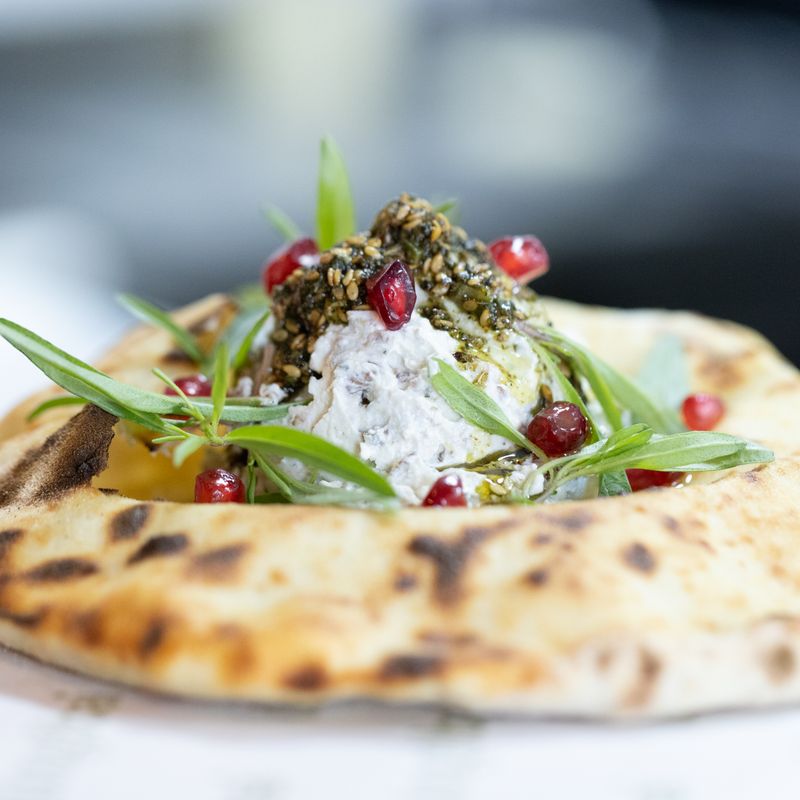
Sourdough Discard Charred Eggplant and Pomegranate Molasses Flatbread
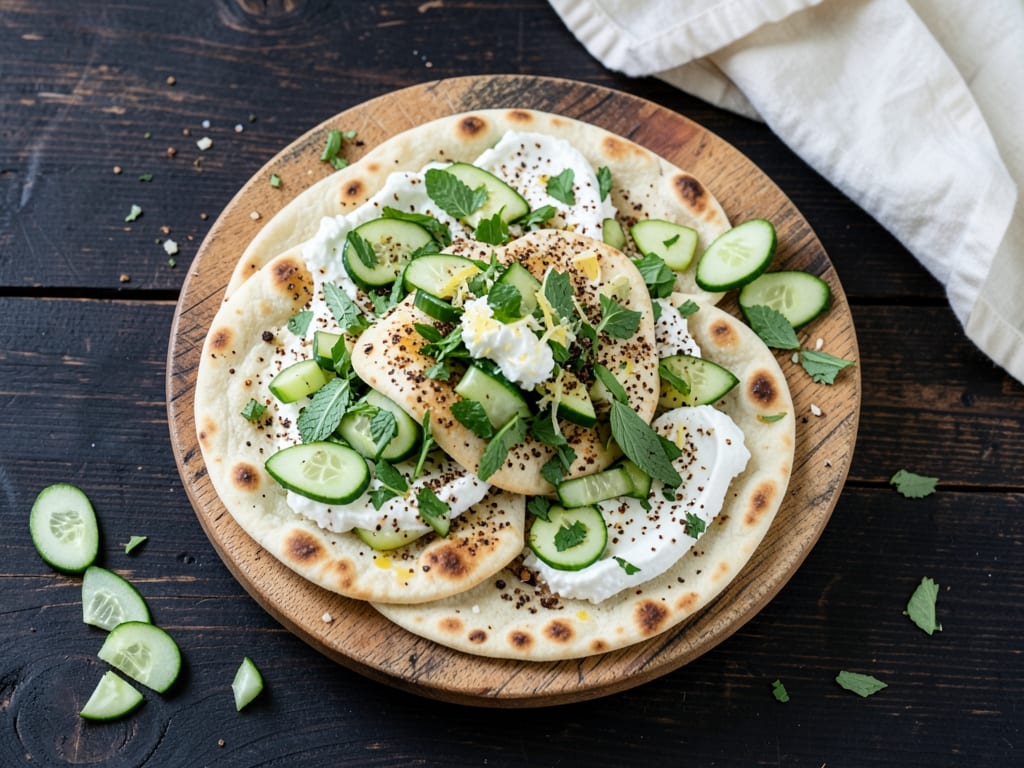
A Levantine-inspired flatbread made with active sourdough discard, topped with blistered eggplant charred until deeply caramelized, then finished with tart pomegranate molasses, creamy tahini, fresh herbs, and pomegranate seeds. The dough is tender and chewy with a crackling crust, while the eggplant becomes jammy and sweet. Perfect for mezze spreads, lunch, or as an appetizer.
- Prep
- 25 min
- Cook
- 30 min
- Wait
- 1 hr 30 min
- Total
- 2 hr 25 min
- Makes
- 4 flatbreads (8–10 inches / 20–25 cm each)
Steps
Before you start
- Ensure your sourdough discard is active and bubbly (fed 4–6 hours prior and at peak). Have all ingredients at room temperature.
- Preheat your oven to 475°F (245°C) and place a baking steel or heavy baking sheet on the middle rack for at least 20 minutes.
- Char the eggplant directly over a gas flame or under a broiler beforehand to save time on final assembly.
Mix the dough
- In a large bowl, combine the active sourdough discard, bread flour, whole wheat flour, room-temperature water, and olive oil.
- Stir with a dough whisk or your hand until no dry flour remains and a shaggy dough forms.
- Let it rest for 10 minutes (autolyse).
- Then add the sea salt and mix thoroughly until fully incorporated, kneading by hand or using a stand mixer on low speed for 5–6 minutes.
- The dough should be slightly sticky, tacky to the touch but not wet.
+ Show details− Hide details
Ready when: Dough is smooth, elastic, and slightly tacky; no dry streaks remain
Tip: Do not overwork the dough—gentle mixing prevents gluten overdevelopment and keeps the crumb light and airy.
Bulk fermentation
- Place the dough in a lightly oiled bowl, cover with a damp kitchen towel or plastic wrap, and let it rise at room temperature (68–72°F / 20–22°C) for 60–75 minutes.
- Perform two sets of stretch-and-folds (at 20 minutes and 40 minutes into the rise): gently lift one side of the dough, stretch it over the center, and fold it down; rotate the bowl 90 degrees and repeat on all four sides.
- The dough should increase in volume by 30–50% and show visible bubbles throughout.
+ Show details− Hide details
Ready when: Dough is noticeably puffy, jiggles slightly when the bowl is gently shaken, and shows visible gas bubbles on the surface and sides
Tip: Stretch-and-folds build strength without aggressive kneading, essential for an open, tender crumb structure.
Char the eggplant
- While the dough ferments, halve the eggplants lengthwise.
- Score the cut sides in a crosshatch pattern (cuts about ¼ inch / 6 mm deep, spaced ½ inch / 1.25 cm apart).
- Brush both sides generously with olive oil and season with a pinch of salt and pepper.
- Heat a cast-iron skillet or heavy sauté pan over medium-high heat until smoking.
- Place eggplant halves cut-side down in the pan and press gently for 4–5 minutes until the surface is deeply charred and caramelized.
- Turn and char the skin side for 2–3 minutes.
- Transfer to a cutting board to cool slightly, then cut into rough ¾-inch (2 cm) chunks.
- The flesh should be soft and jammy.
+ Show details− Hide details
Ready when: Eggplant is deeply caramelized on the cut side (almost blackened), and the flesh yields to gentle pressure; skin is blistered
Tip: Do not move the eggplant while it chars—let it sit undisturbed so a dark, flavorful crust develops. High heat and proper pressure are key to deep caramelization.
Shape and proof the flatbreads
- After bulk fermentation, turn the dough onto a lightly floured surface.
- Divide into four equal pieces (about 150 g / 5 oz each).
- Shape each piece into a round, then loosely cover and rest for 10 minutes.
- Working with one piece at a time, gently stretch it into a rough oval or round about 8–10 inches (20–25 cm) long and ¼ inch (6 mm) thick.
- Place on parchment paper or a floured pizza peel.
- Cover loosely with a damp towel and let proof at room temperature for 15–20 minutes until slightly puffy and holding a gentle dimple when poked.
+ Show details− Hide details
Ready when: Dough is visibly airier and holds a gentle indentation when poked with a floured finger
Tip: Do not over-proof—the dough should feel pillowy but still have slight resistance. Over-proofed dough will spread too much and lose lift in the oven.
Preheat the oven and steelOven 475°F / 245°C
- Place a baking steel or heavy baking sheet on the middle rack of your oven and preheat to 475°F (245°C) for at least 20 minutes.
- This creates a hot, crispy bottom crust.
+ Show details− Hide details
Ready when: Oven reaches 475°F (245°C) and steel is too hot to touch
Tip: A preheated steel or baking sheet is essential for a crackling crust. Do not skip this step.
Bake the flatbreadsOven 475°F / 245°C
- Carefully transfer the first flatbread from the peel to the hot steel by sliding it off or by lifting the parchment and sliding it directly onto the steel.
- Bake for 6–8 minutes until the bottom is golden and crisp and the top is just set but still pale.
- Remove from the oven (it will continue to cook slightly as it cools).
- Repeat with the remaining flatbreads, working in batches of 2 if your steel allows.
- If baking multiple flatbreads at once, rotate them halfway through for even browning.
+ Show details− Hide details
Ready when: Bottom is golden brown and sounds hollow when tapped; top is light golden and no longer doughy
Tip: Watch carefully—sourdough bakes quickly at high heat. A slightly paler top allows the toppings to shine and prevents over-browning.
Make the tahini sauce
- While the flatbreads bake, whisk together the tahini, lemon juice, minced garlic, and water in a small bowl until smooth and pourable.
- The sauce should have the consistency of heavy cream.
- Season to taste with a pinch of salt and pepper.
- If too thick, add water 1 teaspoon at a time.
+ Show details− Hide details
Ready when: Sauce is smooth, pourable, and emulsified with no visible lumps
Tip: Add water gradually to prevent the sauce from becoming too thin. The sauce should flow but not pool.
Assemble the flatbreads
- Transfer each warm flatbread to a serving plate or cutting board.
- Drizzle about 2 tablespoons of the tahini sauce across the surface in thin lines.
- Scatter the charred eggplant chunks evenly over the flatbread.
- Drizzle with 1–2 teaspoons of pomegranate molasses per flatbread in thin threads over the eggplant.
- Scatter pomegranate seeds, chopped parsley, and torn mint (if using) across the top.
- Finish with a small pinch of sumac (if using), freshly ground black pepper, and fleur de sel to taste.
+ Show details− Hide details
Ready when: Flatbread is fully topped and garnished, toppings are evenly distributed
Tip: Assemble just before serving so the flatbread retains warmth and crispness. The tahini sauce will set slightly as it cools.
Good to know
Tips
- Active sourdough discard is essential—it should be fed and bubbly (at peak) 4–6 hours before mixing. Inactive starter will produce a dense, slow-rising flatbread.
- Stretch-and-fold techniques during bulk fermentation build gluten strength gently, resulting in an airy crumb without harsh kneading.
- Charring the eggplant is crucial to flavor; do not skip this step. The caramelization creates sweetness and depth that balances the tart pomegranate molasses and lemon.
- Assemble flatbreads immediately after baking while they retain warmth and crispness. The contrast between the crispy base and soft, jammy eggplant is best fresh.
Make ahead
You can prepare the dough up to 8 hours in advance. After bulk fermentation, divide and shape the flatbreads, then refrigerate them on parchment-lined trays covered loosely with plastic wrap for up to overnight. Bake directly from the fridge, adding 2–3 minutes to the baking time. The eggplant can be charred 2 hours ahead and kept at room temperature; reheat gently in a skillet for 1–2 minutes if desired.
Storage & reheating
Cooled flatbreads keep in an airtight container at room temperature for up to 2 days. Reheat on a preheated baking steel at 375°F (190°C) for 3–4 minutes until warm and crispy. Alternatively, wrap in foil and warm in a 350°F (175°C) oven for 5 minutes. Do not refrigerate or freeze the assembled flatbreads; store components separately. Charred eggplant keeps refrigerated in an airtight container for up to 4 days; tahini sauce keeps for up to 3 days.
Substitutions
- Japanese or Italian eggplant, medium → zucchini or summer squash (halved lengthwise, charred until caramelized). Zucchini cooks faster; reduce charring time to 3–4 minutes per side to avoid becoming mushy.
- pomegranate molasses → Tart-up a drizzle of balsamic reduction or pomegranate juice concentrate mixed with lemon juice (1:1 ratio). Pomegranate molasses provides a specific tart, deep flavor; substitutes will alter the taste profile but still work.
- tahini (sesame paste) → Greek yogurt thinned with lemon juice and garlic to a drizzle consistency. This creates a tangier, creamier sauce but lacks the nuttiness of tahini.
- fresh flat-leaf parsley → arugula, fresh cilantro, or dill. Each herb shifts the flavor; cilantro and dill offer stronger anise/licorice notes; arugula adds peppery bite.
More flatbreads
See all →


Find more like this
- Meal
- Lunch
- Cuisine
- Middle Eastern
- Main ingredient
- Eggplant