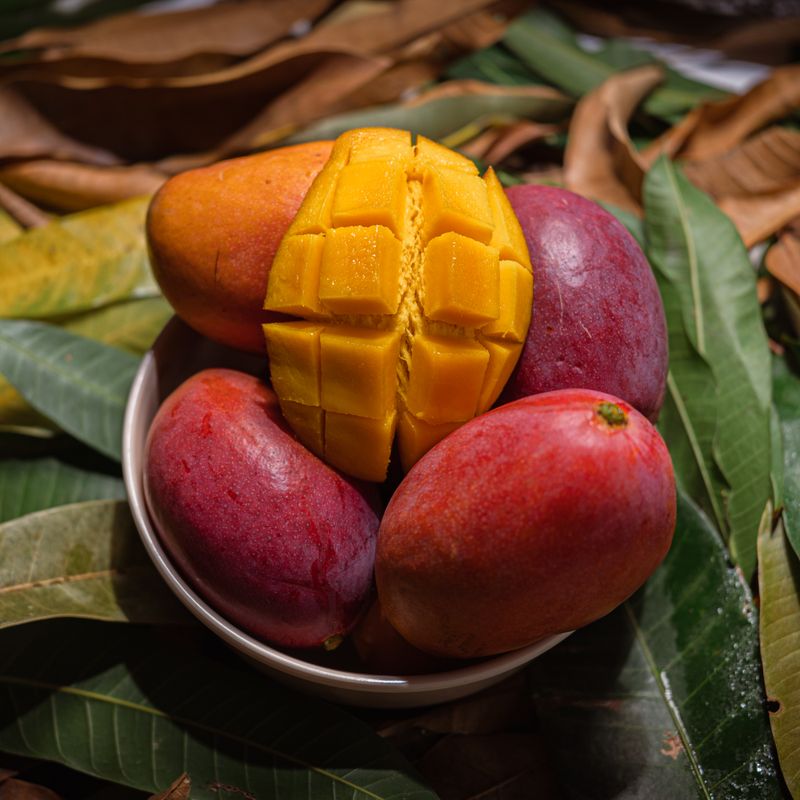
Sourdough Caribbean Scotch Bonnet and Mango Bread Bowl
A rustic sourdough bread bowl with Caribbean flair—tender crumb studded with roasted scotch bonnet peppers, fresh mango, and warm allspice. The naturally sour tang of the dough balances the heat from the peppers and sweetness of mango, making it perfect for serving alongside Caribbean curries, rice and peas, or simply as a showstopping side. The bowl itself becomes edible and soaks up all the flavors of whatever you serve inside.
- Prep
- 30 min
- Cook
- 50 min
- Wait
- 12 hr
- Total
- 13 hr 20 min
- Makes
- 4 bread bowls (each 5–6 inches wide)
Steps
Before you start
- Remove sourdough starter from refrigerator 12 hours before mixing to reach peak activity
- Preheat oven to 450°F (232°C) on baking day, with a Dutch oven inside
- Have mango peeled, pitted, and cut into ¼-inch (6 mm) dice before mixing dough
Roast scotch bonnet peppers
- Heat a dry cast-iron skillet or heavy-bottomed pan over medium-high heat.
- Place scotch bonnet pepper halves cut-side down on the hot surface.
- Let them char for 2–3 minutes until the skin darkens and blisters.
- Flip and char the skin side for another 1 minute.
- Transfer to a cutting board, cool for 5 minutes, then finely dice the flesh into ¼-inch (6 mm) pieces.
- Set aside.
+ Show details− Hide details
Ready when: Skin darkens and blisters; flesh is tender and fragrant
Tip: Roasting mellows the heat and deepens the flavor. Wear gloves when handling the peppers.
Mix dough
- In a large bowl, combine 100 g active sourdough starter, 300 ml lukewarm water (80–90°F / 27–32°C), and 425 g bread flour.
- Stir with a wet hand or wooden spoon until no dry flour remains and all ingredients are shaggy and just combined, about 2 minutes.
- Cover with plastic wrap and let rest at room temperature for 20 minutes (autolyse).
+ Show details− Hide details
Ready when: All flour is moistened and mixture holds together loosely
Tip: Using the warmest water (closer to 90°F / 32°C) speeds fermentation in a cool kitchen.
Add salt and begin stretch-and-fold
- Sprinkle 9 g fine sea salt over the rested dough.
- Using wet hands, fold the dough over itself 4–5 times from the edges toward the center, rotating the bowl after each fold, until salt is fully incorporated and the dough firms up slightly (about 1 minute).
- The dough will still be sticky and loose.
+ Show details− Hide details
Ready when: Salt disappears into the dough; dough feels slightly firmer than before
Tip: Wet hands prevent sticking during folding. Work gently to avoid overworking.
First bulk fermentation with folds
- Cover the bowl and let it sit at room temperature (68–72°F / 20–22°C) for 4 hours, performing 4 sets of stretch-and-folds at 30-minute intervals (at 30, 60, 90, and 120 minutes).
- For each fold, wet your hand and lift the edge of the dough, stretch it over the center, rotate the bowl 90 degrees, and repeat 4 times.
- After the fourth set of folds (at 2 hours), let the dough rest untouched for 2 more hours.
- The dough should increase in volume by 50–75%, feel airy, and show bubbles on the surface.
+ Show details− Hide details
Ready when: Dough increased 50–75% in volume, jiggles slightly when bowl is moved, visible bubbles on surface
Tip: If your kitchen is cool (under 68°F / 20°C), extend this phase by 30–60 minutes. Consistent temperature is key.
Laminate dough with fillings
- Wet your work surface and hands with water.
- Turn the dough out onto the wet surface.
- Gently stretch it into a rough 10-inch × 14-inch (25 × 36 cm) rectangle without tearing (it should be somewhat translucent if you look through it).
- Brush the surface with 1 tbsp (15 ml) olive oil.
- Scatter the roasted diced scotch bonnet pepper evenly across the top, then scatter the diced mango.
- Sprinkle the ground allspice evenly over the fruit and peppers.
- Using a bench scraper or your hands, tightly roll the rectangle from one short end toward you, sealing the seam as you go.
- Gently rotate so the seam faces down.
+ Show details− Hide details
Ready when: Roll is uniform, seam is sealed, fillings are distributed evenly
Tip: If the dough tears, don't worry—wet fingers can pinch it back together. Work gently to avoid overworking the fermented dough.
Divide into bowls and shape
- Using a bench scraper, cut the rolled dough into 4 equal pieces (roughly 3–4 inches / 7–10 cm wide).
- Flip each piece seam-side up and use your hands to tuck and shape each one into a tight round, rotating it on the counter toward you, rotating it 90 degrees after each 2–3 rotations, until a skin forms and the dough is round and fairly tight (about 2–3 minutes per piece).
- The seam should be on the underside when finished.
- Place each round seam-side up in a small bowl or ramekin (4–5 inches wide) that's lined with a kitchen towel dusted lightly with flour.
- Cover loosely with plastic wrap.
+ Show details− Hide details
Ready when: Each round is tight, holds its shape, seam faces down into the towel
Tip: Tension in the dough helps it rise tall in the oven. Don't over-flour or the shapes will be loose.
Cold retard (overnight proof)
- Cover the plastic-wrapped bowls with plastic bags or wrap them tightly and place in the refrigerator (38–40°F / 3–4°C) for 12–18 hours.
- The dough will continue to ferment slowly and develop even more flavor.
- A longer cold proof improves the sour flavor and gives you more flexibility on baking day.
+ Show details− Hide details
Ready when: Dough is chilled throughout, feels slightly firmer than before, may show small cracks
Tip: You can bake directly from the cold retard without room-temperature proofing, or bring to room temp for 30–45 minutes first (this adds 1–2 hours to baking day).
Prepare oven and preheatOven 450°F / 230°C
- Place a Dutch oven (5–6 quart) in the oven and preheat to 450°F (232°C) for at least 45 minutes.
- You want the pot and oven to be very hot.
- Remove one shaped dough bowl from the refrigerator and let it sit at room temperature on the counter for 5 minutes while the oven heats.
- (You'll bake the bowls in batches, two at a time, if your Dutch oven is large enough to fit 2 comfortably.)
+ Show details− Hide details
Ready when: Oven thermometer confirms 450°F (232°C); Dutch oven is hot to the touch
Tip: A screaming-hot Dutch oven traps steam and creates the characteristic crispy crust of artisan sourdough.
Score and load bowls into Dutch ovenOven 450°F / 230°C
- Carefully remove the hot Dutch oven from the oven and place it on a heatproof surface.
- Turn out a chilled dough bowl onto a piece of parchment paper, seam-side up (the seam will now face up).
- Using a sharp knife or lame, score an X or cross pattern on the top (about ¼ inch / 6 mm deep) to allow steam to escape and guide the rise.
- Working quickly and carefully (the pot is very hot), lower the parchment paper with the dough into the Dutch oven using the paper as a sling.
- If baking two at once, place them at opposite ends of the pot, seam-side up.
- Cover the Dutch oven with its lid and return it to the oven.
+ Show details− Hide details
Ready when: Dough is in the pot, scores are visible, lid is on and oven is closed
Tip: Bake straight from cold—no proofing needed. The residual warmth and steam in the covered pot will give excellent oven spring.
Bake covered to trap steamOven 450°F / 230°C
- Bake covered at 450°F (232°C) for 25 minutes.
- The steam will heat the dough gently and encourage rise.
- You should hear crackling and popping as the dough expands.
+ Show details− Hide details
Ready when: Sounds of steam and popping; interior of Dutch oven is steamy when peeking (don't open the lid fully)
Tip: Resist the urge to open the lid during this phase. Steam is crucial for a good rise.
Remove lid and bake until deep brownOven 450°F / 230°C
- Carefully remove the lid from the Dutch oven (watch for escaping steam).
- Continue baking uncovered at 450°F (232°C) for 20–25 minutes, until the bread bowls are deep golden-brown on all sides and the bottoms are firm and hollow-sounding when tapped.
- The internal temperature should reach 205–210°F (96–99°C) when measured with an instant-read thermometer inserted into the thickest part of one bowl (careful not to hit a piece of fruit).
+ Show details− Hide details
Ready when: Deep golden-brown color, firm bottom, hollow-sounding tap, internal temp 205–210°F (96–99°C)
Tip: If the tops are browning too quickly, tent loosely with foil for the last 5 minutes. Every oven is different, so watch for color rather than relying solely on time.
Cool and prepare for serving
- Carefully remove the bowls from the Dutch oven using tongs or a bench scraper and place them on a wire cooling rack.
- Let them cool for at least 15 minutes (they will continue to set as they cool).
- While still warm, you can scoop out a small lid from the top of each bread bowl using a small serrated knife, creating a hollow bowl ready for serving.
- Alternatively, leave the tops whole and tear into the bread as desired.
+ Show details− Hide details
Ready when: Bread is cool enough to handle but still warm; crust is firm and crackling
Tip: If creating a lid, cut a circle about 2 inches (5 cm) in diameter and about 1 inch (2.5 cm) deep. Scoop out some of the interior and reserve for dipping or stuffing alongside the bowl.
Serve
- Serve the bread bowls warm or at room temperature.
- Fill with your choice of Caribbean-inspired stew, curry, seafood, or beans.
- The sweet-spicy flavors of mango and scotch bonnet in the bread complement curries, jerk chicken, pigeon peas and rice, or seafood broth beautifully.
- The bread itself will become tender and absorb the flavors of whatever sits inside.
+ Show details− Hide details
Tip: For best texture, serve within a few hours of baking, though they stay good for up to 2 days.
Good to know
Tips
- For the most pronounced sourdough tang, make sure your starter is bubbly and at peak activity (doubled since the last feeding). If your starter is sluggish, feed it 8–12 hours before making dough.
- Cold fermentation (the overnight retard) is not optional—it develops the complex flavors and sour character that make sourdough special, plus it makes scoring and shaping much easier.
- Mango and pepper fillings add moisture to the dough. Because of this, the cold fermentation is crucial; it gives time for the dough to relax around the fillings and for the gluten to fully develop.
- These bread bowls are large and rustic. If you prefer smaller rolls, divide the dough into 6–8 pieces instead, reduce cooking time by 5–10 minutes, and watch carefully for doneness.
Storage & reheating
Store cooled bread bowls in an airtight container at room temperature for up to 2 days. To refresh, wrap loosely in foil and warm in a 325°F (163°C) oven for 8–10 minutes. Freeze cooled, tightly wrapped bread bowls for up to 1 month; thaw at room temperature and warm as above before serving.
Substitutions
- scotch bonnet peppers → habanero pepper or fresh jalapeño (for milder heat). Habanero offers similar fruity heat; jalapeño is much milder. Adjust quantity to taste and roast the same way.
- fresh mango, ripe but still firm → fresh pineapple or papaya (½-inch / 12 mm dice, patted dry). Both provide similar sweetness and tropical flavor. Dice small and pat dry to avoid excess moisture.
- ground allspice → a pinch each of ground cinnamon and ground cloves. Allspice is a blend of these spices; this substitute recreates that warm spice profile.
- bread flour → all-purpose flour (unbleached). All-purpose flour will work but yields a slightly less structured crumb. You may need 10–15 ml less water.
More yeast breads
See all →
Find more like this
- Meal
- Dinner
- Cuisine
- Caribbean
- Main ingredient
- MangoesBell Peppers
- Method
- Oven