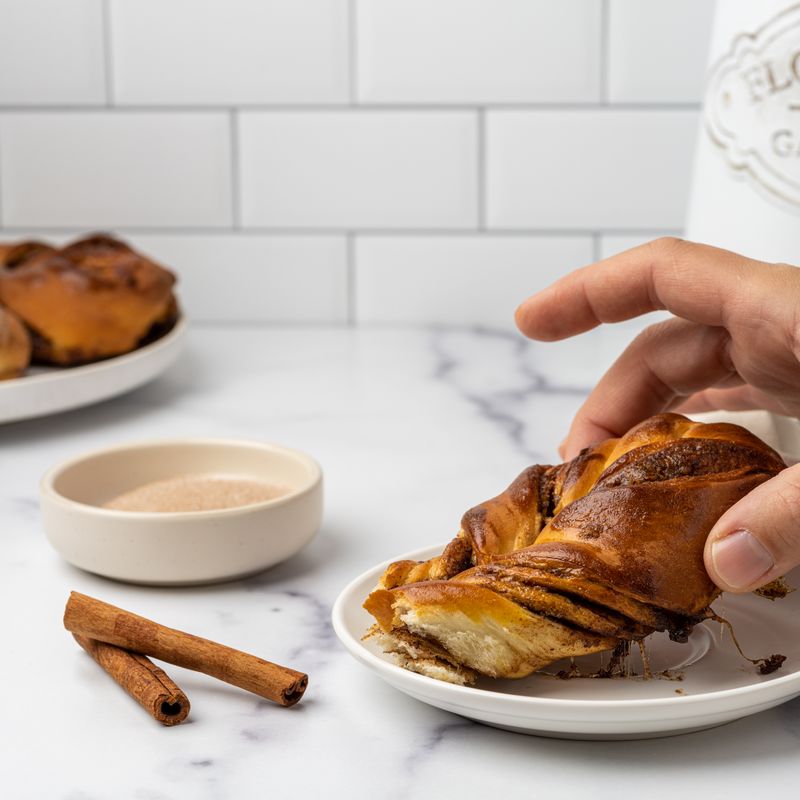
Family-Size Cinnamon Sugar Twist Loaf
A tender, yeasted loaf marbled with cinnamon-brown sugar swirls and topped with a crispy cinnamon-sugar crust. The dough is soft and enriched with butter and milk, making it perfect for slicing warm from the oven. This recipe yields a 9×5-inch loaf that serves 8–10 people at breakfast or brunch.
- Prep
- 25 min
- Cook
- 40 min
- Wait
- 1 hr 30 min
- Total
- 2 hr 35 min
- Makes
- 1 loaf (10–12 slices)
Steps
Before you start
- Warm milk to 110°F (43°C)—it should feel pleasantly warm to the inside of your wrist
- Set out 2 tablespoons butter to soften at room temperature (about 1 hour)
- Preheat oven to 350°F (175°C) 15 minutes before your second rise is complete
Bloom the yeast
- Pour the warmed milk (110°F / 43°C) into a large mixing bowl.
- Sprinkle the instant yeast over the milk and let it sit for 1 minute.
- Stir in the granulated sugar, salt, and softened butter.
- The mixture should feel warm to the touch and smell yeasty.
+ Show details− Hide details
Ready when: Yeast is activated and fragrant
Tip: Use an instant-read thermometer to ensure milk is between 105–115°F (40–46°C); too hot kills yeast, too cool and it won't activate.
Mix the dough
- Add the all-purpose flour to the yeast mixture in three additions, stirring well after each addition with a wooden spoon or stand mixer on low speed.
- Once the dough comes together and pulls away from the sides of the bowl, knead for 8–10 minutes on medium speed (or by hand on a lightly floured surface) until the dough is smooth, elastic, and slightly tacky.
+ Show details− Hide details
Ready when: Dough is smooth, springs back when poked, and clings slightly to your fingers
Tip: If using a stand mixer, use the dough hook for the final 6–8 minutes at medium speed. Don't overwork; the dough should be tender, not stiff.
First rise
- Place the dough in a lightly oiled bowl, turn it to coat all sides, cover with a damp kitchen towel or plastic wrap, and set in a warm, draft-free spot.
- Let it rise for 45–60 minutes until nearly doubled in bulk.
- You should be able to gently poke the dough, and the indentation should spring back slowly.
+ Show details− Hide details
Ready when: Dough has increased noticeably in volume; a gentle poke leaves a slow-bouncing indent
Tip: If your kitchen is cool, place the bowl in a turned-off oven with the light on, or set it near a sunny window to speed rising.
Shape and fill the loaf
- Turn the risen dough onto a lightly floured surface.
- Gently flatten it into a 12×8-inch (30×20 cm) rectangle using your hands or a rolling pin.
- Brush the entire surface with the melted butter, leaving a ½-inch (1 cm) border on all sides.
- In a small bowl, mix the brown sugar and 2½ teaspoons ground cinnamon together.
- Sprinkle this mixture evenly over the buttered dough, pressing gently so it adheres.
+ Show details− Hide details
Ready when: Dough is an even rectangle and cinnamon-sugar fills the surface
Tip: Don't make the rectangle too thick or thin; aim for about ¼ inch thick so the dough will rise properly and brown evenly.
Roll and transfer to pan
- Starting at one long edge, roll the dough tightly into a cylinder, pinching the seam to seal it.
- Place the roll seam-side down in a lightly oiled 9×5-inch (23×13 cm) loaf pan, tucking the ends under slightly if needed so it fits snugly.
+ Show details− Hide details
Ready when: Dough roll fills the loaf pan snugly from end to end
Tip: Roll tightly so the layers don't unravel during rising, but avoid tearing the dough. A pinched seam keeps the roll from springing open.
Second rise
- Cover the loaf pan loosely with a damp kitchen towel or plastic wrap.
- Set it in a warm, draft-free spot and let it rise for 30–40 minutes until the dough rises ½ to ¾ inch above the rim of the pan and springs back slowly when gently poked.
+ Show details− Hide details
Ready when: Dough crests above the pan edge and is puffy but still holds a slow indentation
Tip: Don't let it overproof or it may collapse in the oven. The dough should feel airy but still have some tension.
Prepare toppingOven 350°F / 175°C
- While the dough is in its second rise, mix the 1 tablespoon granulated sugar and ½ teaspoon ground cinnamon in a small bowl.
- When the dough has 10 minutes left in its rise, remove the loaf pan from its warm spot and preheat your oven to 350°F (175°C).
+ Show details− Hide details
Ready when: Sugar and cinnamon are evenly mixed
Tip: Preheating a few minutes before baking ensures the oven reaches the right temperature and heat is even throughout.
Top and bakeOven 350°F / 175°C
- Once the dough has finished its second rise, lightly brush the top with a little water (about ½ teaspoon) to help the topping adhere.
- Sprinkle the cinnamon-sugar topping evenly over the top of the loaf.
- Place the loaf pan in the preheated 350°F (175°C) oven and bake for 35–42 minutes until the loaf is deep golden brown on top and the internal temperature reaches 190–195°F (87–90°C) when an instant-read thermometer is inserted into the center.
+ Show details− Hide details
Ready when: Loaf is deep golden brown; internal temperature is 190–195°F (87–90°C); a skewer inserted in the center comes out clean
Tip: If the top is browning too quickly, loosely tent it with aluminum foil in the last 10 minutes. The internal temperature is crucial—yeast bread needs to reach at least 190°F to be fully baked through.
Cool and serve
- Remove the loaf from the oven and let it cool in the pan for 10 minutes.
- Turn it out onto a wire rack or cutting board and let it cool for at least 20 minutes before slicing.
- The loaf will continue to firm up as it cools.
+ Show details− Hide details
Ready when: Loaf is cool enough to handle and slice cleanly
Tip: Slicing too soon will compress the crumb and make the texture dense. Waiting 20+ minutes gives the structure time to set and makes for cleaner slices.
Good to know
Tips
- Milk temperature is critical: too hot (above 120°F / 49°C) kills the yeast; too cold (below 100°F / 38°C) means slow or no rise. Use an instant-read thermometer.
- Don't skip kneading. The dough needs 8–10 minutes of kneading to develop gluten, which gives the loaf structure and a tender, even crumb.
- For pronounced cinnamon-sugar swirls, don't be shy with the filling; press the sugar mixture gently into the buttered dough so it sticks.
- This loaf is best eaten the day it's baked, while the crumb is still tender and the cinnamon-sugar swirls are moist. Leftover slices are excellent toasted and buttered.
Make ahead
The dough can be prepared through step 4 (rolling and filling), then wrapped tightly in plastic wrap and refrigerated overnight. The next morning, let it come to room temperature for 45 minutes, then proceed with the second rise and baking. Alternatively, wrap the fully baked, cooled loaf in plastic wrap and freeze for up to 3 months.
Storage & reheating
Room temperature (in an airtight container or wrapped in plastic wrap): up to 2 days. Refrigerator: up to 5 days (slice cold or toast to warm). Freezer: up to 3 months (thaw at room temperature, or slice while frozen and toast). To reheat, wrap loosely in foil and warm in a 300°F (150°C) oven for 10–15 minutes until soft and warmed through.
Substitutions
- instant yeast (one ¼ oz / 7 g packet) → Active dry yeast. Use the same weight (7 g / 2.25 teaspoons). Active dry yeast may require an extra 5–10 minutes of rising time since it acts slightly more slowly than instant yeast.
- packed light brown sugar → Muscovado sugar or dark brown sugar. These add deeper molasses flavor. Use the same amount. Muscovado is slightly wetter, so your swirls may be a bit softer but equally delicious.
- all-purpose flour → Bread flour. Bread flour has more protein and will yield a chewier crumb. Reduce the amount to 3.25 cups (390 g) and knead for 2 minutes longer.
- ground cinnamon → Freshly ground cinnamon from whole cassia sticks. Use the same amount by weight (6 g for the filling, 1 g for the topping). Freshly ground cinnamon has more aromatic punch and will brighten the flavor.
More yeast breads
See all →
Find more like this
- Meal
- Breakfast
- Cuisine
- American
- Diet
- VegetarianHalal
- Method
- Oven