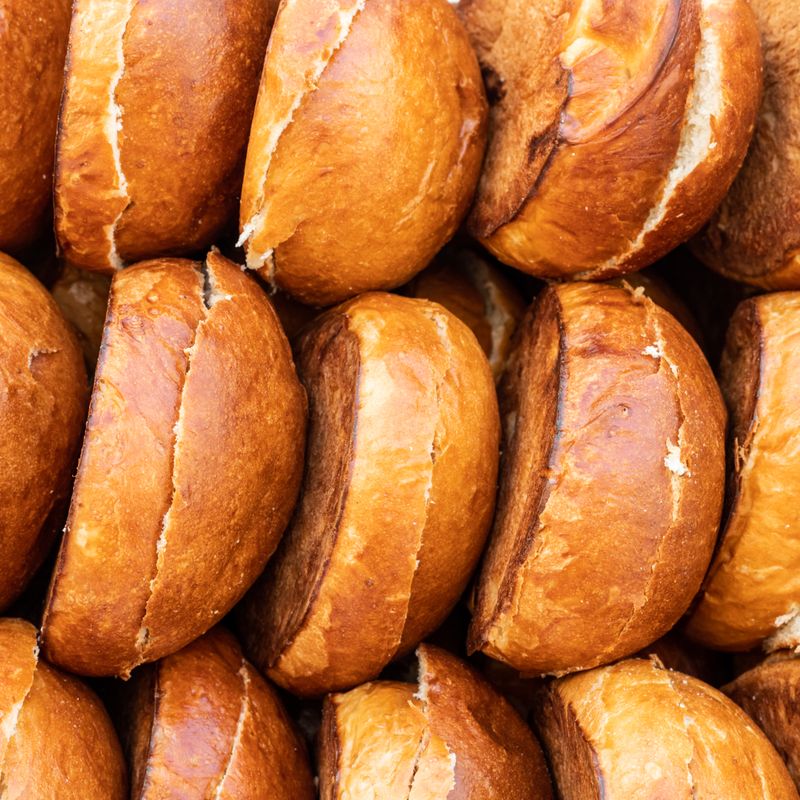
Soft Brioche Buns
Rich, buttery, golden buns with a tender, feathery crumb and a shiny domed top. Sturdy enough for burgers and soft enough to eat plain with jam.
- Prep
- 46 min
- Cook
- 20 min
- Wait
- 3 hr
- Total
- 4 hr 6 min
- Makes
- 12 buns (about 3½ inches / 9 cm wide)
Steps
Before you start
- Take the butter out about 1 hour ahead so it is softened but still cool (about 65°F / 18°C): it should dent easily under a finger without looking greasy.
- Bring the eggs to room temperature (set them in a bowl of warm tap water for 10 minutes) so they don't chill the dough.
- Plan on about 4 hours start to finish; most of that is unattended rising and cooling.
- This dough is soft and sticky by design. Use a stand mixer if you can, and resist adding extra flour.
Combine the dough
- In the bowl of a stand mixer, whisk the bread flour, sugar, salt and yeast.
- Pour in the lukewarm milk and the beaten eggs.
- Fit the dough hook and mix on low speed (speed 2) for about 3 minutes, scraping the bowl once, until no dry flour remains and a shaggy, sticky dough forms.
+ Show details− Hide details
Ready when: No dry flour remains and the dough looks shaggy and sticky.
Tip: Keep the salt and yeast on opposite sides of the bowl when you whisk in the flour if you are adding them by hand; direct contact can slow the yeast.
Knead the base dough
- Increase the mixer to medium-low (speed 3 to 4) and knead for 8 minutes.
- Stop and scrape the hook and bowl once or twice.
- The dough will start sticky and gradually pull together into a smoother mass that slaps against the sides of the bowl.
+ Show details− Hide details
Ready when: The dough is smooth, elastic and mostly clears the sides of the bowl, though it still clings to the bottom.
Tip: Do not add flour. The butter in the next step will make the dough more manageable.
Beat in the butter
- With the mixer on medium-low, add the softened butter 2 or 3 pieces at a time, waiting until each addition is mostly absorbed before adding more (about 1 minute each).
- This takes about 6 minutes.
- Scrape the bowl as needed.
- Then knead for 4 to 6 more minutes on medium speed.
- The dough will look slick and broken at first, then come back together into a glossy, very soft dough.
+ Show details− Hide details
Ready when: Pinch off a golf-ball piece and stretch it: it should thin into a translucent windowpane without tearing right away. The dough should be shiny and about 77 to 80°F (25 to 27°C).
Tip: If the dough feels warm and greasy and the butter is melting, stop the mixer and chill the bowl for 15 minutes before continuing.
First rise
- Scrape the dough into a lightly greased large bowl and turn it once to coat.
- Cover tightly with plastic wrap.
- Let it rise at room temperature (72 to 75°F / 22 to 24°C) for 90 minutes, until puffy and about doubled in size.
+ Show details− Hide details
Ready when: The dough is doubled and jiggles like a soft pillow; a floured finger poke leaves a dent that springs back slowly.
Tip: In a cool kitchen, rise in the oven with only the light on, or allow up to 30 extra minutes.
Chill the dough
- Gently press down the dough to deflate it.
- Re-cover the bowl and refrigerate for 30 minutes.
- This firms the buttery dough so it is much easier to divide and shape.
+ Show details− Hide details
Ready when: The dough feels cool and less sticky to the touch.
Tip: You can chill it up to 12 hours (see make-ahead); it will need an extra 20 minutes at room temperature before shaping.
Divide and shape
- Line two baking sheets with parchment.
- Turn the cold dough onto a very lightly floured counter.
- Weigh it (about 1,000 g) and divide into 12 pieces of about 83 g each.
- Working with one piece at a time, flatten slightly, fold the edges into the center, then flip seam-side down.
- Cup your hand over it and roll in small circles against the counter, with light pressure, until you have a tight, smooth ball.
- Place 6 buns per sheet, spaced about 3 inches (7.5 cm) apart.
+ Show details− Hide details
Ready when: Each ball is smooth and taut on top with the seam sealed underneath.
Tip: Use as little flour as possible; too much prevents the dough from gripping the counter and forming a tight surface.
Second riseOven 375°F / 190°C
- Cover the buns loosely with greased plastic wrap or a damp towel.
- Let them rise at room temperature for about 60 minutes until puffy and nearly doubled.
- Press the buns gently to flatten them to about 1 inch (2.5 cm) thick after 10 minutes if you want wider burger buns.
- About 20 minutes before the end of the rise, position racks in the upper and lower thirds of the oven and preheat to 375°F (190°C).
+ Show details− Hide details
Ready when: Buns are puffy and marshmallow-like; a gentle fingertip poke leaves a dent that fills back slowly.
Tip: Under-proofed buns bake dense and can split at the sides; over-proofed ones collapse. Trust the poke test over the clock.
Egg wash and topOven 375°F / 190°C
- Whisk the wash egg with the tablespoon of milk until completely smooth.
- Gently brush the tops and upper sides of each bun, taking care not to let wash pool at the base or deflate the dough.
- If using, sprinkle with sesame seeds.
+ Show details− Hide details
Ready when: The tops are evenly glossy with no streaks.
Tip: Pooled egg wash glues the buns to the parchment and stops them rising; brush lightly.
Bake the bunsOven 375°F / 190°C
- Bake at 375°F (190°C) for 18 to 22 minutes, one sheet per rack, swapping and rotating the sheets halfway through.
- If the tops brown too quickly, tent loosely with foil for the last 5 minutes.
+ Show details− Hide details
Ready when: The tops are deep golden brown, the bottoms sound hollow when tapped, and the center of a bun reads 190°F (88°C) on an instant-read thermometer.
Tip: Rich doughs brown fast because of the milk, sugar and eggs; check at 15 minutes.
Cool completely
- Slide the parchment with the buns onto wire racks, or transfer the buns directly to the racks.
- Cool for at least 30 minutes before slicing.
- For an extra soft, shiny crust, brush the warm tops with a little melted butter if desired.
+ Show details− Hide details
Ready when: Buns feel barely warm at the center and the crumb is set.
Tip: Slicing too early compresses the soft crumb and makes it gummy.
Good to know
Tips
- Weigh the ingredients, especially the flour. Brioche is sensitive to too much flour and becomes dry and heavy if you add extra.
- Add the butter slowly and keep it cool but pliable. Butter that is too warm makes greasy dough, and butter that is too cold will not blend in.
- For uniform buns, weigh each dough piece (about 83 g) and keep the ones you aren't shaping covered.
- For burger buns, flatten each ball gently to about 1 inch (2.5 cm) thick before the second rise so they bake to a wider, flatter shape.
Make ahead
"After the first rise, deflate the dough and refrigerate it, covered, for 8 to 12 hours (or overnight). Shape straight from the fridge, then allow 75 to 90 minutes for the second rise since the dough starts cold. Shaped buns can also be frozen unbaked on a tray, then bagged; thaw on a lined baking sheet and proof until puffy before baking."
Storage & reheating
"Room temperature: store in an airtight bag or container for up to 3 days. Fridge: not recommended, as it dries out the crumb, but fine for up to 5 days if sealed. Freezer: wrap individually and freeze for up to 3 months. Thaw at room temperature for 1 to 2 hours, then refresh in a 300°F (150°C) oven for 5 to 8 minutes until warm and soft."
Substitutions
- bread flour → all-purpose flour. Use the same weight (500 g). The buns will be slightly softer and less chewy, and the dough may feel a bit wetter, so knead 1 to 2 minutes longer.
- instant yeast → active dry yeast. Use the same amount (7 g). Dissolve it in the lukewarm milk for 5 to 10 minutes until foamy before adding to the flour.
- whole milk → unsweetened plain oat milk or lactose-free milk. Works at a 1:1 ratio with a very similar result. Dairy-free versions will taste less rich.
- unsalted butter → salted butter. Use the same amount and reduce the salt in the dough to 1 teaspoon (6 g).
More rolls & buns
See all →

Find more like this
- Meal
- Breakfast
- Diet
- VegetarianHalal
- Method
- Oven
- Quick & Easy
- Make Ahead