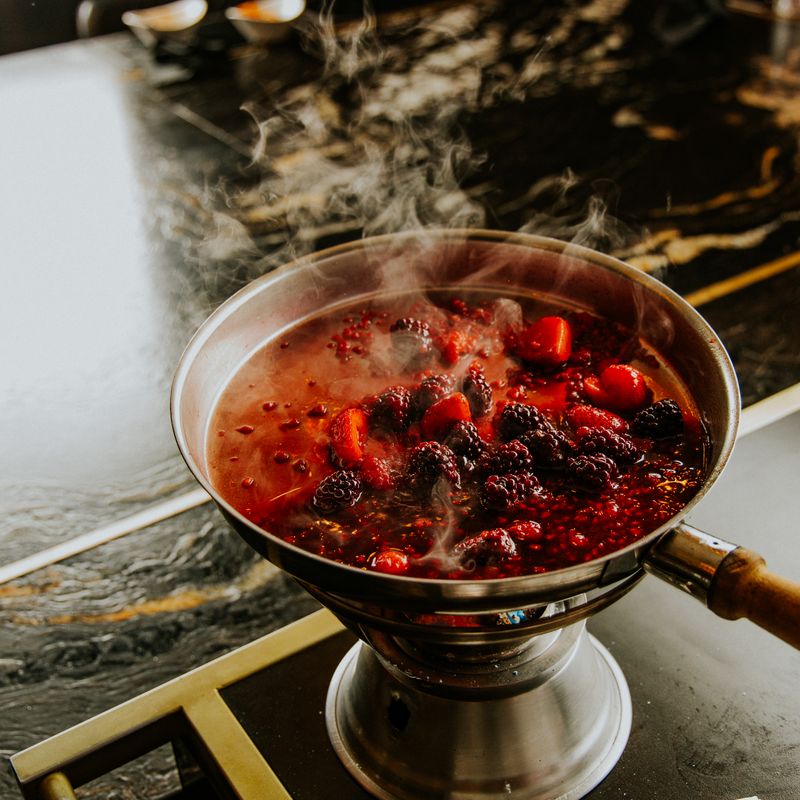
Slow Cooker Blackberry Port Vinaigrette
A sophisticated French-inspired vinaigrette made by slow-cooking fresh blackberries with port wine, red wine vinegar, and fragrant thyme. The slow cooking method allows the fruit to break down completely and the flavors to meld into a silky, deeply flavored dressing with subtle sweetness and complex acidity. Perfect for drizzling over bitter greens, roasted beets, or duck salads.
- Prep
- 10 min
- Cook
- —
- Wait
- 3 hr
- Total
- 3 hr 10 min
- Makes
- About 1 cup (240 ml)
Steps
Before you start
- Use fresh, ripe blackberries (not frozen, which will release too much liquid)
- Have a fine-mesh strainer ready to pass the vinaigrette through at the end
- Choose a good-quality port wine—not cooking port, which contains added salt
- Measure all ingredients before starting, as the slow cooker will be active for 3 hours
Assemble in slow cooker
- Add blackberries, port wine, red wine vinegar, halved shallots, and thyme sprigs to a 3-quart (2.8 L) slow cooker.
- Stir gently with a wooden spoon to combine.
- Do not crush the blackberries; let them break down naturally during cooking.
+ Show details− Hide details
Tip: Avoid mashing the fruit now; the slow cooker will do the work gently and evenly.
Cook on low heat
- Cover the slow cooker and set to LOW for 3 hours.
- During this time, the blackberries will fully break down, the shallots will soften and release their flavor, and the port wine will meld with the vinegar.
- The liquid will reduce slightly and develop a deep, glossy appearance.
- Do not stir during cooking.
+ Show details− Hide details
Ready when: Liquid is glossy and deep burgundy; blackberries have completely broken down; shallots are soft
Tip: Do not use HIGH heat; it will cause the vinegar's acidity to become sharp and the fruit to lose its delicate structure.
Cool briefly
- Turn off the slow cooker and let the mixture sit uncovered for 10 minutes to cool slightly, which stops the cooking process and allows flavors to settle.
+ Show details− Hide details
Ready when: Mixture is no longer steaming
Strain the dressing
- Pour the entire mixture through a fine-mesh strainer or chinois set over a glass jar or bowl, pressing gently on the solids with the back of a wooden spoon to extract all liquid and flavor without pushing pulp through.
- You should have about 1 cup (240 ml) of deep burgundy liquid.
- Discard the solids.
+ Show details− Hide details
Ready when: All liquid has drained; solids are nearly dry
Tip: Press gently; pressing too hard will push pulp and seed fragments through the strainer, making the dressing gritty.
Season the base
- Add black pepper and a pinch of sea salt to the strained liquid.
- Whisk well to combine.
- Taste and adjust seasoning—remember that the olive oil will be added next and will slightly dilute the intensity of the flavors.
+ Show details− Hide details
Tip: Taste before adding oil; you cannot easily adjust seasoning after emulsifying.
Emulsify with olive oil
- While whisking constantly, add the cold extra-virgin olive oil in a very slow stream—about a tablespoon at a time—allowing each addition to fully incorporate before adding the next.
- This gradual approach creates a stable emulsion.
- Once about half the oil is incorporated, you can add the remaining oil in slightly larger amounts.
- Whisk until the vinaigrette is uniform and silky.
+ Show details− Hide details
Ready when: Vinaigrette is glossy, uniform, and slightly thickened; no visible oil pools on the surface
Tip: If the emulsion breaks (oil and vinegar separate), start with a fresh bowl, add a teaspoon of cool water, and slowly whisk in the broken vinaigrette to re-emulsify.
Good to know
Tips
- Use ripe, fresh blackberries (not frozen). Frozen berries release too much liquid and will dilute the final vinaigrette. If blackberries are not in season, this dressing is best saved for summer.
- The slow cooker's low, even heat is essential; it gently breaks down the fruit while preserving the delicate balance of acidity and tannins from the port and vinegar. High heat will make the vinegar taste harsh.
- This vinaigrette is perfect over bitter greens like frisée, radicchio, or arugula, or alongside roasted beets, duck breast, or soft goat cheese.
- If emulsification fails and the vinaigrette breaks, it is still delicious as a loose, pourable dressing. Simply whisk it again before serving or store it as is and whisk each time you use it.
Make ahead
Prepare the slow cooker mixture up to 2 hours ahead, cover, and refrigerate. Cook as directed when ready. The finished vinaigrette can be made up to 5 days ahead.
Storage & reheating
Store in a glass jar or airtight container. Room temperature: 1 day (emulsion may separate; whisk again before serving). Refrigerated: up to 5 days (vinaigrette will thicken when cold; let sit 10 minutes at room temperature to return to pouring consistency). Do not freeze. To rewarm if separated: let sit at room temperature for 15 minutes, then whisk briskly.
Substitutions
- fresh thyme sprigs → 1 fresh bay leaf or 2 sprigs fresh tarragon. Bay leaf gives an earthier note; tarragon adds licorice-like complexity. Adjust to your preference for the greens you are dressing.
- fresh blackberries, ripe → 1 cup (285 g) fresh raspberries or 8 oz (225 g) fresh blueberries. Raspberries will make a lighter, slightly more tart dressing; blueberries will add deeper blue-black color and less acidity. Cooking time remains the same.
- ruby or vintage port wine → ¾ cup (180 ml) dry red wine plus 1 tablespoon (12 g) honey. This mimics port's sweetness but creates a drier, less fruity flavor profile. Add honey after cooking.
- red wine vinegar → ⅓ cup (80 ml) balsamic vinegar or sherry vinegar. Balsamic adds deeper sweetness and viscosity; sherry is more mellow and elegant. Both require no adjustment to cooking time.
More dressings
See all →


Find more like this
- Cuisine
- French
- Method
- Slow Cooker