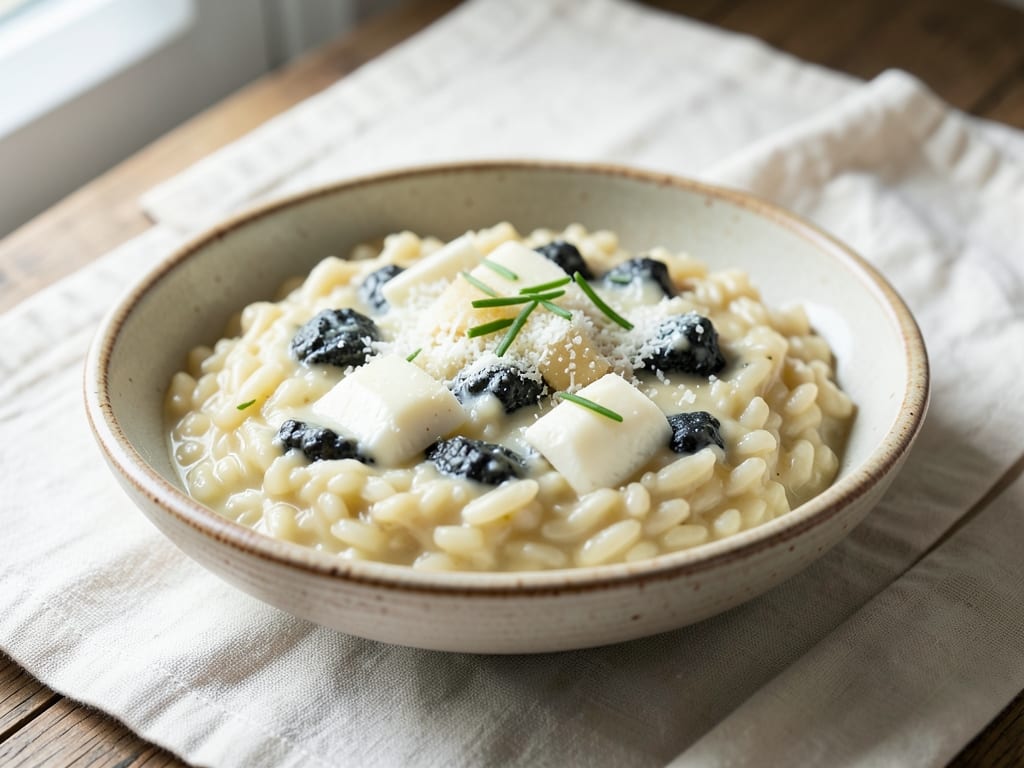
Risotto Verde
A vibrant, creamy risotto infused with spinach, fresh basil, and Parmesan cheese. The rice absorbs flavorful stock gradually, creating a luxurious texture while the greens provide bright, herbaceous flavor. This is a classic Northern Italian dish that showcases the interplay between butter, cheese, and fresh vegetables. Serve immediately as a main course or elegant side dish.
- Prep
- 15 min
- Cook
- 25 min
- Wait
- 5 min
- Total
- 45 min
- Makes
- 4 servings (about 1½ cups each)
Steps
Before you start
- Bring stock to a simmer in a separate pot and keep it hot throughout cooking
- Wash and roughly chop the fresh spinach and basil
- Have all ingredients measured and within reach—risotto requires constant attention
Sauté aromatics
- Heat olive oil in a large heavy-bottomed pot over medium heat.
- Add diced onion and cook for 3 minutes, stirring occasionally, until translucent and soft.
- Add minced garlic and stir constantly for about 30 seconds until fragrant.
- Do not brown the garlic or it will taste bitter.
+ Show details− Hide details
Ready when: Onion is translucent and soft; garlic is fragrant
Tip: Keep the heat at medium to avoid browning the garlic, which will make the risotto taste burnt.
Toast the rice
- Add Arborio rice to the pot and stir constantly for 2 minutes, coating all grains with oil.
- The rice should smell slightly nutty and the edges of a few grains may turn translucent.
- This step helps the rice maintain its shape during cooking.
+ Show details− Hide details
Ready when: Rice grains are coated and smell nutty; some edges appear translucent
Tip: Do not skip toasting—it seals the rice grain surface so it stays al dente rather than turning mushy.
Deglaze with wine
- Pour in dry white wine and stir until almost all liquid is absorbed, about 1–2 minutes.
- You will hear the characteristic sizzle and smell the wine.
- Stop when the rice looks mostly dry again.
+ Show details− Hide details
Ready when: Most wine is absorbed; rice surface looks nearly dry
Tip: The acidity in the wine helps prevent mushiness and adds depth of flavor.
Begin stock addition
- Add warm stock one ladle at a time (about ¾ cup/180 ml per ladle).
- Stir frequently but not constantly—every 30 seconds or so—until the stock is almost completely absorbed before adding the next ladle.
- Continue this process for about 18 minutes.
- You should go through 5–6 ladles.
+ Show details− Hide details
Ready when: Stock is nearly absorbed before each new addition; rice is creamy but grains still have slight resistance
Tip: Keeping the stock warm helps the risotto cook evenly. Cold stock will drop the temperature and slow cooking. Stir frequently enough to prevent sticking but not so much that you mash the rice.
Add greens and continue cooking
- After about 18 minutes, add the chopped spinach and basil along with another ladle of stock.
- Stir to wilt the greens, about 1 minute.
- They will lose color and volume as they cook.
- Continue adding stock one ladle at a time, stirring every 30 seconds, for another 3–5 minutes until the rice is tender with just a slight bite in the center of each grain (al dente) and the mixture is flowing but creamy, not soupy.
+ Show details− Hide details
Ready when: Rice is tender but not mushy, with slight bite in the center of each grain; consistency is creamy and flows slightly on the plate
Tip: Add the greens toward the end so they retain their bright color and fresh flavor. If the risotto seems too thick before the rice is done, add stock by the tablespoon rather than a full ladle.
Finish with butter and cheese
- Remove the pot from heat.
- Add cold butter pieces and grated Parmigiano-Reggiano cheese.
- Stir vigorously for 1 minute, using a wooden spoon to work the butter and cheese into the rice.
- The risotto will become even creamier as the fat and cheese emulsify into the mixture.
- Season with kosher salt and freshly ground black pepper to taste.
+ Show details− Hide details
Ready when: Butter and cheese are fully incorporated; risotto is creamy and cohesive
Tip: This final vigorous stirring (called 'mantecatura') is what gives risotto its signature creamy texture. Never skip this step. Taste and adjust seasoning just before serving.
Rest and serve
- Let the risotto rest off heat for about 2 minutes, uncovered.
- Divide among warm bowls and serve immediately while hot and creamy.
+ Show details− Hide details
Tip: Risotto waits for no one—serve immediately after the rest period. If serving multiple portions, have warm bowls ready.
Good to know
Tips
- Arborio rice is essential—its high starch content creates the signature creaminess. Do not substitute short-grain or long-grain rice. In a pinch, Carnaroli rice works similarly.
- Keep your stock at a gentle simmer throughout cooking. Cold stock disrupts the cooking process and results in unevenly cooked grains.
- The risotto should flow slightly when plated, not pile up or sit in a thick blob. If it seems too firm after the final butter and cheese addition, add stock or warm water by the tablespoon and stir.
- For the greenest risotto, blanch the spinach and basil in boiling salted water for 30 seconds, then squeeze dry and puree in a food processor before stirring in during step 5. This concentrates the color and flavor, though the traditional method (in this recipe) is simpler.
Storage & reheating
Best served fresh, but leftovers keep refrigerated in an airtight container for up to 2 days. Reheat gently on the stovetop over medium-low heat with a splash of warm stock or water, stirring frequently, until creamy again (about 3–5 minutes). Do not microwave, which breaks down the creamy texture. Freezing is not recommended as the texture becomes grainy.
Substitutions
- fresh baby spinach → fresh arugula or blanched frozen spinach (thaw and squeeze dry first). Arugula adds a peppery note; use frozen spinach in winter when fresh quality is poor. Frozen spinach should be thawed and excess moisture squeezed out to avoid wateriness.
- fresh basil leaves → fresh parsley, mint, or chives. Parsley gives an herbal note without basil's licorice flavor; mint adds brightness; chives provide mild onion undertones. Use the same weight.
- Parmigiano-Reggiano cheese → Pecorino Romano or Grana Padano. Pecorino is sharper and saltier, so reduce added salt. Grana Padano is milder and creamier. Avoid pre-grated cheese, which contains anti-caking agents that prevent proper emulsification.
- vegetable or chicken stock → chicken stock or a mix of half chicken and half white wine. Chicken stock adds richness; wine deepens the herbaceous flavor. Use warm liquid only.