
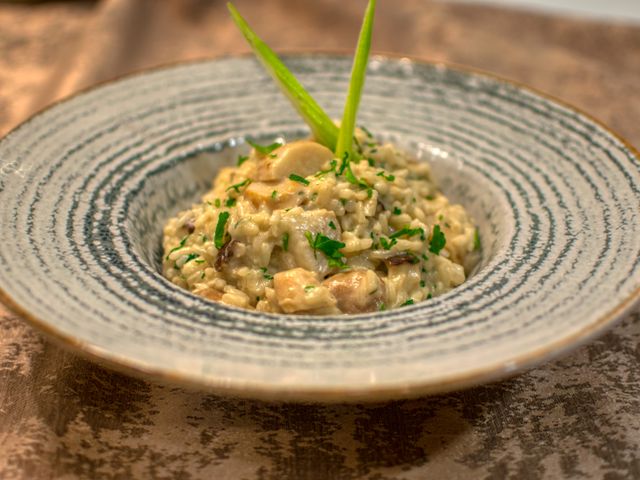
Risotto Milanese
Creamy, golden risotto infused with saffron and finished with butter and Parmesan. This traditional Milan dish is elegant but approachable—the key is patience and constant stirring to coax the starch from the rice grains, creating that signature silky texture. It makes an ideal side for osso buco or braised meats, or serve it on its own.
- Prep
- 10 min
- Cook
- 20 min
- Wait
- 5 min
- Total
- 35 min
- Makes
- 4 servings (about 1½ cups each)
Steps
Before you start
- Bring the broth to a gentle simmer in a pot and keep it hot throughout cooking
- Have all ingredients measured and ready before you begin—risotto waits for no one
- Use a heavy-bottomed pot or wide shallow pan to ensure even heat distribution
Toast the saffron
- Place the saffron threads in a dry skillet over low heat and stir gently for about 1 minute, until fragrant.
- Do not brown.
- Transfer to a small cup and add ¼ cup (60 ml) of the hot broth.
- Let steep while you continue.
+ Show details− Hide details
Ready when: Saffron is fragrant and threads are slightly curled
Tip: Toasting brings out the saffron's floral notes; overheating makes it bitter.
Start the broth
- Pour the remaining broth (3¾ cups / 890 ml) into a 3-quart pot and bring to a bare simmer.
- Keep it at a low simmer throughout cooking—hot broth ensures the rice cooks evenly and quickly.
+ Show details− Hide details
Ready when: Broth steams gently with small bubbles at the surface
Tip: Do not boil vigorously; a gentle simmer prevents the rice from cooking unevenly.
Sauté the onion
- Heat 2 tablespoons (30 g) of cold butter in a large heavy-bottomed pot or 4-quart Dutch oven over medium heat.
- Once foaming, add the diced onion and cook for 3–4 minutes, stirring frequently, until softened and fragrant but not colored.
+ Show details− Hide details
Ready when: Onion is soft and translucent
Tip: Keep the heat at medium; high heat will brown the onion and make the risotto taste bitter.
Toast the rice
- Add the Arborio rice to the pot with the onion and stir constantly for 1–2 minutes.
- The rice grains will become opaque and slightly translucent at the edges, and you'll hear a gentle clicking sound as they move in the pot.
- This toasting helps the rice absorb liquid evenly.
+ Show details− Hide details
Ready when: Rice grains are opaque with translucent centers; you hear a light clicking sound
Tip: Do not skip this step; toasting prevents a gluey, underdone texture.
Deglaze with wine
- Pour in the white wine and stir constantly until nearly all the liquid is absorbed, 1–2 minutes.
- You should be able to drag a spoon across the bottom of the pot and see the bottom briefly before the rice flows back.
+ Show details− Hide details
Ready when: Wine is almost completely absorbed; the pot bottom is briefly visible when scraped
Tip: This step adds acidity and flavor; rushing it means the rice misses this key seasoning.
Add saffron broth and begin stirring
- Pour the saffron mixture (broth plus steeped saffron) into the pot and stir constantly until the liquid is nearly absorbed, about 2 minutes.
- The pot will smell intensely floral and golden.
+ Show details− Hide details
Ready when: Saffron liquid is nearly absorbed; rice grains are creamy and move loosely
Tip: Constant stirring is essential now—it releases the rice's starch, creating creaminess.
Add broth in stages
- Reduce the heat to medium and begin adding the remaining hot broth in ¾-cup (180 ml) additions.
- Add a ladle or measure of broth, stir frequently (not constantly—every 15–20 seconds), and wait until the liquid is nearly absorbed before adding the next ladle.
- The rice should always look creamy and loose, not soupy or dry.
- This process takes 15–18 minutes total.
+ Show details− Hide details
Ready when: Rice grains are tender but still have a slight firmness in the center (al dente); broth is creamy and coats the spoon
Tip: Frequent stirring coaxes starch from the rice; lazy stirring means grainy risotto. Taste a grain at the 15-minute mark to gauge doneness.
Finish with butter and cheese
- When the rice is al dente, remove the pot from heat.
- Vigorously stir in the 3 tablespoons (45 g) of cold butter and ¾ cup (75 g) of grated Parmesan cheese.
- The cold butter will emulsify into the risotto, making it luxuriously creamy.
- Season with salt and black pepper to taste.
+ Show details− Hide details
Ready when: Risotto is glossy, creamy, and thick enough to slowly spread when spooned onto a plate
Tip: Adding cold butter off heat creates a silky, restaurant-quality texture. Do not add the butter while the pot is hot, or it will separate.
Rest and serve
- Cover the pot and let the risotto rest off heat for 2–3 minutes.
- This allows the rice to settle and the flavors to meld.
- Stir once more gently and serve immediately in warm bowls.
- The risotto should flow slightly on the plate, not sit in a stiff mound.
+ Show details− Hide details
Ready when: Risotto is creamy and spreads slowly when spooned
Tip: Resting prevents the risotto from overcooking and settling too tightly. It's the final step that defines perfect risotto texture.
Good to know
Tips
- Saffron is precious and can be harsh if overtoasted. Toast it gently for just 1 minute; any longer and it turns bitter. Steeping it in hot broth mellows and distributes the flavor throughout the risotto.
- The broth must stay hot throughout cooking. Cold broth shocks the rice, stops it from cooking evenly, and ruins the texture. Use a separate pot to keep it simmering.
- Constant stirring during the first minute or two releases maximum starch, but frequent stirring afterward (every 15–20 seconds) prevents the rice from sticking while allowing the grains to cook evenly. Do not stir so vigorously that you break the grains.
- Al dente rice has a tiny bit of firmness in the center; overcooked risotto tastes mushy. Taste at 15 minutes and add broth in smaller amounts (½-cup instead of ¾-cup) near the end if it seems nearly done.
Storage & reheating
Best served immediately. Leftover risotto may be refrigerated in an airtight container for up to 3 days. To reheat: add 2–3 tablespoons of broth per cup of risotto to a pot over low heat, stirring gently until creamy and warm (3–5 minutes). The texture will not be quite as silky as freshly made risotto.
Substitutions
- Arborio rice → Carnaroli rice. Carnaroli has a similar starch content and will produce equally creamy results. It holds its shape slightly better if the risotto sits for a moment before serving.
- dry white wine → dry vermouth or additional broth. Vermouth adds herbal notes; if using broth, you may lose some acidity—compensate with a pinch of lemon juice at the end.
- unsalted chicken or vegetable broth → vegetable broth. Use the same quantity. Vegetable broth is lighter and lets the saffron shine, while chicken broth adds more body.
- Parmigiano-Reggiano cheese, finely grated → Grana Padano cheese. Very similar to Parmigiano-Reggiano in flavor and texture. Use the same quantity and preparation.
More risotto
See all →



Find more like this
- Meal
- Dinner
- Cuisine
- Italian
- Main ingredient
- Basmati Rice
- Method
- Stovetop