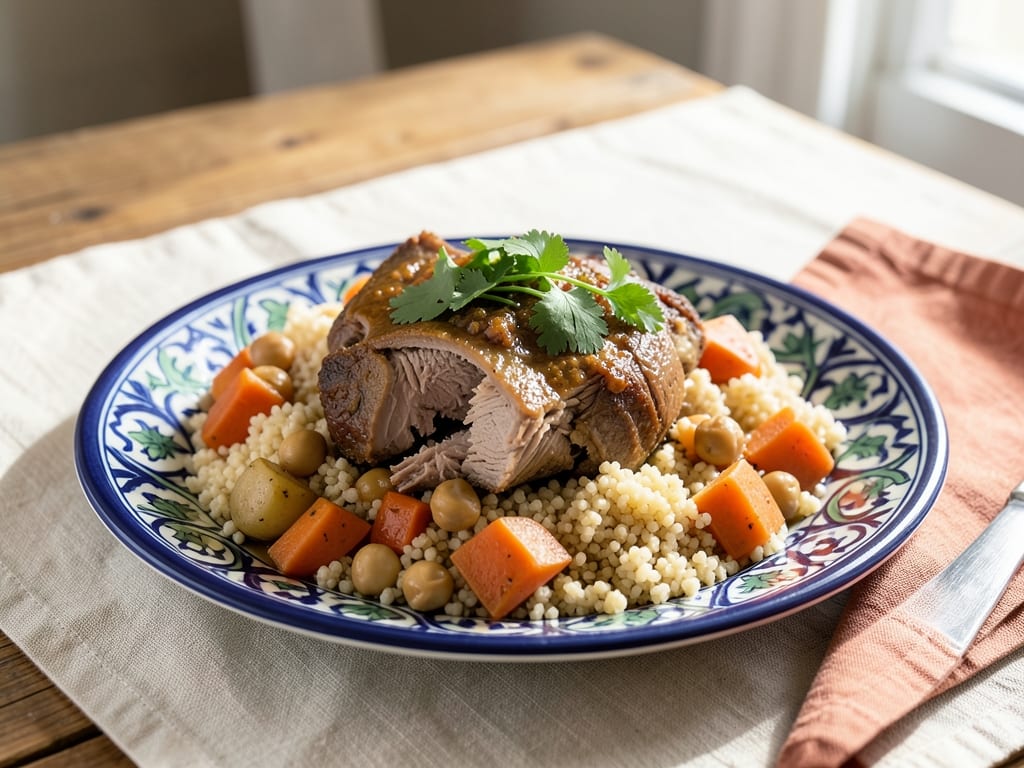
Ramadan Iftar Lamb Couscous Platter
A traditional Moroccan-style lamb couscous featuring tender braised lamb, root vegetables, and chickpeas in a fragrant spiced broth. Couscous is hydrated with butter and broth, then gently steamed above the simmering stew before being arranged on a large platter for family-style serving. Warming spices like cumin, cinnamon, and a hint of saffron create the signature Moroccan flavor. Perfect for breaking the Ramadan fast with a celebratory, nourishing meal.
- Prep
- 20 min
- Cook
- 19 min
- Wait
- 1 hr 13 min
- Total
- 1 hr 52 min
- Makes
- Serves 4–6
Steps
Before you start
- Cut lamb into 2-inch cubes and let sit at room temperature for 15 minutes (promotes even browning)
- Prepare all vegetables and measure spices before you start cooking
- Have broth heating on a back burner so it's hot when you need it
- A tight-fitting lid is essential for proper braising
Prepare all ingredients
- Cut the lamb shoulder into 2-inch cubes.
- Dice the large onion into small pieces.
- Mince the garlic cloves and ginger root.
- Cut carrots and zucchini into 1.5-inch pieces.
- Drain and rinse the canned chickpeas thoroughly.
- Chop the cilantro and parsley.
- Measure out all the spices.
- Having everything prepared before you start cooking (mise en place) ensures smooth, unhurried cooking.
+ Show details− Hide details
Tip: Prep work goes faster with a sharp chef's knife and a sturdy cutting board.
Sear the lamb
- Heat the olive oil in the Dutch oven over medium-high heat until shimmering, about 1 minute.
- Working in batches so you don't overcrowd the pot, add lamb cubes and season lightly with salt and pepper.
- Sear each batch until deeply browned on 2–3 sides, about 6–8 minutes per batch.
- Don't stir constantly; let the meat sit undisturbed so it develops a dark brown crust.
- Transfer browned lamb to a clean plate.
- The meat doesn't need to be cooked through—browning is the goal.
+ Show details− Hide details
Ready when: Lamb is dark brown on multiple sides
Tip: Crowding the pan lowers the temperature and causes steaming instead of browning. Work in batches even if it takes longer.
Toast spices and build broth
- Return the pot to medium-high heat.
- Add the diced onion, minced garlic, and minced ginger.
- Stir and cook for about 1 minute, stirring often, until the aromatics are fragrant and softened.
- Add the ground cumin, cinnamon, paprika, and turmeric.
- If using saffron, crush the threads slightly and add now.
- Stir the spices constantly for about 30 seconds until the kitchen smells incredibly fragrant—this bloom releases all their flavors.
- Pour in 3 cups of the vegetable broth and 1 cup of water, using a wooden spoon to scrape the bottom of the pot and release all the browned, flavorful bits.
+ Show details− Hide details
Ready when: Spices release a strong, warm aroma and the liquid is bubbling
Tip: Blooming spices in hot oil releases their essential oils and deepens their flavor—this technique is key to authentic Moroccan taste.
Return lamb and start braising
- Return all the seared lamb to the pot along with any accumulated juices on the plate.
- Stir gently.
- Bring the liquid to a boil (should take just a minute or two).
- Reduce the heat to medium-low.
- Place the lid on the pot.
- Adjust the heat so the liquid is at a gentle simmer—you should see occasional bubbles breaking the surface and steam gently escaping from under the lid, not a rolling boil.
+ Show details− Hide details
Ready when: After 45 minutes, the lamb should be noticeably tender when pierced with a fork
Tip: Maintaining a gentle, consistent simmer prevents the meat from becoming tough. High heat or boiling can toughen braised meats.
Add vegetables and continue braising
- After 45 minutes, carefully open the pot (watch out for the steam).
- Add the carrot pieces, zucchini pieces, and drained chickpeas.
- Stir gently to combine with the broth.
- Taste the broth and season with additional salt and pepper as needed—it should taste well-seasoned and savory.
- Cover the pot again and return to a gentle simmer over medium-low heat.
+ Show details− Hide details
Ready when: Carrots and zucchini are tender when pierced with a fork; lamb is very soft and easily breaks apart
Tip: Adding vegetables partway through prevents them from becoming mushy. If added at the start, they disintegrate into the broth.
Prepare couscous for steaming
- While the vegetables finish braising, place 2 cups of couscous in a medium bowl.
- Cut 3 tablespoons of room-temperature butter into small pieces and scatter over the couscous along with 1/2 teaspoon of salt.
- Pour 2.5 cups of hot vegetable broth over the couscous.
- Stir gently with a fork to break up any lumps.
- Let the couscous sit uncovered for 2 minutes to absorb the liquid.
- The grains will swell and separate.
+ Show details− Hide details
Ready when: Couscous grains are no longer rock-hard; they're plump and soft to the bite
Tip: Room-temperature butter ensures even distribution. Hot broth helps the couscous hydrate quickly and evenly.
Steam couscous over stew
- By now, the vegetables should be very tender.
- Place a large colander or steamer basket over the pot so it rests on the rim without touching the simmering broth below.
- Using a fork, gently fluff the hydrated couscous to separate any remaining clumps and transfer it to the colander, mounding it loosely (don't pack it tightly).
- Cover the couscous loosely with aluminum foil, then place the pot's lid on top.
- The steam from the simmering broth below will rise through the couscous.
- Maintain medium-low heat for 8 minutes.
- The couscous will warm through and become even lighter and fluffier.
+ Show details− Hide details
Ready when: Couscous is light and fluffy; when you stir with a fork, grains separate easily and don't clump
Tip: Don't pack the couscous tightly in the colander—steam needs room to circulate and heat all the grains evenly.
Finish and serve
- Carefully remove the colander of couscous from over the pot.
- Transfer the couscous to a large serving platter, mounding it in the center in a crown shape.
- Using a slotted spoon to leave most of the broth behind, arrange the lamb pieces and vegetables around and on top of the couscous mound.
- Drizzle about 1/2 cup of the remaining cooking broth over the couscous and vegetables (the couscous should glisten but not be soupy).
- Sprinkle the chopped cilantro and parsley generously over the top.
- Pour the remaining broth into a small serving bowl and place it on the side so guests can add more to their portions as desired.
+ Show details− Hide details
Tip: Mounding the couscous in the center and arranging the lamb and vegetables around it creates an impressive, restaurant-quality presentation perfect for an Iftar celebration.
Good to know
Tips
- This dish is traditionally served family-style from one large platter, with everyone eating from their own section. For Iftar, it's a perfect main dish to break the fast—the braised lamb is tender and easy to digest after a day of fasting.
- If you don't have a colander or steamer basket for the final couscous steaming step, prepare the couscous exactly as directed but skip the steaming—simply transfer it directly to the serving platter and drizzle with warm broth. The couscous will still be delicious, warm, and fluffy.
- The spice level in this dish is gentle and warming, not fiery. Start with the amounts given and adjust cumin and paprika to taste if you prefer more pronounced spice.
- If using saffron, soak the threads in 1/4 cup of warm broth for 10 minutes before adding to the pot—this releases more of saffron's delicate flavor.
Make ahead
The lamb stew (minus the couscous) can be prepared up to 2 days ahead. Complete through Step 5, then cool completely and store in an airtight container in the refrigerator. To serve, reheat the stew gently over medium heat for 15 minutes while preparing the couscous. You can also prepare and steam the couscous fresh just before serving, or prepare it ahead and reheat: place leftover couscous in a bowl, break up clumps, drizzle lightly with water, cover, and microwave for 2–3 minutes until warm.
Storage & reheating
Refrigerator (up to 3 days): Store the stew (lamb, vegetables, and broth) and couscous separately in airtight containers. To reheat, warm the stew gently over medium heat for 12–15 minutes. Reheat couscous by breaking up clumps, sprinkling lightly with water, covering, and microwaving for 2–3 minutes. Freezer (up to 2 months): Freeze the stew in freezer bags or containers. Couscous does not freeze well; prepare fresh when serving. Thaw the stew overnight in the refrigerator and reheat as above.
Substitutions
- lamb shoulder → beef chuck or beef short ribs. Use the same weight (2 lbs); increase braising time to 50–60 minutes for beef to become tender. The flavor will be slightly earthier but equally delicious.
- vegetable or chicken broth → chicken broth or beef broth. Any broth works; chicken is lightest, beef is most robust. Avoid commercial bouillon cubes as they can be too salty.
- saffron threads → ground turmeric. Add an additional 1/4 teaspoon turmeric when toasting spices. Turmeric provides earthiness where saffron offers subtle floral notes.
- couscous → bulgur wheat or farro. Prepare according to package directions, drain excess water if needed, and mound on the platter in place of couscous. The texture will be slightly chewier but equally delicious.
More quinoa & couscous
See all →
Find more like this
- Meal
- Dinner
- Cuisine
- Moroccan
- Main ingredient
- ChickpeasLamb Shoulder
- Diet
- HalalSugar-Free
- Method
- Stovetop
- Occasion
- Ramadan