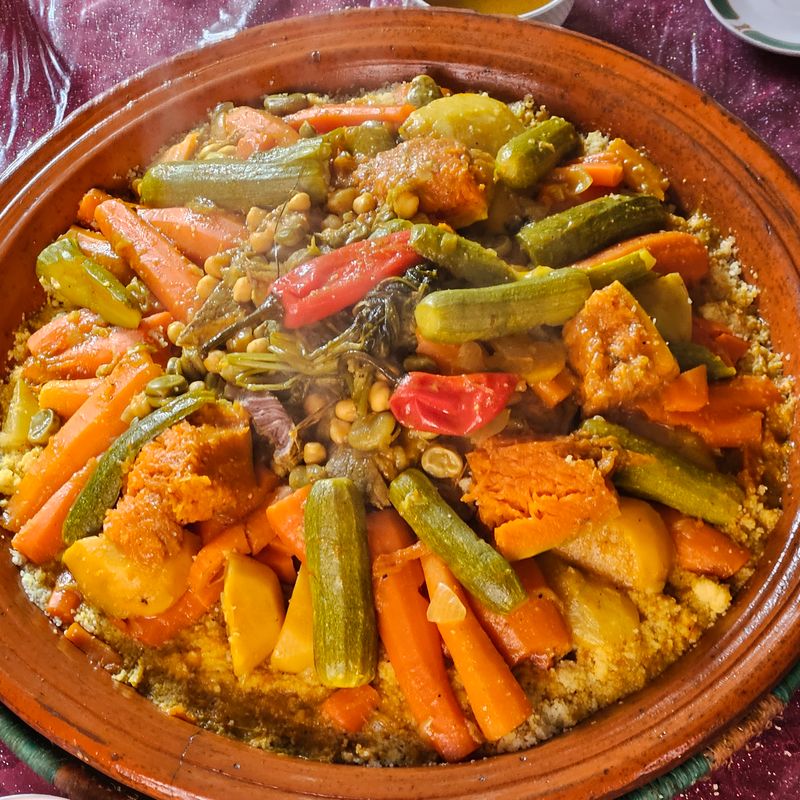
Vegetable Couscous with Chickpeas
A fragrant North African-style stew of carrots, zucchini, tomatoes and chickpeas, simmered with ras el hanout and spooned over fluffy steamed couscous. Easy, vegan and ready in an hour.
- Prep
- 20 min
- Cook
- 35 min
- Wait
- 5 min
- Total
- 1 hr
- Makes
- 4 generous main-course servings (about 8 cups total)
Steps
Before you start
- Use fine-grain instant (pre-steamed) couscous, the common boxed kind. Pearl (Israeli) or hand-rolled couscous needs a different method.
- Check your ras el hanout: blends vary in heat and saltiness. Start with the amount given and adjust at the end.
- Boil a kettle of water when you reach the couscous step so it is ready to pour.
- Cut the vegetables to the sizes listed so they all finish cooking at the same time.
Prep the vegetables
- Cut the onion, carrots, tomatoes and zucchini as listed in the ingredients.
- Mince the garlic, drain and rinse the chickpeas, and chop the parsley.
- Keep the zucchini and chickpeas in a separate bowl from the carrots, since they go in later.
+ Show details− Hide details
Ready when: Vegetables are cut to even sizes, so they cook at the same rate.
Tip: Cut carrots a little smaller than you think you need. They take the longest to soften.
Soften the onion
- Heat 3 tablespoons olive oil in a large, deep sauté pan or heavy stockpot over medium heat until it shimmers.
- Add the onion and 1 teaspoon salt.
- Cook, stirring every minute or so, for 7 to 8 minutes.
+ Show details− Hide details
Ready when: Onion is soft, translucent and just starting to turn golden at the edges.
Tip: If the onion browns quickly or sticks, lower the heat slightly. You want sweet, not scorched.
Bloom the spices
- Add the garlic, ras el hanout and tomato paste.
- Stir constantly for 1 minute so the spices toast in the oil and the paste darkens slightly.
+ Show details− Hide details
Ready when: The mixture smells strongly spiced and fragrant, and the tomato paste turns a deeper brick red.
Tip: Do not walk away. Ground spices and garlic can burn in seconds and turn bitter. If the pan looks dry, add a splash of broth.
Simmer carrots and tomatoes
- Stir in the carrots, chopped tomatoes with their juices, and the broth, scraping up any browned bits from the bottom.
- Bring to a boil over high heat, then reduce to medium-low, cover and simmer for 12 minutes, stirring once halfway.
+ Show details− Hide details
Ready when: A knife meets slight resistance in the carrots, which are about three-quarters tender.
Tip: Keep the simmer gentle, with small steady bubbles. A hard boil will reduce the sauce too quickly.
Add zucchini and chickpeas
- Stir in the zucchini and chickpeas.
- Cover and simmer over medium-low heat for 8 to 10 minutes.
+ Show details− Hide details
Ready when: Zucchini is tender but still holds its shape, carrots are fully tender when pierced with a fork, and the broth is thick enough to coat a spoon lightly.
Tip: Zucchini turns mushy fast. Start checking at 8 minutes.
Finish the stew
- Remove the pan from the heat.
- Stir in 1 tablespoon lemon juice and a few grinds of black pepper.
- Taste and add more salt, about ¼ teaspoon at a time, if needed.
- Cover and keep warm while you make the couscous.
+ Show details− Hide details
Ready when: The stew tastes bright and well seasoned, with no raw lemon sharpness.
Tip: Season after the lemon goes in. Acid changes how salty the stew tastes.
Steam the couscous
- Put the couscous, 1 tablespoon olive oil and ½ teaspoon salt in a medium heatproof bowl and stir to coat each grain.
- Pour in 1½ cups (355 ml) freshly boiled water, stir once, and cover tightly with a plate or lid.
- Let it stand for 5 minutes.
+ Show details− Hide details
Ready when: All the water is absorbed and the grains are tender with no hard center.
Tip: Water must be at a full boil when it hits the couscous, and the bowl must stay covered. Cool water makes gummy, uneven grains.
Fluff the couscous
- Uncover and rake through the couscous with a fork, breaking up clumps and lifting the grains from the bottom, for about 1 minute.
+ Show details− Hide details
Ready when: Grains are separate, light and fluffy rather than clumped together.
Tip: Use a fork, not a spoon. A spoon mashes the grains.
Serve
- Reheat the stew over low heat for 1 to 2 minutes if it has cooled.
- Mound the couscous on a platter or in shallow bowls, spoon the vegetables, chickpeas and broth over the top, and scatter with parsley.
- Serve with lemon wedges and harissa on the side.
+ Show details− Hide details
Ready when: The stew is steaming hot throughout.
Tip: Spoon extra broth over the couscous. It soaks into the grains and carries the flavor.
Good to know
Tips
- Season in layers: salt the onion, the stew and the couscous separately so the whole dish tastes seasoned, not just the broth.
- Keep the stew a little brothy. The couscous soaks up liquid at the table, so a saucy stew is ideal.
- For extra richness, stir 1 tablespoon of butter or olive oil into the fluffed couscous.
- For a touch of sweetness and texture, add ¼ cup raisins with the carrots, or top with toasted slivered almonds.
Make ahead
The stew (through step 6) can be made up to 3 days ahead. Cool, refrigerate in an airtight container, and reheat gently, adding a splash of broth or water if it has thickened. Make the couscous fresh just before serving for the best texture.
Storage & reheating
Room temperature: up to 2 hours. Fridge: store stew and couscous separately in airtight containers for up to 4 days. Freezer: freeze the stew only, for up to 3 months, and thaw overnight in the fridge. Reheat the stew in a saucepan over medium-low heat until steaming, adding a splash of water if needed. Reheat couscous in the microwave, covered, with 1 tablespoon of water per cup for 1 to 2 minutes, then fluff.
Substitutions
- ras el hanout → 1 teaspoon ground cumin, 1 teaspoon ground coriander, ½ teaspoon ground cinnamon, ½ teaspoon ground turmeric and ¼ teaspoon ground ginger. Gives a similar warm, aromatic profile. The flavor will be a bit simpler.
- instant couscous → whole wheat instant couscous. Use the same amounts and method. The flavor is nuttier and the texture slightly chewier.
- ripe tomatoes → 1 can (14.5 oz / 411 g) diced tomatoes with their juices. Handy when fresh tomatoes are out of season. Reduce the broth to 1¾ cups (415 ml).
- medium zucchini → butternut squash or sweet potato in ¾-inch (2 cm) cubes. Add with the carrots in step 4, since they take longer to cook than zucchini.