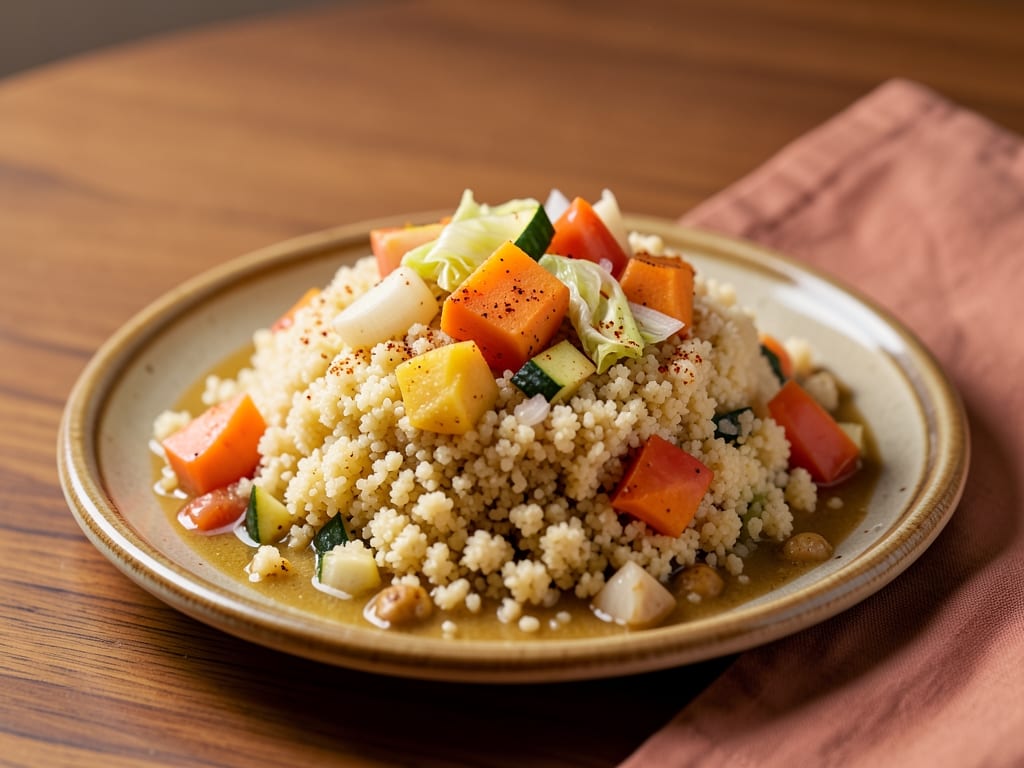
Seven-Vegetable Couscous
A Moroccan Friday-table classic: fluffy, twice-steamed couscous piled high and crowned with tender carrot, turnip, pumpkin, zucchini, cabbage, tomato and onion in a gently spiced, golden chickpea broth.
- Prep
- 30 min
- Cook
- 1 hr
- Wait
- 25 min
- Total
- 1 hr 55 min
- Makes
- 6 generous main-course servings (about 8 cups cooked couscous plus vegetables and broth)
Steps
Before you start
- Use dried medium-grain couscous (not pearl/Israeli couscous). If your box says 'instant', it still works here, but it will need less steaming time.
- You need a couscoussier or an 8-quart (7.5 L) pot topped with a steamer insert or large metal colander that sits snugly. Check that it fits before you begin.
- Read the timing: the couscous steams twice, and the vegetables are added in stages so nothing turns to mush.
- Cut the vegetables into large, even pieces. They must stay whole-ish after about 25 minutes of cooking.
- Warm 1½ cups (360 ml) water for the couscous so it is ready when you need it.
Prep the vegetables
- Peel and cut the carrots, turnips and pumpkin; cut the cabbage into 4 wedges and the zucchini into 3-inch (7.5 cm) lengths, halved lengthwise.
- Cut the onions into wedges, slice the garlic, and grate the tomatoes into a bowl.
- Tie the cilantro and parsley into one bundle with kitchen twine.
- Keep the zucchini, pumpkin and cabbage in separate piles, because they go in at different times.
+ Show details− Hide details
Ready when: Vegetables are in large, even pieces and sorted by cooking time.
Tip: Cut harder vegetables (carrot, turnip) slightly smaller than soft ones (zucchini) so everything finishes together.
Hydrate the couscous
- Put the couscous in a large bowl.
- Dissolve the 1 tsp salt in 1 cup (240 ml) of the warm water.
- Sprinkle the water over the couscous while stirring with a fork, then let it sit for 10 minutes.
- Drizzle on the 2 tbsp olive oil and rub the grains between your palms for about 1 minute to break up every lump.
+ Show details− Hide details
Ready when: Grains are plump, slightly damp and no longer stick together in clumps.
Tip: Don't add all the water at once. Extra water now makes gummy couscous later.
Build the broth base
- Set the 8-quart (7.5 L) pot over medium heat and warm the 3 tbsp olive oil.
- Add the onion wedges and cook, stirring often, for 5 minutes until softened and translucent.
- Stir in the garlic, ginger, turmeric, pepper and cinnamon and cook 1 minute until fragrant.
- Add the grated tomato and tomato paste and cook, stirring, for 3 minutes until the mixture thickens and darkens slightly.
+ Show details− Hide details
Ready when: Onion is soft and translucent, and the tomato has reduced to a thick, jammy paste.
Tip: If the spices begin to stick or darken, add a splash of water right away.
Simmer the root vegetables
- Pour in the 6 cups (1.4 L) water and add the 2 tsp salt, the herb bundle, chickpeas, carrots and turnips.
- Bring to a boil over high heat, then reduce to a steady simmer.
- Cook for about 7 minutes while you set up the steamer.
+ Show details− Hide details
Ready when: Broth is at a steady, bubbling simmer with plenty of steam rising.
Tip: The liquid level must stay at least 2 inches (5 cm) below the base of the steamer so the couscous never touches the broth.
Steam the couscous once
- Set the steamer insert snugly on the pot, or wrap a damp towel around the seam where the colander meets the pot to seal it.
- Loosely pile the couscous into the steamer without packing it down.
- Cover and steam for 15 minutes over a steady simmer (medium heat), counting from when steam visibly rises through the grains.
+ Show details− Hide details
Ready when: Steam rises evenly through the whole surface and the grains look puffed and feel hot and slightly firm.
Tip: Don't press the grains down. They need room to expand, and packed couscous steams unevenly.
Rake, rest, add squash
- Tip the hot couscous into the large bowl and spread it out.
- Sprinkle with the remaining ½ cup (120 ml) warm water and rake with a fork, then rub it gently to break up clumps.
- Let it rest 10 minutes.
- While it rests, add the pumpkin and cabbage wedges to the pot, tucking them into the broth, cover the pot, and keep it at a gentle simmer.
+ Show details− Hide details
Ready when: Grains are separate, plump and no longer dry or crunchy at the center.
Tip: Wet your hands slightly if the hot couscous is hard to rub; work quickly while it's still warm.
Add zucchini, steam again
- Slide the zucchini into the broth.
- Return the couscous to the steamer, again without packing, and cover.
- Steam for 15 minutes over a steady simmer.
- The vegetables below will finish cooking at the same time.
+ Show details− Hide details
Ready when: Couscous is hot, fluffy and tender with no hard center; a knife slides easily into the carrot and pumpkin, which hold their shape.
Tip: Zucchini goes in last because it turns mushy quickly. Pull the pot off the heat as soon as the carrot is tender.
Butter the couscous
- Tip the couscous into the bowl.
- Scatter the butter cubes over the top and toss with a fork until melted and the grains are glossy.
- Cover with a towel and leave for 5 minutes.
- Meanwhile, taste the broth and add salt if needed; discard the herb bundle.
+ Show details− Hide details
Ready when: Grains are shiny, separate and light, with no clumps.
Tip: Rake with a fork, never a spoon, so the grains stay fluffy instead of getting mashed.
Assemble and serve
- Mound the couscous on a large platter in a volcano shape and make a shallow well in the center.
- Use a slotted spoon to arrange the vegetables and chickpeas over and around the couscous, with the cabbage and pumpkin on top.
- Ladle about 1 cup (240 ml) of broth over the couscous.
- Pour the remaining broth into a bowl to pass at the table.
- For a spicy sauce, stir the harissa into 1 cup (240 ml) of hot broth in a small bowl.
+ Show details− Hide details
Ready when: Couscous is moist and flavored with broth but not soggy; vegetables are crowning the mound.
Tip: Serve immediately; couscous firms up as it cools.
Good to know
Tips
- Keep the broth below the steamer: if it boils too high, pour off a little so it doesn't wet the couscous.
- Add the vegetables in stages (carrot and turnip, then pumpkin and cabbage, then zucchini) so each one is tender but intact.
- Keep the couscous loose when steaming and raking; clumps mean more rubbing with oiled hands, not more water.
- Make the broth well seasoned; the couscous is mild and relies on it for flavor.
Make ahead
Cook the vegetables and broth up to 1 day ahead and refrigerate them together. Steam the couscous fresh just before serving, or reheat the broth and vegetables gently while you steam the couscous.
Storage & reheating
Store couscous and the vegetables in broth separately in airtight containers. Room temperature: up to 2 hours. Refrigerator: up to 4 days. Freezer: the broth and vegetables up to 2 months (the zucchini and cabbage soften); couscous up to 1 month. Reheat the vegetables and broth in a pot over medium-low heat until steaming hot. Reheat couscous covered in the microwave with 1 tbsp water per cup, or re-steam for 5 minutes, then fluff with a fork.
Substitutions
- pumpkin or butternut squash → butternut squash or kabocha squash. Same weight and chunk size; butternut gives a slightly sweeter result and keeps its shape well.
- turnips → parsnip or peeled daikon. Parsnip is sweeter; daikon is closest to turnip's mild peppery flavor. Use the same weight.
- unsalted butter → olive oil or vegan butter. Use 2 tbsp olive oil or the same amount of vegan butter to make the dish fully vegan.
- cooked chickpeas (from one 15-oz / 425 g can) → white beans or 1 lb (450 g) cubed lamb shoulder. White beans are a close vegetarian swap. For lamb, brown it in the oil first and simmer 45 minutes before adding the vegetables.