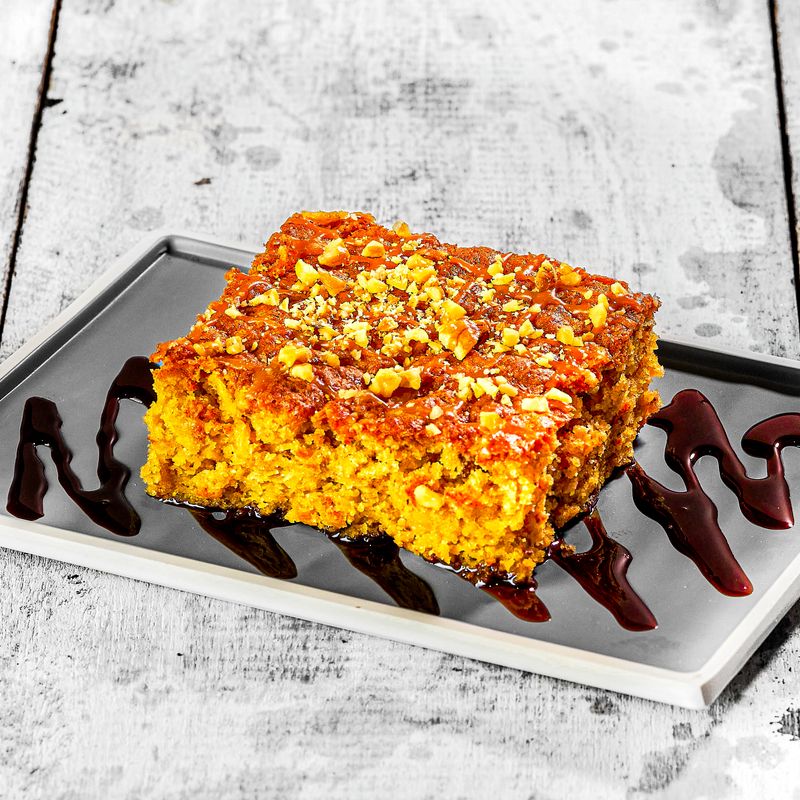
Lemon Semolina Syrup Cake
A moist, tender Middle Eastern cake made with fine semolina and yogurt, topped with toasted almonds and soaked in a warm lemon-honey syrup. The combination of semolina and coconut creates a delicate texture, while the syrup keeps the cake wonderfully moist and fragrant. This cake improves as it sits, making it ideal for advance preparation.
- Prep
- 15 min
- Cook
- 35 min
- Wait
- 2 hr
- Total
- 2 hr 50 min
- Makes
- 1 cake (12 slices)
Steps
Before you start
- Preheat oven to 350°F (175°C) and position a rack in the center
- Line a 9×13-inch (23×33 cm) baking pan with parchment paper or lightly grease it
- Have all ingredients at room temperature for best mixing
- Prepare the honey-lemon syrup ahead so it cools to room temperature before pouring over the hot cake
Combine dry ingredients
- In a large bowl, whisk together the semolina (300 g), unsweetened coconut (85 g), all-purpose flour (60 g), baking powder (1.5 tsp), and salt (0.25 tsp) until evenly combined.
- Set aside.
+ Show details− Hide details
Ready when: Mixture is uniform with no streaks
Tip: Whisk thoroughly to distribute the baking powder evenly for even rising
Mix wet ingredients
- In a medium bowl, whisk together the yogurt (1 cup / 240 ml), vegetable oil (0.75 cup / 180 ml), sugar (1 cup / 200 g), and eggs (3 large).
- Whisk until smooth and well combined, about 1 minute.
- Stir in the lemon zest (2 tbsp / 12 g) and lemon juice (3 tbsp / 45 ml).
+ Show details− Hide details
Ready when: Mixture is smooth, sugar is mostly dissolved, and lemon zest and juice are fully incorporated
Tip: Room-temperature ingredients blend more smoothly and create a more tender cake
Combine batter
- Pour the wet mixture into the dry ingredients and fold together gently with a spatula or wooden spoon until just combined—do not overmix.
- The batter should be thick and slightly lumpy; overmixing toughens the cake.
- Fold until no streaks of dry ingredients remain.
+ Show details− Hide details
Ready when: No streaks of flour remain but the batter is still lumpy
Tip: Fold gently to keep the cake tender; overmixing develops gluten and makes it tough and dense
Spread batter and add almonds
- Pour the batter into the prepared 9×13-inch (23×33 cm) pan and smooth the top with a spatula.
- Scatter the sliced almonds (0.75 cup / 85 g) evenly over the surface, pressing them gently into the batter so they stay on during baking.
+ Show details− Hide details
Ready when: Almonds are visible and slightly pressed into the batter
Tip: Pressing almonds into the batter helps them toast and adhere during baking
Bake the cakeOven 350°F / 175°C
- Bake in a preheated 350°F (175°C) oven for 30–35 minutes, until a toothpick inserted in the center comes out with just a few moist crumbs and the top is light golden brown.
- The cake will look slightly underdone—this is correct and keeps it moist.
+ Show details− Hide details
Ready when: Toothpick inserted in the center has just a few moist crumbs; top is light golden brown and springs back when gently pressed
Tip: Do not overbake; the cake will be moist when removed from the oven and will firm up as the syrup is absorbed
Make the syrup
- While the cake bakes, prepare the syrup.
- In a small saucepan, combine the honey (1 cup / 340 g) and water (1.5 cups / 360 ml).
- Heat over medium-high heat, stirring occasionally, until the mixture comes to a gentle boil, about 5 minutes.
- Stir in the lemon juice (3 tbsp / 45 ml).
- If using, add the thin lemon zest strips (1 tbsp / 6 g).
- Reduce heat to medium-low and simmer for 3–4 minutes.
- Remove from heat and let cool to room temperature, about 20 minutes.
- The syrup should be warm but not hot when poured over the hot cake.
+ Show details− Hide details
Ready when: Syrup is clear and aromatic; it has cooled to warm (still steaming slightly but comfortable to touch on the pan's side)
Tip: Cooling the syrup to room temperature prevents it from evaporating too quickly and allows the cake to absorb it evenly. Pouring cold syrup over a hot cake shocks it; pouring boiling syrup over it can burn the top.
Pour syrup and rest
- As soon as the cake is removed from the oven, use a toothpick or skewer to pierce it all over, making 20–30 small holes so the syrup soaks in.
- Pour the cooled syrup slowly and evenly over the entire warm cake.
- Let the cake rest in the pan for at least 2 hours at room temperature, undisturbed, to allow the syrup to fully absorb.
- The cake will continue to absorb syrup and become more moist and tender as it sits.
+ Show details− Hide details
Ready when: Syrup is fully absorbed; the cake is no longer wet on top but is tender and moist throughout
Tip: Piercing the cake allows the syrup to penetrate evenly. The cake improves as it sits—it will be better tomorrow than today.
Cut and serve
- Once the cake has fully cooled and absorbed the syrup, cut it into 12 squares or rectangles.
- Serve at room temperature or slightly warmed.
+ Show details− Hide details
Ready when: Cake cuts cleanly with a sharp knife
Tip: A slightly damp knife wiped between cuts prevents dragging and keeps edges clean
Good to know
Tips
- This cake is traditionally served at room temperature and pairs beautifully with strong coffee, tea, or a glass of sweet wine.
- Do not skip piercing the cake before pouring the syrup—it allows even absorption and prevents a soggy bottom.
- The cake improves significantly after 1–2 days, making it ideal for advance preparation. Flavors meld and the texture becomes even more tender and moist.
- If the top of the cake browns too quickly while baking, tent it loosely with foil for the last 10 minutes of baking.
Make ahead
The cake actually improves when made 1–2 days ahead. Prepare it fully through step 7, wrap the pan tightly with plastic wrap or foil, and store at room temperature. The flavors meld and the cake becomes even more moist. You can also prepare the syrup up to 3 days in advance and store it covered in the refrigerator; gently reheat it before pouring.
Storage & reheating
Store the covered cake at room temperature for up to 4 days (it becomes more moist over time). Refrigerate for up to 1 week in an airtight container or wrapped tightly with plastic wrap. To freeze, wrap individual slices or the whole cake tightly in plastic wrap and then foil; freeze for up to 3 months. Thaw at room temperature for 2–3 hours or overnight in the refrigerator. No need to reheat; serve at room temperature or warm gently in a 300°F (150°C) oven for 10 minutes if preferred.
Substitutions
- unsweetened desiccated coconut → unsweetened shredded coconut, finely chopped to resemble desiccated coconut. Desiccated coconut is finer and drier; shredded coconut will work but may make the cake slightly less tender. Use the same weight.
- plain full-fat yogurt, at room temperature → sour cream or Greek yogurt thinned with a little milk. Both add tanginess and moisture. Greek yogurt is thicker, so whisk it with 2–3 tbsp milk to match the original consistency.
- honey → light corn syrup or agave nectar combined with a little extra sugar for richness. Honey adds depth; corn syrup or agave will be less rich. You may need to add 2 tbsp extra sugar to the syrup for the same sweetness.
- sliced almonds → sliced pistachios, pine nuts, or blanched almond slivers. Pistachios add color and a slightly different flavor; pine nuts are delicate and brown quickly. Watch them carefully if using pine nuts. Use the same weight.
More cakes
See all →
Find more like this
- Meal
- Dessert
- Cuisine
- Middle Eastern
- Diet
- VegetarianHalal
- Quick & Easy
- EasyMake Ahead