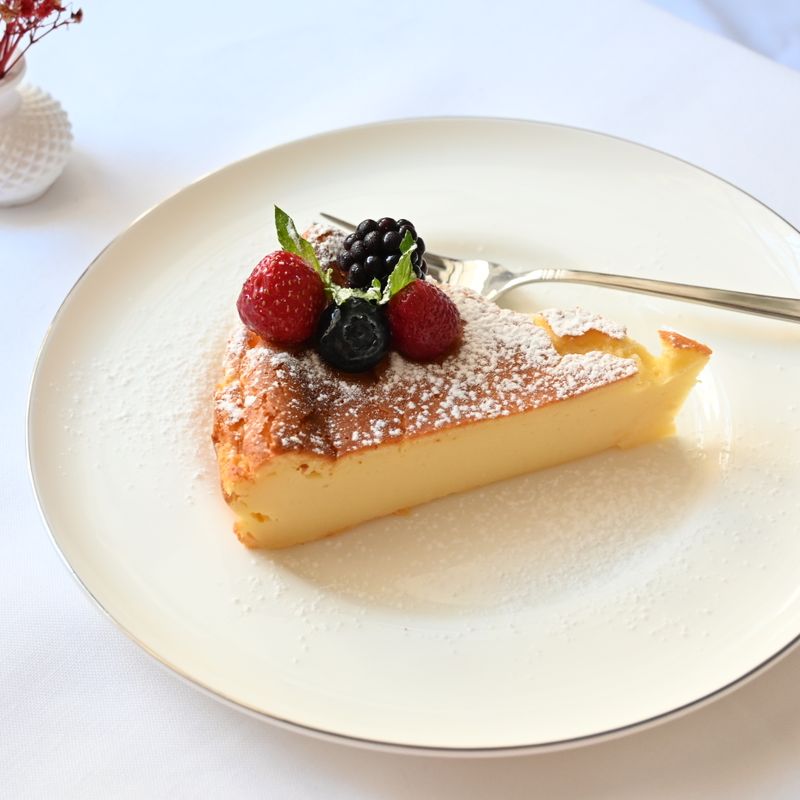
Rose Water Custard Cake
A delicate Middle Eastern custard cake featuring a light sponge layer beneath a silky rose water–infused custard that sets as it bakes. The result is a cake with distinct, beautiful layers—tender sponge below and creamy custard above—enhanced by the floral notes of rose water and crowned with ground pistachios. Serve chilled for the best flavor and texture.
- Prep
- 30 min
- Cook
- 45 min
- Wait
- 1 hr 25 min
- Total
- 2 hr 40 min
- Makes
- 1 cake (12 slices)
Steps
Before you start
- Preheat oven to 350°F (175°C)
- Butter and lightly flour a 9×13-inch (23×33 cm) baking pan
- Remove large eggs from refrigerator—they must be room temperature before you start the batter
Make and Spread Cake Batter
- In a large bowl, cream together the softened butter and sugar until pale and fluffy, about 2–3 minutes.
- Add the room-temperature eggs one at a time, beating for about 1 minute after each addition until well combined.
- In a separate bowl, whisk together the flour, baking powder, and salt.
- Alternately add the flour mixture and milk to the butter mixture in three additions: flour, then milk, then flour, then milk, then flour.
- Fold each addition in gently with a spatula to avoid deflating the aerated eggs.
- Stir in the vanilla extract.
- Pour the batter into the prepared 9×13-inch pan and spread evenly with an offset spatula or the back of a spoon.
+ Show details− Hide details
Ready when: Batter is smooth, creamy, and free of flour lumps
Tip: Gently fold to avoid deflating the aerated eggs; beat on medium speed to avoid overworking the butter-egg mixture
Prepare Custard Base
- In a medium bowl, whisk the egg yolks and sugar together until thick and pale yellow, about 2 minutes.
- Sift the cornstarch over the mixture and whisk until no lumps remain and the mixture is smooth.
+ Show details− Hide details
Ready when: Mixture is pale yellow, thick, and free of cornstarch lumps
Tip: Sifting the cornstarch prevents lumps that can persist in the cooked custard
Heat Milk and Temper YolksOven 180°F / 80°C
- In a small saucepan, heat the milk over medium heat until it's steaming and small bubbles appear around the edges (about 180°F / 82°C), 4–5 minutes.
- Do not allow it to boil.
- Slowly drizzle the hot milk into the egg yolk mixture while whisking constantly—this gradually raises the temperature of the yolks without scrambling them.
- Continue whisking until all the milk is incorporated and the mixture is smooth and uniform with no visible egg streaks.
+ Show details− Hide details
Ready when: Mixture is smooth and uniform; no egg yolk streaks are visible
Tip: Add the milk very slowly while whisking constantly; if you see scrambled bits, strain the custard through a fine sieve to remove them
Cook Custard to Thicken
- Pour the tempered egg mixture back into the saucepan.
- Cook over medium heat, stirring constantly with a whisk or wooden spoon, until the custard thickens enough to coat the back of a spoon, about 5–7 minutes.
- To test doneness, dip a spoon in the custard and run your finger across the back; the line should hold without custard running back over it.
- Keep the heat at medium so the custard stays creamy and doesn't scramble.
- Remove from heat and immediately stir in the rose water and cold butter pieces until fully incorporated and smooth.
+ Show details− Hide details
Ready when: Custard coats the back of a spoon; when you run your finger through, the line holds without running back
Tip: Stir constantly to prevent sticking on the bottom and uneven heating; do not let it boil or the eggs will scramble
Assemble and Bake CakeOven 350°F / 175°C
- Carefully pour the warm custard over the cake batter in the pan.
- Do not stir or fold—let the custard settle naturally over the batter; they will create distinct layers as they bake together.
- Transfer the pan to the preheated 350°F (175°C) oven and bake for 35–40 minutes.
- The top should turn light golden, and a toothpick inserted into the cake layer (not the custard) should come out clean.
- As it bakes, the cake will rise around and through the custard.
+ Show details− Hide details
Ready when: Top is light golden; cake springs back when lightly touched; toothpick inserted into the cake layer comes out clean
Tip: Do not stir the custard into the batter; the layers form naturally and beautifully as they bake together
Cool Cake Completely
- Remove the pan from the oven and let cool in the pan for 15 minutes—this allows the cake to firm up and set.
- Then carefully turn the cake out onto a wire cooling rack.
- If turning out seems difficult, slide a thin knife around the edges first to loosen the cake from the pan.
- Cool completely on the rack to room temperature, about 30–45 minutes, before slicing or decorating.
+ Show details− Hide details
Ready when: Cake is completely cool to the touch
Tip: Cooling in the pan first allows the cake to firm up and makes turning out easier; don't skip this step or the cake may break
Make Rose Water Syrup
- In a small saucepan, combine the water and sugar.
- Bring to a boil over medium heat, stirring occasionally.
- Once boiling, reduce heat to medium-low and simmer for 3 minutes without stirring.
- Remove from heat and stir in the rose water and lemon juice.
- Allow the syrup to cool to room temperature, about 10 minutes.
- It will thicken slightly as it cools.
- (This step is optional; if you prefer a less-sweet cake, you can skip it and dust with confectioners' sugar instead.)
+ Show details− Hide details
Ready when: Syrup is clear and slightly thickened
Tip: Make this while the cake cools to save time; don't over-reduce the syrup or it becomes too thick and sticky
Finish and Chill
- Place the cooled cake on a serving platter.
- With a fork or skewer, pierce the top of the cake all over—this helps the syrup absorb and keeps the cake moist.
- Drizzle the rose water syrup evenly over the top in a thin stream (if using), then sprinkle the ground pistachios over the cake.
- Cover loosely with plastic wrap and refrigerate for at least 30 minutes before serving.
- This chilling time allows the flavors to meld together and the cake to firm up for clean slicing.
+ Show details− Hide details
Ready when: Cake is chilled and ready to serve
Tip: If not using the rose water syrup, you can dust the top with confectioners' sugar and pistachios for a simpler, less-sweet presentation
Good to know
Tips
- Room-temperature eggs are essential for a light, fluffy cake; cold eggs don't emulsify properly with the butter and will result in a dense cake with poor crumb
- Don't skip tempering the egg yolks in the custard—slowly adding hot milk prevents scrambling and ensures a smooth, silky custard with no cooked bits
- The magic of this cake is not stirring the custard into the batter; as they bake, they create distinct, beautiful layers naturally—the sponge rises to the top while the custard settles below
- Pierce the cooled cake before drizzling the syrup to help it absorb and keep the cake moist; without this step, the syrup sits on the surface and can make the top soggy
Make ahead
The baked cake can be made up to 2 days ahead; store in an airtight container in the refrigerator. The rose water syrup can be made up to 1 week ahead and stored in a glass jar in the refrigerator. Assemble and drizzle the syrup just before serving for the best presentation and flavor.
Storage & reheating
Store the finished cake covered in the refrigerator for up to 4 days. The cake can also be frozen for up to 1 month without the syrup; wrap well in plastic wrap and store in an airtight container. Thaw at room temperature for about 2 hours before serving. To reheat (if frozen), warm gently in a 300°F (150°C) oven for 10–15 minutes, then drizzle with fresh syrup if desired.
Substitutions
- rose water → Orange blossom water. Use an equal amount of orange blossom water for a slightly different floral note; the cake will have a delicate citrus essence instead of pure rose flavor
- ground pistachios → Ground almonds or walnuts. Use an equal amount of finely ground almonds or walnuts if pistachios are unavailable or for a different flavor profile
- rose water → Honey syrup. Omit the rose water syrup and instead brush the cooled cake with a simple honey syrup (equal parts honey and water heated and cooled) mixed with a teaspoon of lemon juice for a less floral, simpler finish
- all-purpose flour → Cake flour. Use 1⅜ cups (165g) cake flour if you prefer a more delicate crumb; reduce the amount since cake flour is more finely milled than all-purpose flour
More cakes
See all →
Find more like this
- Meal
- Dessert
- Cuisine
- Middle Eastern
- Diet
- VegetarianHalal
- Method
- Oven