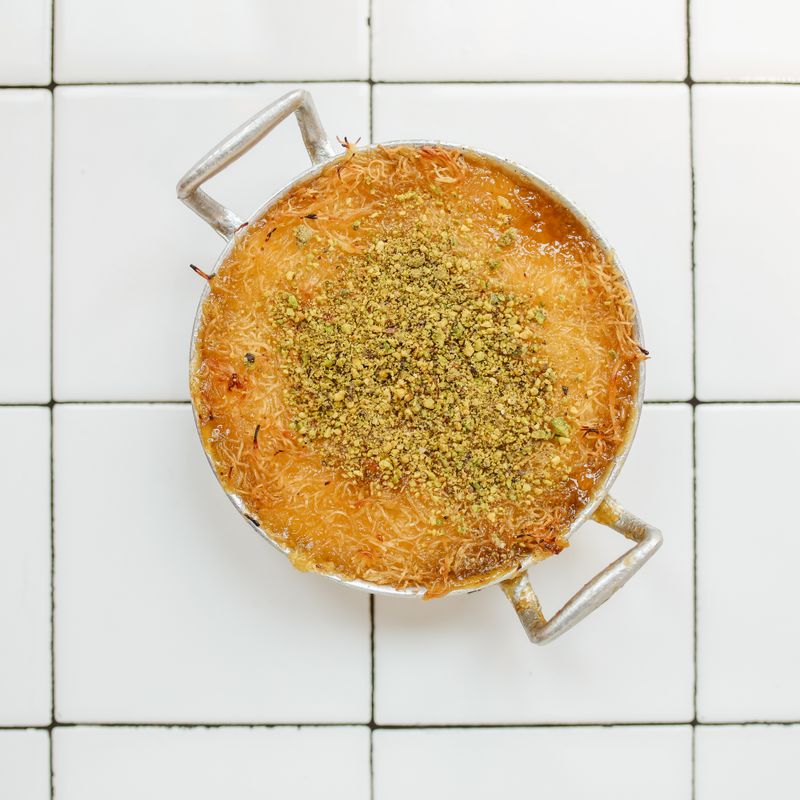
Date Syrup Semolina Cake
A traditional Middle Eastern semolina cake made tender with yogurt and oil, enriched with date syrup both in the batter and the soaking syrup. The warm cake absorbs the aromatic syrup, creating a moist, deeply flavored dessert topped with whole almonds. This cake improves after a day as the flavors meld and the syrup fully penetrates.
- Prep
- 15 min
- Cook
- 38 min
- Wait
- 40 min
- Total
- 1 hr 33 min
- Makes
- 1 cake (12 pieces), 9×13-inch pan
Steps
Before you start
- Preheat oven to 350°F (175°C)
- Have all ingredients at room temperature
- Prepare the syrup first so it can cool to warm (not hot) before soaking
- Line the 9×13-inch pan with parchment paper for easy removal
Make the soaking syrup
- In a medium saucepan, combine the water, sugar, date syrup, lemon juice, and cinnamon stick.
- Bring to a gentle boil over medium-high heat, stirring to dissolve the sugar.
- Once it reaches a boil, reduce heat to medium-low and simmer for 8–10 minutes until slightly thickened (the syrup should coat the back of a spoon lightly).
- Remove from heat and let cool to warm (about body temperature, around 100°F/38°C) before you bake the cake—it should still be warm, not hot, when poured onto the baked cake.
+ Show details− Hide details
Ready when: Syrup simmers gently and slightly thickens; cinnamon flavors the liquid
Tip: Cool the syrup to warm (not piping hot) before pouring on the baked cake so the cake absorbs it evenly without becoming mushy at the edges.
Whisk dry ingredients
- In a large mixing bowl, whisk together the fine semolina, all-purpose flour, baking powder, and salt.
- Set aside.
+ Show details− Hide details
Ready when: Dry ingredients are evenly combined with no lumps
Mix wet ingredients
- In a medium bowl, whisk together the yogurt, oil, date syrup, sugar, eggs, and vanilla extract until smooth and well combined.
- The mixture should be homogeneous with no streaks of date syrup visible.
+ Show details− Hide details
Ready when: Wet mixture is smooth and uniform in color
Tip: Whisking thoroughly here distributes the date syrup evenly; overmixing is not a concern for this cake.
Combine and pour batter
- Pour the wet ingredients into the bowl of dry ingredients and fold together gently with a spatula until just combined.
- Do not overmix; stop as soon as no dry streaks remain.
- Oil or butter your 9×13-inch pan and line it with parchment paper.
- Pour the batter into the prepared pan and smooth the top with a spatula.
+ Show details− Hide details
Ready when: Batter is smooth and fills the pan evenly
Tip: Fold gently to keep the cake tender; overmixing develops gluten and makes the cake tougher.
Score and top with almonds
- Using a sharp knife, cut the unbaked cake into diamond or square pieces (about 2×2 inches or 5×5 cm for 12 pieces).
- Do not cut all the way through the pan; cut only about three-quarters of the way through so the pieces stay in place while baking.
- Place one whole almond on the center of each piece, pressing it gently into the batter.
+ Show details− Hide details
Ready when: Cake is scored into even pieces and almonds are pressed into batter
Tip: Scoring before baking helps the pieces separate cleanly after soaking and makes plating easier.
Bake the cakeOven 350°F / 175°C
- Preheat your oven to 350°F (175°C).
- Place the pan on the center rack and bake for 35–38 minutes until the top is light golden brown and springs back when lightly touched.
- A wooden skewer inserted in the center should come out clean or with just a few moist crumbs.
- Do not overbake; the cake should still be tender.
+ Show details− Hide details
Ready when: Top is golden brown, cake springs back when lightly touched, and a skewer comes out clean
Tip: Do not overbake; the cake will continue to soften as it soaks in the syrup, so it should still feel slightly tender when it comes out of the oven.
Soak with warm syrup
- Remove the cake from the oven and let it cool in the pan for 2–3 minutes.
- While the cake is still hot but cooling, slowly pour the warm (not hot) soaking syrup evenly over the entire surface, distributing it so every piece absorbs some syrup.
- Work slowly and let the syrup soak in; you may need to pour in two stages.
- The cake should glisten and the syrup should be mostly absorbed by the time you finish.
+ Show details− Hide details
Ready when: Syrup is absorbed into the cake; the surface is glossy and no pooling syrup remains
Tip: The warm cake absorbs syrup much better than a cool one; this is why timing is critical. If the cake gets too cold, the syrup sits on top rather than soaking in.
Good to know
Tips
- Make the syrup first and let it cool while you prepare the batter. This way, when the cake comes out of the oven, the syrup is ready at the ideal warm temperature for soaking.
- Do not skip the lemon juice in the syrup. Even 1 tablespoon cuts the sweetness and brightens the date flavor, preventing the cake from tasting cloying.
- Score the cake before baking, not after soaking, so the pieces separate cleanly when serving. Scoring after soaking causes the cake to crumble.
- This cake is best on day 2, after flavors have fully developed and the syrup has penetrated every layer. Plan to make it a day ahead if possible.
Make ahead
You can bake the cake up to 1 day ahead, wrap it tightly (with the syrup fully absorbed), and store it at room temperature. The flavors actually improve as they sit, and the cake becomes more moist. To serve, gently separate the pieces and arrange on a platter.
Storage & reheating
Room temperature: up to 3 days, covered loosely with foil. Refrigerator: up to 5 days in an airtight container (the cake becomes denser and sweeter when cold, which is often preferred). Freezer: up to 2 months, wrapped in plastic wrap and foil; thaw at room temperature. Do not reheat; serve at room temperature or slightly chilled.
Substitutions
- plain yogurt (not Greek) → sour cream or labneh. Use the same amount; sour cream will make the cake slightly tangier and denser, while labneh adds a richer dairy flavor. Both work well.
- neutral oil (vegetable or canola) → light olive oil or clarified butter (ghee). Olive oil adds a subtle fruity note traditional to some Middle Eastern versions. Ghee adds richness; use the same amount.
- date syrup → honey or equal parts honey and date syrup. If date syrup is unavailable, honey creates a lighter syrup, but you lose the distinctive date flavor. Use half date syrup and half honey for a closer match.
- whole blanched or skin-on almonds → pine nuts, pistachios, or sesame seeds. Pine nuts are luxurious; pistachios add color and flavor. Sesame seeds (white or black) add nuttiness and are traditional in some regions. Use the same weight.
More cakes
See all →
Find more like this
- Meal
- Dessert
- Cuisine
- Middle Eastern
- Diet
- VegetarianHalal
- Quick & Easy
- EasyMake Ahead