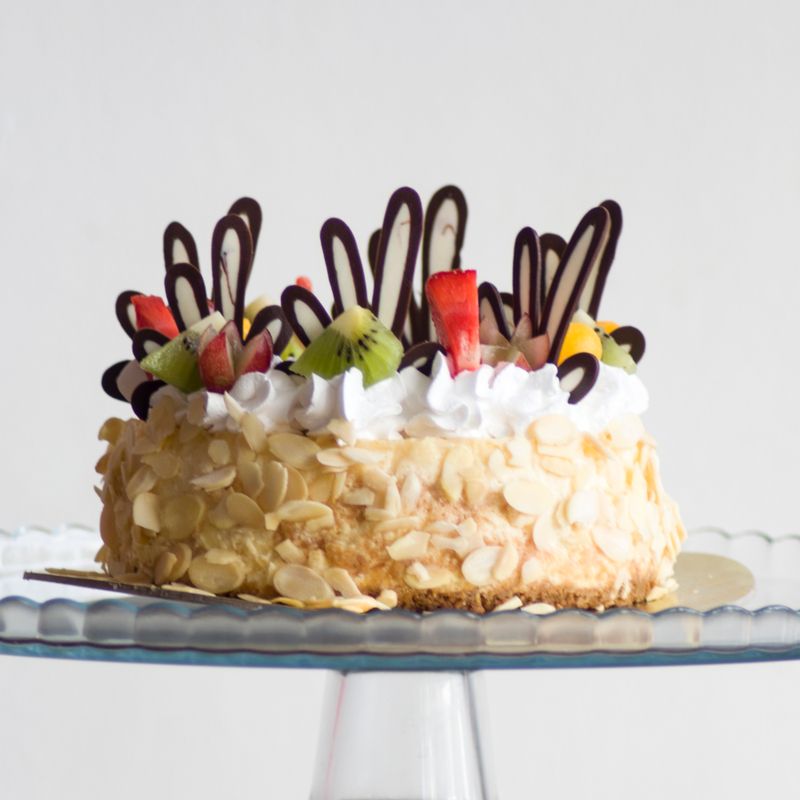
Almond Cream Cake
An elegant two-layer cake made with a delicate blend of ground almonds and flour, naturally sweetened with honey and perfumed with orange blossom water. Filled and frosted with a silky whipped mascarpone cream, this Middle Eastern-inspired cake is sophisticated yet surprisingly light and moist. Perfect for special occasions or afternoon gatherings, it strikes a beautiful balance between the nutty warmth of almonds and the brightness of orange blossom.
- Prep
- 25 min
- Cook
- 28 min
- Wait
- 1 hr
- Total
- 1 hr 53 min
- Makes
- 1 two-layer cake (8 slices)
Steps
Before you start
- Soften butter at room temperature for 1 hour, or use the quick-soften method (cut into cubes and let sit for 20 minutes)
- Preheat oven to 350°F (175°C) about 15 minutes before you plan to bake
- Bring eggs to room temperature by letting them sit out for 30 minutes
- Have all ingredients measured out and ready before you begin mixing
Preheat and prepare pansOven 350°F / 175°C
- Preheat your oven to 350°F (175°C).
- Grease the inside of two 8-inch round cake pans with a light coating of butter or baking spray.
- Line the bottoms with parchment paper, then grease the parchment.
- This prevents the delicate almond cakes from sticking.
+ Show details− Hide details
Tip: Lining with parchment paper is important for almond cakes, which are more delicate than flour-based cakes.
Cream butter and honey
- In a large bowl, beat the softened butter and honey together using an electric mixer on medium speed for 3–4 minutes, until the mixture is light, fluffy, and pale (it should increase noticeably in volume).
- This aerates the batter and creates the tender crumb.
+ Show details− Hide details
Ready when: Mixture is light, pale, and has roughly doubled in volume
Tip: Make sure your butter is truly softened but not greasy; cold or melted butter will not incorporate air properly.
Add eggs one at a time
- Reduce mixer speed to medium.
- Add the eggs one at a time, beating for about 1 minute after each addition to fully incorporate before adding the next egg.
- After all four eggs are added, continue beating for another 1–2 minutes.
- The mixture should look smooth and slightly lighter.
+ Show details− Hide details
Ready when: Batter is smooth, pale, and homogeneous with no visible egg white streaks
Tip: Room-temperature eggs mix in more easily and create a more even batter. If you add a cold egg, the butter may seize.
Whisk dry ingredients
- In a separate medium bowl, whisk together the all-purpose flour, ground almonds, baking powder, and salt until evenly combined.
- This distributes the leavening agent and salt throughout the dry mixture.
+ Show details− Hide details
Ready when: No visible lumps; the mixture is uniform and light
Tip: Whisking by hand (rather than sifting) is fine for this combination and prevents overworking the almonds.
Fold in dry mixture and flavorings
- Reduce mixer to low speed.
- Add the dry mixture in two batches, folding gently with a rubber spatula after each addition and mixing briefly on low just until no flour streaks are visible.
- Avoid overbeating once the flour is added, as this develops gluten and toughens the cake.
- After the flour is incorporated, add the orange blossom water (if using) and vanilla extract, and fold gently until just combined.
+ Show details− Hide details
Ready when: Batter is smooth with no visible flour streaks; it should be thick but spreadable
Tip: Fold gently with a spatula and mix on low to keep the cake tender. Overmixing will make it dense and tough.
Divide batter into pans
- Divide the batter evenly between the two prepared pans, aiming for about 13 oz (370 g) per pan.
- Gently tap the pans on the counter a few times to release air bubbles.
- Smooth the tops with an offset spatula so they're level.
+ Show details− Hide details
Ready when: Batter is evenly distributed; surfaces are level
Tip: Use a small scale if you have one to ensure even division, which guarantees level cake layers.
Bake the cake layersOven 350°F / 175°C
- Place both pans on the middle oven rack.
- Bake at 350°F (175°C) for 25–30 minutes (begin checking at 25 minutes).
- The cakes should be golden on top and just spring back when lightly touched in the center.
+ Show details− Hide details
Ready when: A cake tester or toothpick inserted into the center comes out clean or with just a few moist crumbs; tops are golden brown and spring back when lightly touched
Tip: Don't open the oven before 23 minutes—drafts can cause the delicate cakes to sink. If the tops are browning too quickly, tent loosely with foil.
Cool in pans
- Remove the pans from the oven and let them rest at room temperature for 15 minutes.
- This allows the cakes to firm up slightly so they don't break when turned out.
- Run a thin knife around the inside edge of each pan to loosen the cake, then carefully invert each cake onto a wire rack, peel away the parchment, and let it cool completely for another 15–20 minutes.
+ Show details− Hide details
Ready when: Cakes are no longer warm to the touch and are firm enough to handle
Tip: Be gentle when inverting and removing parchment. If the paper sticks, use a small damp brush to dampen it slightly and peel slowly.
Make the cream filling
- While the cakes are cooling or once they're completely cool, prepare the filling.
- Pour the cold heavy cream into a chilled bowl and whip it on high speed until soft peaks form (the cream drags slightly when you lift the whisk, about 3–4 minutes).
- In a separate small bowl, gently fold together the room-temperature mascarpone and honey until just combined.
- Carefully fold the mascarpone mixture into the whipped cream in two additions, then fold in the orange blossom water (if using).
- Stir gently until no streaks remain, but do not overbeat or the mixture will become grainy.
+ Show details− Hide details
Ready when: Cream is thick, billowy, and just holds its shape; no visible streaks of mascarpone remain
Tip: Whipping is easier if your bowl, whisk, and cream are truly cold. Overbeating mascarpone will cause it to become thick and grainy, so fold gently and stop as soon as combined.
Assemble the cake
- Once the cake layers are completely cool, place one layer on a serving plate or cake board.
- Using an offset spatula or back of a spoon, spread about half of the cream filling (roughly 1 to 1.5 cups) evenly across the top, leaving a thin border around the edge.
- Carefully place the second cake layer on top, pressing gently.
- Spread the remaining filling over the top and around the sides of the cake.
- If desired, garnish with thin almond slices or a light dusting of ground cinnamon.
+ Show details− Hide details
Ready when: Cake is level, frosting is smoothly applied, and any garnish is evenly distributed
Tip: If the cakes are still slightly warm, the cream filling may soften too much. Ensure both layers are completely cooled before assembly. A cake turntable makes frosting the sides much easier.
Chill and serve
- Refrigerate the assembled cake for at least 30 minutes (or up to 4 hours) before serving.
- This allows the filling to set and the flavors to meld.
- The cake can be served chilled or at cool room temperature.
- Slice with a sharp knife, wiping the blade clean between cuts for neat slices.
+ Show details− Hide details
Ready when: Cake is cold to the touch and slices cleanly
Tip: A hot knife dipped in hot water and wiped clean between each slice will give you the cleanest, most elegant presentation.
Good to know
Tips
- Do not skip the cream-and-beat step with the butter and honey. This aerates the batter and is essential for the light, delicate texture of the cake. Use a stand mixer or strong hand mixer for best results.
- Orange blossom water is optional but highly recommended—it is the signature flavor in many Middle Eastern cakes. Avoid imitation versions; look for pure distilled orange blossom water in specialty or Middle Eastern markets.
- Check the cakes early, especially in a hot or convection oven. The high proportion of almonds makes them more prone to browning quickly, so begin testing at 23–24 minutes rather than 28.
- This cake is best served the day it's made or the next day. The almond layers remain moist and the filling stays fresh in the refrigerator. If baking ahead, freeze the unfrosted layers (wrapped individually) for up to 4 weeks and assemble the day before serving.
Storage & reheating
Store in an airtight container in the refrigerator for up to 3 days. The cake can also be frozen (unfrosted cake layers only) for up to 1 month; thaw at room temperature for 1 hour before filling and serving. Reheat gently: if you prefer the cake slightly warm, let it sit at room temperature for 15–20 minutes before serving, or warm individual slices in a 300°F (150°C) oven for 5 minutes.
Substitutions
- orange blossom water → rose water or a small pinch of ground cardamom. Orange blossom water is traditional in Middle Eastern cakes; rose water is a close alternative with a slightly floral note. Cardamom adds warmth but use sparingly (1/4 tsp total for the cake and filling combined) to avoid overwhelming the almonds.
- mascarpone cheese → full-fat Greek yogurt or whipped cream cheese (with a tablespoon of sour cream). Mascarpone is rich and tangy; Greek yogurt is lighter but slightly more tart (reduce honey by 1 tbsp if using), and cream cheese will give a denser, tangier filling.
- ground almonds (almond flour) → blanched almond flour or a blend of 1 cup blanched almond flour plus 1/2 cup finely ground pistachios. Use blanched almond flour (without skins) for a paler, more delicate crumb. Pistachio adds an authentic Middle Eastern flavor variation but will tint the cake green and add slight bitterness; reduce honey by 1 tbsp if substituting.
- honey → agave nectar or maple syrup (use same volume, reduce by 1 tbsp as these are less thick). Honey provides a distinctive warm flavor; agave is milder and more neutral, while maple syrup adds a different complexity. All three are fermentable by similar amounts and will bake similarly.
More cakes
See all →
Find more like this
- Meal
- Dessert
- Cuisine
- Middle Eastern
- Diet
- VegetarianHalal
- Method
- Oven