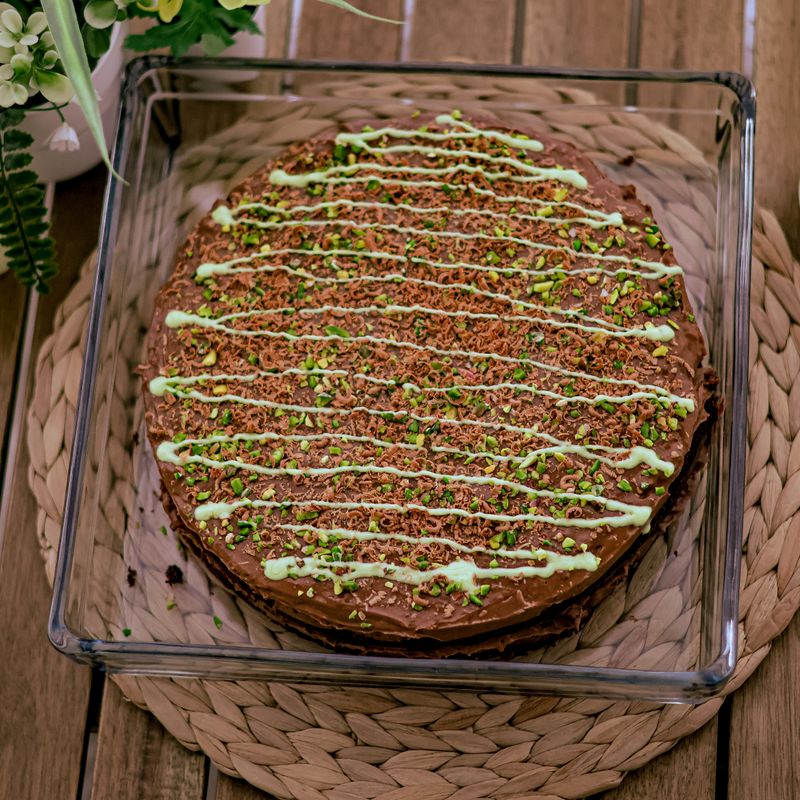
Pistachio Cream Cake
A luxurious layered cake with a tender, airy sponge base and a rich pistachio cream filling sweetened with honey. This Middle Eastern-inspired dessert combines the delicate crumb of a classic sponge cake with the nutty richness of pistachio paste, finished with crushed pistachios and an optional honey syrup that keeps the layers moist and aromatic.
- Prep
- 20 min
- Cook
- 28 min
- Wait
- 1 hr 55 min
- Total
- 2 hr 43 min
- Makes
- 1 cake (10 slices)
Steps
Before you start
- Have eggs at room temperature for 30 minutes before mixing to improve emulsification and create a lighter cake
- Keep heavy cream cold in the refrigerator until just before whipping
- Preheat your oven to 350°F (175°C) at least 15 minutes before baking
- Gather all ingredients and equipment—this recipe moves quickly once you start mixing
Preheat and Prepare PansOven 350°F / 175°C
- Set your oven to 350°F (175°C).
- Line the bottoms of two 8-inch (20 cm) round cake pans with parchment paper.
- Lightly butter the parchment and the sides of each pan to prevent sticking.
- Leave the pans on your work surface ready to fill.
+ Show details− Hide details
Ready when: Oven reaches 350°F (175°C)
Combine Eggs and Sugar
- Crack 4 room-temperature large eggs into a large mixing bowl.
- Add 100g (3.5 oz) granulated sugar.
- Using a stand mixer fitted with the whisk attachment or a handheld mixer on medium-high speed, beat the mixture for 4–5 minutes.
- The eggs and sugar will transform from pale yellow to a thick, ribbon-like texture as the volume roughly triples.
- This aeration is crucial for a light, airy cake—the beaten eggs trap air bubbles that create the sponge structure.
+ Show details− Hide details
Ready when: Mixture is pale yellow and thick; when beaters are lifted, a ribbon trails from them for a few seconds
Tip: Room-temperature eggs emulsify better with sugar, creating more volume and a lighter crumb. Cold eggs won't incorporate as much air.
Incorporate Oil and Milk
- In a small bowl, whisk together 50ml (1.7 oz) vegetable oil and 60ml (0.25 cup) whole milk.
- Stir in 1 tsp (5 ml) vanilla extract.
- With the mixer running on medium speed, pour this mixture into the egg mixture in a thin, steady stream—this gradual incorporation prevents the batter from splitting.
- Beat for another 1–2 minutes until the batter is smooth and no visible streaks of oil remain.
+ Show details− Hide details
Ready when: Oil and milk are fully incorporated; batter is smooth with no oily streaks
Tip: Pouring slowly prevents the oil from being too cold when it hits the warm egg mixture, which could cause separation.
Fold in Dry Ingredients
- In a medium bowl, sift together 120g (4.2 oz) all-purpose flour, 1.5 tsp (7 g) baking powder, and 0.25 tsp (1.5 g) salt.
- Remove the mixing bowl from the mixer.
- Using a flexible silicone spatula, gently fold the dry ingredients into the wet batter in three additions.
- Rotate the bowl as you fold, using broad motions to combine without deflating the air you just incorporated.
- Stop folding as soon as no visible flour streaks remain—overmixing will toughen the crumb.
+ Show details− Hide details
Ready when: No dry flour visible; batter is light and smooth
Tip: Gentle folding preserves the airy texture you created during the egg-and-sugar stage. Overmixing introduces gluten development, making the cake dense.
Divide and Bake the CakesOven 350°F / 175°C
- Divide the batter evenly between the two prepared pans—each should get about 400 ml (1.75 cups).
- Smooth the tops gently with an offset spatula, keeping the surfaces level.
- Place both pans on the middle rack of the preheated 350°F (175°C) oven, leaving space between them for heat circulation.
- Bake for 25–30 minutes.
- The cakes are done when the tops spring back when lightly touched and a toothpick inserted into the center comes out clean or with just a few moist crumbs.
+ Show details− Hide details
Ready when: Tops spring back when lightly pressed; toothpick inserted in center comes out clean
Tip: Avoid opening the oven door before 22 minutes, as temperature fluctuations can cause the cakes to sink or bake unevenly.
Cool in the Pans
- Remove both pans from the oven and place them on a heat-safe surface.
- Let the cakes rest in the pans for 10 minutes.
- This resting time allows them to firm up enough to handle without breaking, while still being warm enough to release cleanly.
+ Show details− Hide details
Ready when: Cakes are cool enough to handle comfortably but still warm
Turn Out and Cool Completely
- Run a thin knife around the inside edge of each pan to loosen the cake.
- Place a wire cooling rack on top of the first cake, then flip the pan and rack together so the cake lands on the rack.
- Gently peel away the parchment paper from the bottom of the cake.
- Repeat with the second cake.
- Allow both cakes to cool completely at room temperature, about 30–40 minutes.
- They should feel completely cool to the touch before assembly—any residual warmth will soften the pistachio cream.
+ Show details− Hide details
Ready when: Cakes are completely cool, no warmth at the center when you touch them
Tip: While the cakes cool, you can prepare the honey syrup and pistachio cream to save time.
Make the Honey Syrup
- In a small saucepan, combine 100 ml (3.4 fl oz) water and 75 ml (2.6 oz) honey.
- Add 1 tbsp (15 ml) fresh lemon juice and, if using, 1 cinnamon stick for subtle warmth and spice.
- Place the pan over medium heat and bring to a gentle simmer, stirring occasionally until the honey dissolves.
- Let it simmer for 2 minutes, then remove from heat.
- Allow the syrup to cool to room temperature, about 10 minutes.
- Remove the cinnamon stick if used.
- This honey syrup will brush onto the cake layers to keep them moist and add Middle Eastern-inspired aromatic flavor.
+ Show details− Hide details
Ready when: Honey is dissolved; syrup is thin and light amber in color
Tip: Apply the syrup to the cake layers while they are still slightly warm for better absorption of flavor.
Prepare the Pistachio Cream
- Pour 400 ml (13.5 fl oz) cold heavy cream into a large, clean, chilled mixing bowl.
- Using a whisk or electric mixer on medium speed, whip the cream for 2–3 minutes until it forms soft peaks.
- Add 60 g (2 oz) powdered sugar and continue whipping for another 1–2 minutes until medium-firm peaks form—do not go to stiff peaks yet, or the cream will be grainy when folded with the pistachio paste.
- In a separate small bowl, stir together 200 g (7 oz) pistachio paste, 45 ml (1.5 fl oz) honey, and 1 tsp (5 ml) vanilla extract until completely smooth.
- Gently fold the pistachio mixture into the whipped cream in three additions using a flexible spatula.
- Stop folding as soon as no white streaks remain.
- This yields a rich, nutty, creamy filling with a deep pistachio flavor.
+ Show details− Hide details
Ready when: Pistachio cream is uniform in color with no white streaks; holds soft-to-medium peaks when a spoon is lifted
Tip: Keep all equipment cold—a chilled bowl and whisk prevent the cream from separating when pistachio paste (which is slightly warmer) is folded in.
Level the Cake Layers (Optional)
- If either cake layer has domed on top, place it on a turntable or work surface.
- Using a serrated knife and a gentle sawing motion, carefully level the top by removing the dome in one smooth, even slice.
- Brush away any crumbs.
- Leveling creates a flat, stable surface for even filling distribution and a professional-looking final product.
+ Show details− Hide details
Ready when: Both cake layers are level and roughly equal in height
Tip: Use a long, sharp serrated knife and let the weight of the knife do the work—don't press hard, which can squeeze and compress the delicate crumb.
Assemble the Cake
- Place one cooled, leveled cake layer on your serving plate or cake base.
- Using an offset spatula, lightly brush the top surface with some of the cooled honey syrup—this keeps the layer moist and adds aromatic sweetness.
- Spread about 350 ml (1.5 cups) of the pistachio cream evenly on top of the first cake layer, using the offset spatula to create an even thickness.
- Carefully lift the second cake layer and place it on top, keeping it as level as possible.
- Brush the top of this second layer lightly with more honey syrup if desired.
- Spread the remaining pistachio cream (about 300 ml) on the top and around the sides of the assembled cake.
- You can create a smooth, professional finish or leave the surface lightly textured, as you prefer.
+ Show details− Hide details
Ready when: Cake is fully frosted with pistachio cream; layers are stacked level and stable
Tip: Work quickly so the cream doesn't warm up too much and become difficult to spread. If the cream softens, refrigerate it for a few minutes.
Chill Until Set
- Place the assembled cake in the refrigerator for at least 45 minutes to 1 hour.
- The pistachio cream needs time to firm up so slices hold their shape, and chilling also allows the flavors to meld and develop.
- A well-chilled cake is easier to slice cleanly.
+ Show details− Hide details
Ready when: Cream feels firm to the touch; entire cake is cold throughout
Garnish and Serve
- Remove the cake from the refrigerator just before serving.
- Press 80 g (2.8 oz) finely crushed roasted pistachios around the sides of the cake using your hand or an offset spatula, or sprinkle them on the top surface.
- If using them, arrange 12–15 whole roasted pistachios decoratively on the top.
- Slice the cake with a sharp, thin-bladed knife.
- Dip the knife in hot water and wipe it clean between cuts for neat, clean slices.
- Serve immediately while chilled, using a spatula to transfer each slice to a plate.
+ Show details− Hide details
Ready when: Cake is fully garnished and ready to slice
Tip: Hot water on the knife creates clean cuts through the creamy filling. Wipe after each slice for the best results.
Good to know
Tips
- Room-temperature eggs are key: they incorporate more air when beaten with sugar, creating a lighter, fluffier cake. Remove them from the refrigerator 30 minutes before baking.
- Fold the dry ingredients gently in three additions—this prevents deflating the aerated egg mixture and keeps the cake tender rather than dense or tough.
- Don't over-whip the cream once pistachio paste is added. Stop at medium-firm peaks or the cream may become grainy and separate as you fold.
- The honey syrup adds authentic Middle Eastern flavor and moisture to the layers. While optional, it's highly recommended—brush it on warm cake for better absorption.
- For neat, clean slices through the creamy filling, use a thin, sharp knife dipped in hot water, wiping it between cuts. This prevents the pistachio cream from dragging and smudging.
- This cake is best served chilled straight from the refrigerator. The cold temperature keeps the cream firm and showcases the contrast between the tender cake and creamy filling.
Make ahead
The sponge cakes can be baked 1 day ahead and stored in an airtight container at room temperature. The pistachio cream can be prepared up to 4 hours ahead and refrigerated in a covered bowl. The assembled cake can be completed and chilled up to 6 hours before serving.
Storage & reheating
Room temperature: 3 hours maximum (due to whipped cream filling). Refrigerator: 3–4 days in an airtight container. Freezer: 2 months wrapped well in plastic wrap and foil; thaw in the refrigerator for 4 hours before serving. Do not reheat; serve cold straight from the refrigerator.
Substitutions
- pistachio paste → Almond butter or tahini. Use the same amount. Almond butter will be slightly sweeter; tahini will be more savory. Both work but create a different flavor profile than pistachio.
- honey → Maple syrup or agave nectar. Use the same amount. Maple syrup adds earthiness; agave is more neutral. The cake will taste slightly different but remain delicious.
- vegetable oil → Melted unsalted butter or neutral oil like canola oil. Use the same amount. Butter adds slight richness; the cake texture will be very similar.
- heavy cream → Greek yogurt mixed with a small amount of whipped cream (50/50). This creates a tangier, slightly lighter filling. Use the same total volume but reduce powdered sugar slightly (to 45 g) as Greek yogurt adds body.
More cakes
See all →
Find more like this
- Meal
- Dessert
- Cuisine
- Middle Eastern
- Main ingredient
- Eggs
- Diet
- VegetarianHalal
- Method
- Oven