Korean Gochujang Chicken Biryani
Juicy chicken thighs marinated in gochujang, yogurt and garam masala are layered with saffron basmati, crisp fried onions and scallions, then sealed and steamed dum-style on the stovetop. The result is a savory, gently spicy, sesame-scented biryani that sits between Seoul and Hyderabad.
- Prep
- 35 min
- Cook
- 1 hr 9 min
- Wait
- 2 hr 10 min
- Total
- 3 hr 54 min
- Makes
- 6 generous servings (about 9 cups cooked biryani)
Steps
Before you start
- Start the marinade at least 2 hours ahead (up to 12 hours in the fridge). Gochujang brands vary in heat and saltiness, so taste yours first and use the lower amount if it is very salty.
- Rinse and soak the rice during the last 30 minutes of marinating so it is ready to boil when the chicken is cooked.
- Pick a heavy-bottomed 5–6 quart (4.7–5.7 L) pot with a tight lid that can also be used for the dum steaming. This recipe is made entirely on the stovetop (no oven needed). You will need foil to seal the pot.
- Boneless skinless thighs are used because they stay moist during the long steam. Trim large pieces of fat but leave the thighs in generous 1½-inch pieces.
Marinate the chicken
- In a large bowl, whisk the gochujang, yogurt, grated garlic, grated ginger, soy sauce, lemon juice, garam masala, cumin, gochugaru (if using), 1 teaspoon kosher salt and 1 tablespoon (15 ml) of the sesame oil until completely smooth.
- Add the chicken pieces and turn until every piece is thickly coated.
- Cover and refrigerate for at least 2 hours, or up to 12 hours.
+ Show details− Hide details
Ready when: Chicken is evenly coated in a thick, brick-red marinade with no dry spots
Tip: Use a bowl large enough to toss freely; a snug bowl leaves uncoated patches that cook unevenly.
Soak rice, bloom saffron
- During the last 30 minutes of marinating, rinse the basmati in a bowl of cold water, swishing gently and draining, 4–5 times until the water is almost clear.
- Cover with fresh cold water and soak 30 minutes, then drain well in a sieve.
- Meanwhile, stir the saffron into the warm milk and let it steep.
+ Show details− Hide details
Ready when: Soaked grains turn opaque white and the milk turns deep golden orange
Tip: Handle the rice gently; broken grains turn mushy in the dum.
Fry the onions
- Heat the neutral oil in the heavy pot over medium heat.
- Add the sliced onions with 1 pinch of the rice salt and cook, stirring every 2 minutes at first and every 30 seconds near the end, for 18–20 minutes.
- Lower the heat if they darken too fast.
- Transfer with a slotted spoon to a plate lined with paper towels, leaving the oil in the pot.
- They crisp as they cool.
+ Show details− Hide details
Ready when: Onions are deep golden brown, not black, and begin to crisp at the edges
Tip: Pull them a shade lighter than you want; they keep darkening from residual heat.
Cook the chicken base
- Return the pot to medium-high heat.
- Add the chicken with all of its marinade and half of the fried onions, crushing them in with your fingers.
- Cook, stirring often, for 12–15 minutes until the sauce reduces to a thick paste that clings to the chicken and the oil begins to separate at the edges.
- The chicken will be mostly cooked through.
- Spread it into an even layer and remove the pot from the heat.
+ Show details− Hide details
Ready when: Sauce is thick and glossy, with no watery liquid pooling; thickest chicken pieces are opaque, near 160°F (71°C)
Tip: A watery base makes soggy rice, so keep cooking until you can drag a spoon through and see the pot bottom for a second.
Parboil the rice
- In the large pot, bring the water to a rolling boil over high heat with the salt, cardamom, cinnamon, bay leaves, cloves and star anise.
- Add the drained rice and boil for 5–6 minutes.
- Test a grain: it should snap when pressed, be soft on the outside and still chalky and firm in the center (about 70% cooked).
- Drain immediately in a sieve, discard the whole spices if you like, and do not rinse.
+ Show details− Hide details
Ready when: Grains are about twice their original length and break cleanly when pinched, with a hard white core
Tip: Err on the side of undercooked; the rice finishes in the steam, and overcooked rice turns gluey.
Layer the biryani
- Spoon half of the parboiled rice over the chicken and spread it level without pressing.
- Scatter over 4 sliced scallions, all the cilantro and half of the remaining fried onions.
- Add the rest of the rice in a loose mound.
- Top with the last of the fried onions.
- Drizzle the saffron milk in streaks across the surface, then the melted ghee and the remaining 1 tablespoon (15 ml) of sesame oil.
+ Show details− Hide details
Ready when: Rice sits in an even, fluffy mound with golden saffron streaks
Tip: Keep the pot off the heat while layering so the chicken base doesn't scorch.
Seal and dum steam
- Cover the pot with a sheet of foil, pressing it around the rim, then set the lid on top so no steam can escape.
- Place over medium-high heat for 3–4 minutes until you hear a steady sizzle and see steam seep at the rim.
- Turn the heat to its lowest setting (use a flame tamer or tawa under the pot if the pot bottom is thin) and cook undisturbed for 25 minutes.
+ Show details− Hide details
Ready when: Steam smells of sesame, spices and saffron; a lifted corner of foil shows rice grains fully tender and bottom chicken at 175°F (79°C)
Tip: Do not lift the lid during steaming; lost steam leaves hard rice on top.
Rest the pot
- Turn off the heat and leave the sealed pot undisturbed for 10 minutes.
- This lets the steam redistribute so the rice grains firm up and separate.
+ Show details− Hide details
Ready when: Pot is still very hot and the rice has stopped steaming vigorously when opened
Fluff and serve
- Remove the foil and lid.
- Using a wide spoon or fork, gently fold the rice from the edges down toward the chicken, lifting from the bottom so the layers mix without breaking the grains.
- Transfer to a platter or serve from the pot, and scatter over the remaining 2 sliced scallions and the toasted sesame seeds.
- Serve hot with cucumber raita or kimchi.
+ Show details− Hide details
Ready when: Rice grains are separate and fluffy, streaked red-orange and yellow, with no hard centers
Tip: Fold, don't stir; stirring mashes the long grains.
Good to know
Tips
- Aged basmati holds its shape best; fresh or inexpensive rice breaks and turns sticky.
- For a gentler heat, use 3 tablespoons gochujang and omit the gochugaru; for more fire, add 1 more teaspoon of gochugaru.
- A tight seal is the heart of dum. If your lid is loose, add a clean kitchen towel under the lid, tucking the ends well away from the flame.
- Because the chicken base should be thick and slightly dry before layering, let it cook until the oil separates; this gives intense flavor without soggy rice.
Make ahead
The chicken can marinate up to 12 hours in the fridge. The fried onions can be made a day ahead and kept in an airtight container at room temperature, and the chicken base can be cooked (step 4) up to 1 day ahead and refrigerated. Bring the base to room temperature before layering, and add 5 extra minutes to the dum time if the base is still cool.
Storage & reheating
Cool within 1 hour. Refrigerate in an airtight container for up to 3 days. Freeze portions for up to 2 months. Reheat single portions covered in the microwave with 1 tablespoon water for 2–3 minutes, stirring halfway, until steaming hot (165°F / 74°C), or in a covered skillet over low heat for 8–10 minutes. Do not leave at room temperature more than 2 hours.
Substitutions
- boneless, skinless chicken thighs → bone-in chicken thighs or drumsticks. Add 10 minutes to cooking the base in step 4 and 10 minutes to the dum; check that the thickest part reaches 175°F (79°C).
- plain whole-milk yogurt → unsweetened coconut yogurt. Keeps it dairy-free; use the same quantity and a bit more lemon juice for tang.
- gochujang (Korean chili paste) → 2 tbsp sriracha plus 2 tbsp white miso. Not identical, but gives heat and savory depth; add 1 tsp sugar.
- ghee or unsalted butter → unsalted butter. Use the same amount; the flavor is slightly less nutty.
More biryani
See all →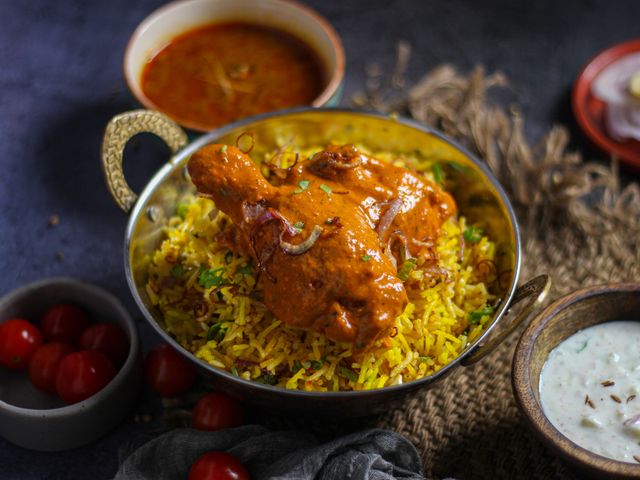
Find more like this
- Meal
- Dinner
- Cuisine
- Indian
- Main ingredient
- Chicken Thighs
- Diet
- HalalSugar-Free
- Method
- Stovetop
- Quick & Easy
- One-Pot