Korean Geotjeori Mixed Vegetable Banchan Pickle
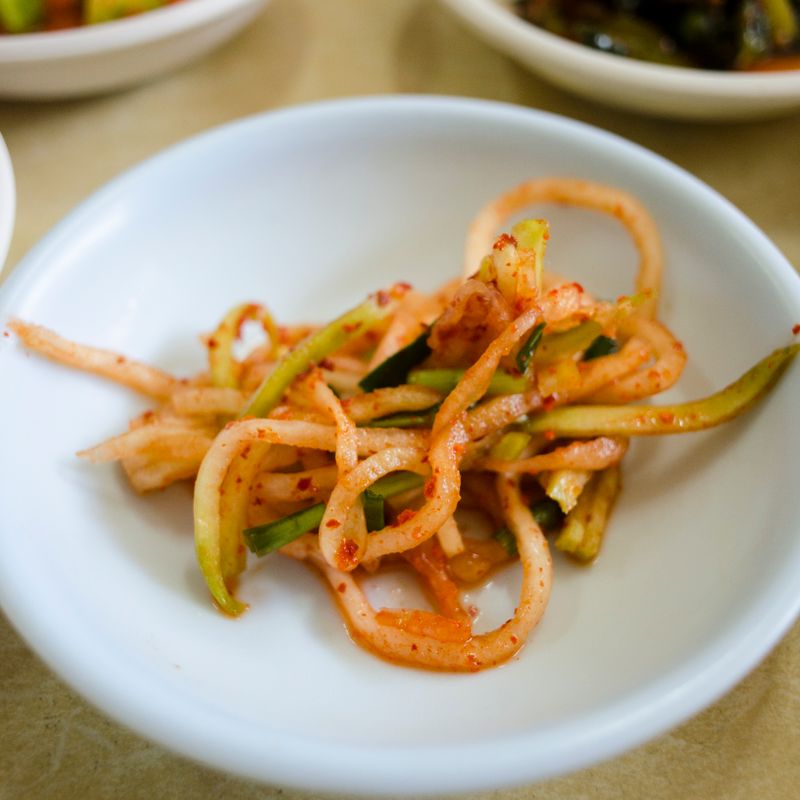
A bright, crunchy Korean banchan (side dish) of mixed vegetables tossed in a light soy-sesame dressing. Ready in minutes, geotjeori is crisp, tangy, and slightly sweet—perfect alongside rice and grilled meats. The vegetables stay firm and fresh-tasting, never soggy.
- Prep
- 15 min
- Cook
- —
- Wait
- 10 min
- Total
- 25 min
- Makes
- About 3 cups (720 ml)
Steps
Before you start
- Have all vegetables prepped and in a large mixing bowl
- Toast sesame seeds lightly in a dry skillet if not already toasted
- Use Korean soy sauce (ganjang) for authentic flavor; salty low-sodium soy works too
Prepare the vegetables
- Peel the daikon and cut it into 2-inch (5 cm) matchsticks about ¼ inch (6 mm) thick.
- Halve the cucumber lengthwise, scoop out the seeds with a spoon, and cut into 2-inch matchsticks of similar size.
- Peel the carrot and cut into matchsticks to match.
- Trim the green onions and slice into 2-inch pieces.
- Place all vegetables in a large 3-quart (3-liter) mixing bowl.
+ Show details− Hide details
Ready when: All vegetables are cut to uniform matchstick size and ready to season
Tip: Cut the vegetables roughly the same size so they absorb the dressing evenly and stay crisp. Removing cucumber seeds prevents excess water from diluting the flavor.
Make the dressing
- In a small bowl, whisk together 3 tablespoons (45 ml) soy sauce, 1 tablespoon (15 ml) rice vinegar, 1.5 teaspoons (7 ml) sesame oil, 1 minced garlic clove, ½ teaspoon (2 g) sugar, and ¼ teaspoon (0.5 g) red pepper flakes if using.
- Taste and adjust salt if needed (the soy sauce is salty, so usually none is needed).
+ Show details− Hide details
Ready when: Dressing is well combined and smells fragrant
Tip: Whisk the dressing in a separate bowl first so you can taste and adjust seasoning before combining with the vegetables.
Dress and toss the vegetables
- Pour the dressing over the vegetables in the bowl and toss gently but thoroughly with your hands or two spoons for about 1 minute, making sure every piece is coated.
- The vegetables will begin to release a little liquid; this is normal.
+ Show details− Hide details
Ready when: All vegetables are evenly coated with the glossy dressing
Tip: Toss gently to keep the vegetables crisp and avoid breaking them. Rough handling will make them limp.
Let it rest and finish
- Let the geotjeori sit at room temperature for 10 minutes.
- This allows the vegetables to soften slightly and the flavors to blend while still staying crisp.
- Just before serving, sprinkle with 1.5 tablespoons (15 g) toasted sesame seeds and toss once more.
+ Show details− Hide details
Ready when: Vegetables have softened a bit but still have a firm crunch; sesame seeds are distributed throughout
Tip: Don't refrigerate before serving if possible—geotjeori tastes best at room temperature or lightly chilled, when the vegetables are still crisp. If you must make ahead, add sesame seeds only just before serving so they stay crunchy.
Good to know
Tips
- For the crispest geotjeori, cut the vegetables no more than 30 minutes before serving and don't refrigerate until just before eating. Cold slows the wilting process.
- Korean soy sauce (ganjang) is thinner, saltier, and less sweet than Japanese shoyu; it's the traditional choice and gives the best flavor, but all-purpose soy sauce works fine.
- Toast your own sesame seeds in a dry skillet over medium heat for 2–3 minutes if they're not already toasted—it releases the oils and deepens the nutty flavor dramatically.
- Geotjeori is meant to be a bright, quick banchan, not a long-term pickle. Eat it fresh for the best texture and flavor.
Make ahead
Prepare and dress the vegetables up to 2 hours ahead. Hold at room temperature uncovered. Add sesame seeds just before serving so they don't soften.
Storage & reheating
Room temperature (uncovered): up to 4 hours. Refrigerate (covered): up to 2 days. The vegetables will soften and become more pickled over time but remain flavorful. Freeze: not recommended (vegetables lose their crisp texture when thawed). To reheat: serve chilled or at room temperature; do not heat.
Substitutions
- Japanese or Kirby cucumber → 1 medium zucchini or 1 English cucumber. Zucchini is softer and less crisp; English cucumber may be less astringent. Seed both the same way. The texture will be slightly less firm.
- unseasoned rice vinegar → apple cider vinegar or white vinegar. Use the same amount (1 tablespoon). Apple cider vinegar adds a slightly richer flavor; white vinegar is harsher. Both work.
- toasted sesame oil → Regular neutral oil or omit entirely. Sesame oil is essential for authentic flavor, but if unavailable, use a mild oil like vegetable or canola oil (reduces the nutty aroma) or skip it and add an extra pinch of salt.
- red pepper flakes (gochugaru or common red pepper flakes) → Fresh red chili, minced, or ½ teaspoon gochugaru (Korean chili powder). Gochugaru gives a more authentic Korean heat and color. Start with a pinch and adjust to taste.