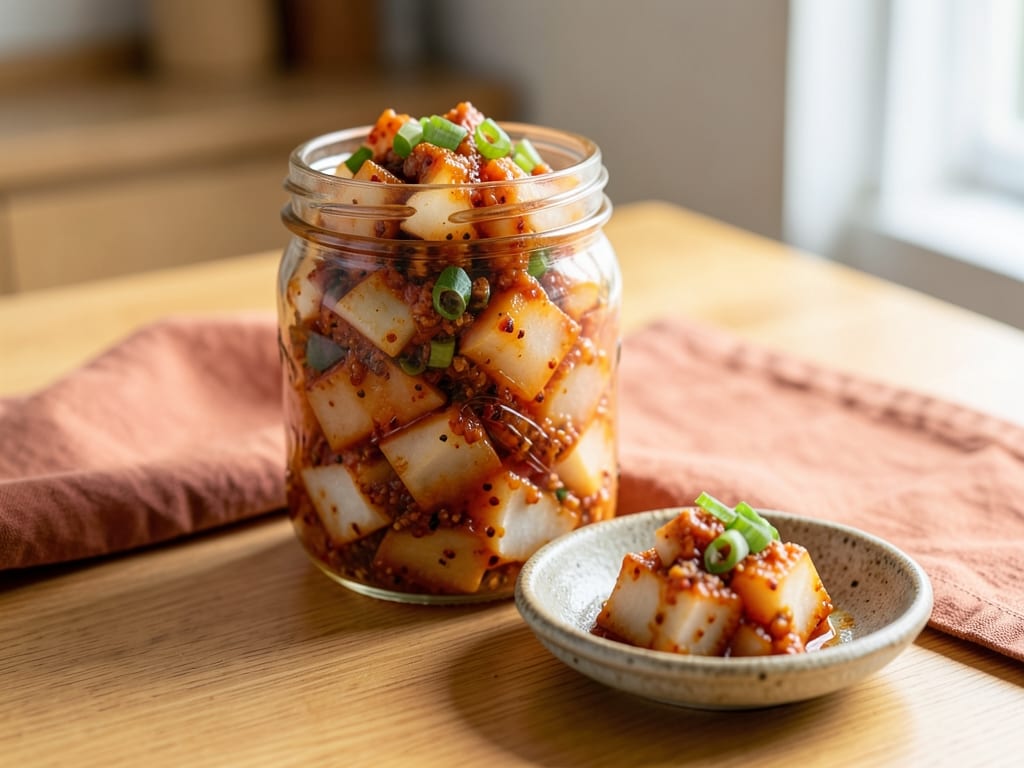
Kkakdugi (Korean Cubed Radish Kimchi)
Crunchy, juicy cubes of Korean radish coated in a garlicky, gingery chile paste with scallions. It's ready to eat after a day of fermenting and gets tangier and more complex over the following weeks.
- Prep
- 35 min
- Cook
- 5 min
- Wait
- 1.2 days
- Total
- 1.2 days
- Makes
- About 1.5 quarts (1.4 L), roughly 12 side-dish servings
Steps
Before you start
- Wash a 2-quart (2 L) glass jar or airtight container and its lid with hot soapy water, rinse well and let it air-dry.
- Buy Korean radish (mu), which is short, stout, pale green at the shoulder and very dense. Daikon works but is more watery.
- Use non-iodized salt (kosher or sea salt). Iodized salt can slow fermentation and taste harsh.
- Wear gloves when mixing: gochugaru will sting skin and stain.
- Plan for about 1 day at room temperature, then refrigeration. Read the timing: 40 minutes salting, 1 day fermenting.
Cube the radish
- Peel the radish, trimming any fibrous or woody spots.
- Cut into slabs ¾ inch (2 cm) thick, then into sticks, then into ¾-inch (2 cm) cubes.
- Place in the large mixing bowl.
+ Show details− Hide details
Ready when: Cubes are roughly uniform in size.
Tip: Even cubes ferment and crunch evenly.
Salt and sweeten
- Sprinkle the salt and sugar over the radish and toss with your hands.
- Let stand 30 minutes, tossing once or twice, so the radish releases liquid.
+ Show details− Hide details
Ready when: A pool of liquid sits at the bowl's bottom and cubes bend slightly but stay crisp.
Cook rice paste
- In the small saucepan, whisk the rice flour into the water until smooth.
- Cook over medium heat, stirring constantly, for 2 to 3 minutes until it thickens to a thin glue-like paste with a few bubbles.
- Remove from heat and cool for 10 minutes.
+ Show details− Hide details
Ready when: Paste coats the back of a spoon and looks translucent.
Tip: Keep whisking; rice flour scorches quickly.
Drain the radish
- Drain the radish in a colander, reserving 2 tablespoons (30 ml) of the salty liquid.
- Do not rinse.
- Return the cubes to the bowl.
+ Show details− Hide details
Ready when: No more liquid drips from the colander.
Color the radish
- Wearing gloves, add the gochugaru to the radish and toss for 1 minute until the cubes are evenly red-orange.
- Letting the chile coat the radish first gives the kimchi its signature color.
+ Show details− Hide details
Ready when: Every cube is evenly stained, with no white patches.
Mix the seasoning
- Add the cooled rice paste, fish sauce, salted shrimp if using, garlic, ginger, scallions and the reserved 2 tablespoons of liquid.
- Mix thoroughly with gloved hands for 1 to 2 minutes until everything is evenly coated.
+ Show details− Hide details
Ready when: Cubes are glossy and evenly coated, with scallions distributed throughout.
Tip: Taste a cube: it should be assertively salty and savory, since the radish will mellow it.
Pack the jar
- Pack the kimchi into the clean jar, pressing firmly with a clean spoon so the liquid rises around the cubes.
- Leave 1½ inches (4 cm) of headspace.
- Wipe the rim and close the lid loosely.
+ Show details− Hide details
Ready when: Brine covers or nearly covers the cubes with headspace remaining.
Tip: Headspace matters: fermenting kimchi bubbles up and can overflow.
Ferment at room temperature
- Set the jar on a plate away from direct sun at 65–72°F (18–22°C) for 24 hours.
- Once or twice, open the lid to release gas and press the cubes under the brine.
+ Show details− Hide details
Ready when: Small bubbles rise when pressed and it smells pleasantly tangy.
Tip: In a warm kitchen over 75°F (24°F), check after 12 to 18 hours.
Chill and mature
- Refrigerate.
- It is good to eat after 1 day, and the flavor peaks at 1 to 2 weeks as it turns tangier and the radish stays crunchy.
+ Show details− Hide details
Ready when: Pleasantly sour, crunchy and spicy.
Good to know
Tips
- Don't rinse the radish after salting; the surface salt and liquid season the kimchi.
- Use coarse gochugaru for the best color and texture. Fine powder gives a pasty, harsher result.
- Press the cubes beneath the brine each time you open the jar to prevent surface mold.
- If you see fuzzy mold or smell something rotten rather than tangy, discard the batch.
Make ahead
Best made 1 to 2 weeks before serving, after which it has developed full flavor. It keeps improving in the fridge.
Storage & reheating
Room temperature: 24 hours only, for the initial fermentation. Fridge: up to 4 weeks in an airtight jar, pressed under the brine; it becomes more sour over time. Freezer: not recommended because the radish loses its crunch. Serve cold, and older, very sour kkakdugi is excellent in stews and fried rice.
Substitutions
- Korean radish (mu) → daikon radish. Releases more water and is less dense; salt for 40 minutes and expect a milder flavor.
- fish sauce → soy sauce or vegan fish sauce. Use the same amount for a vegan version, and omit the salted shrimp.
- sweet (glutinous) rice flour → cooked rice, mashed (2 tbsp). Or use plain flour; each helps the seasoning cling.
- salted shrimp (saeujeot) → extra 1 tbsp fish sauce. Adds savory depth but a little less complexity.
More pickles & chutneys
See all →
Find more like this
- Meal
- Dinner
- Cuisine
- Korean
- Method
- Stovetop
- Quick & Easy
- EasyMake Ahead