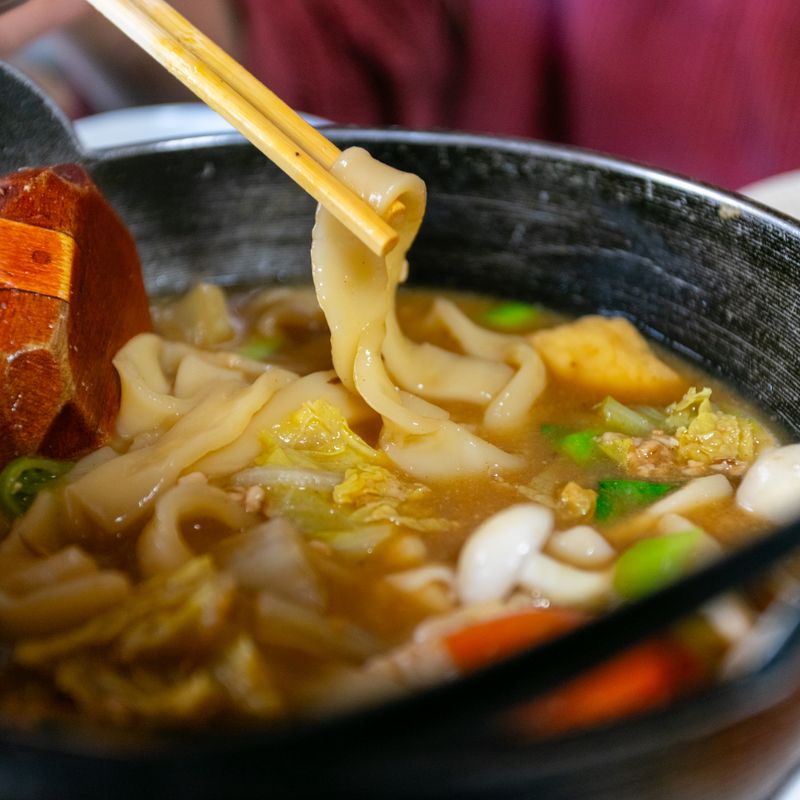
Japanese Dashi-Based Vegetable Noodle Soup
A light, aromatic noodle soup built on a delicate dashi foundation, studded with tender daikon radish, earthy shiitake mushrooms, sweet carrots, and bright scallions. The broth is gently simmered to let the umami-rich flavors develop, then tossed with chewy udon noodles for a warming, satisfying bowl that feels both simple and refined.
Steps
Before you start
- If using dried kombu and bonito flakes to make dashi, prepare it first so it cools slightly before combining with noodles (about 15 minutes ahead). Alternatively, use ready-made dashi stock to simplify. Bring a separate pot of water to a boil for cooking the udon noodles.
Prepare vegetables
- On a cutting board, peel and slice the daikon radish into ¼-inch thick half-moons.
- Remove the stems from shiitake mushrooms and halve or quarter the caps depending on size.
- Peel the carrot and cut it on the bias into ¼-inch thick ovals (about 2 inches long).
- Mince or finely grate the ginger.
- Slice the scallions, keeping the white and light green parts separate from the dark green tops.
- Set everything aside.
+ Show details− Hide details
Ready when: All vegetables are evenly cut and ready to cook
Tip: Cut vegetables into similar sizes so they cook evenly and create a visually balanced bowl.
Bring water to boil for noodles
- Fill a separate pot with 2.5 quarts (2.4 L) of water and bring it to a rolling boil over high heat.
- This will be used later to cook the udon noodles; keeping it separate ensures you have a rapid boil when needed.
+ Show details− Hide details
Ready when: Water is at a rolling boil
Build the broth base
- Pour the dashi stock into a 2-quart saucepan and set it over medium-high heat.
- Once small bubbles begin to form around the edges (do not let it boil), stir in the soy sauce, mirin, sake, and minced ginger.
- Stir gently for about 30 seconds to combine.
- Reduce heat to medium.
+ Show details− Hide details
Ready when: Broth is steaming and flavoring ingredients are fully dissolved
Tip: Do not boil the dashi vigorously; a gentle simmer preserves the delicate umami flavors.
Add harder vegetables
- Add the sliced daikon radish and carrot to the broth.
- Stir to distribute them evenly.
- Maintain a gentle simmer over medium heat and cook for 8–10 minutes, until the daikon begins to soften and becomes slightly translucent at the edges.
+ Show details− Hide details
Ready when: Daikon and carrot are fork-tender but still slightly firm; daikon shows slight translucency
Tip: Gentle simmering prevents the vegetables from becoming mushy and allows them to absorb the dashi flavor gradually.
Add mushrooms and scallion whites
- Stir in the shiitake mushroom pieces and the white and light green parts of the scallions.
- Simmer gently for another 3–4 minutes, stirring occasionally.
- The mushrooms will soften and release their earthy aroma into the broth.
+ Show details− Hide details
Ready when: Shiitake caps are tender and absorb the broth; no hard or rubbery texture remains
Tip: Adding mushrooms toward the end prevents them from becoming too soft; they should hold their shape.
Cook the udon noodles
- While the broth simmers, add the fresh or frozen udon noodles to your boiling water in the separate pot.
- Stir gently to separate them.
- Fresh noodles typically cook for 2–3 minutes; frozen noodles for 4–5 minutes.
- Follow package instructions if available.
- Drain the noodles in a colander and rinse briefly under warm water to remove excess starch, but do not chill them.
+ Show details− Hide details
Ready when: Noodles are al dente, tender but still slightly chewy; they float to the surface when fully cooked
Tip: Do not overcook udon noodles; they should have a firm bite. Rinsing removes starch but keeping them warm prevents them from sticking together.
Taste and adjust seasoning
- Carefully taste a spoonful of the hot broth.
- The flavor should be well-balanced—savory and slightly sweet with subtle ginger warmth.
- If needed, add a pinch of salt to brighten the flavors, or a small splash of soy sauce for depth.
- Stir gently and taste again.
- Adjust until you're satisfied.
+ Show details− Hide details
Ready when: Broth tastes balanced and flavorful
Tip: Season conservatively at first; you can always add more, but you cannot remove it.
Assemble bowls
- Divide the warm cooked udon noodles evenly among 4 bowls, placing them in the center.
- Ladle the hot broth and vegetables over the noodles, distributing the daikon, carrot, and shiitake pieces evenly.
- Aim for roughly 1.5 cups (360 ml) of broth per bowl and an even amount of vegetables in each.
+ Show details− Hide details
Ready when: Bowls are full and attractively arranged
Tip: Use warmed bowls if available; this keeps the soup hot longer and makes for a more pleasant eating experience.
Garnish and serve
- Top each bowl with the reserved dark green scallion tops, dividing them evenly.
- If using sesame oil, drizzle a very small amount (¼ teaspoon per bowl) over the surface for a subtle nutty aroma.
- Serve immediately while the soup is steaming hot.
+ Show details− Hide details
Ready when: Bowls are garnished and ready to serve
Tip: Fresh scallion greens add color, freshness, and a mild onion bite; add them just before serving so they retain their crisp texture.
Good to know
Tips
- If you cannot find fresh dashi, instant dashi powder (hon-dashi) works well: dissolve 2–3 teaspoons in 6 cups of hot water for a quick, reliable base.
- For extra richness and umami, add a 2-inch square of kombu to the broth as it simmers; remove it after 2 minutes.
- Bite into a piece of daikon as it cooks to gauge doneness; it should soften gradually from the outside in, not fall apart.
- If the broth tastes too strong, thin it slightly with a splash of warm water; if it tastes weak, add a pinch of salt or a teaspoon of soy sauce.
Make ahead
Dashi stock can be made up to 3 days ahead and stored in the refrigerator. The vegetables can be prepped 4 hours ahead and stored in an airtight container in the fridge. Assemble the soup no more than 5 minutes before serving for best texture and temperature.
Storage & reheating
Store leftover soup (in separate containers: broth with vegetables separate from noodles) in the refrigerator for up to 2 days. The noodles will absorb broth and soften over time. To reheat, gently warm the broth and vegetables in a pot over medium heat, then add cooked noodles (reheat them separately or in the broth for 1 minute). Do not freeze; the texture of the noodles and delicate vegetables deteriorates significantly.
Substitutions
- dashi stock (or homemade from kombu and bonito flakes) → chicken or vegetable broth (unsalted or low-sodium). The soup will be lighter and less umami-rich, but still satisfying. Use the same quantity and adjust soy sauce and mirin to taste.
- fresh or frozen udon noodles → ramen noodles, soba noodles, or fettuccine pasta. Soba offers an earthy, nutty flavor; ramen provides a chewier texture. Adjust cooking time according to package directions.
- daikon radish → turnip or additional carrot. Turnips are mild and slightly sweet; carrots will make the soup sweeter overall. Use the same weight.
- shiitake mushrooms → cremini, oyster, or enoki mushrooms. Cremini offers earthiness; oyster has a delicate texture; enoki are very mild. If using enoki, add them in the last minute of cooking.