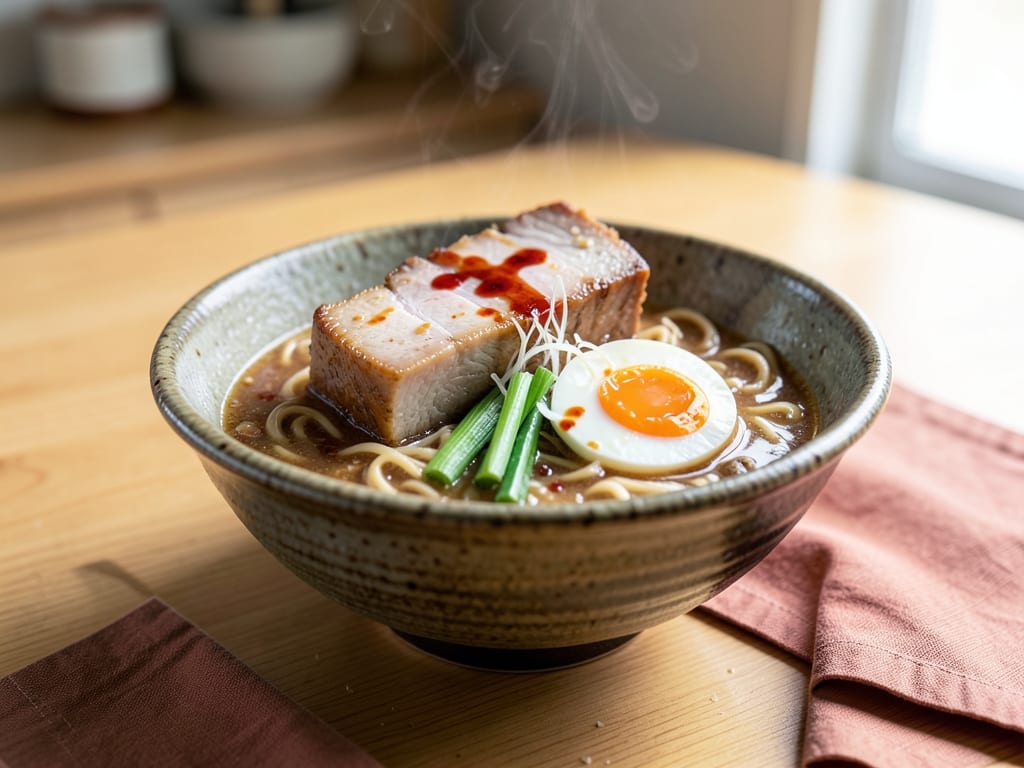
Homemade Ramen with Soft-Boiled Eggs
A bowl of chicken-based shoyu ramen with soy-braised pork belly, jammy soft-boiled eggs, and fresh scallions. The pork braises on the stove while a ginger, garlic and shiitake broth simmers next to it. Every part is made from scratch, with no special equipment.
- Prep
- 30 min
- Cook
- 2 hr 3 min
- Wait
- 20 min
- Total
- 2 hr 53 min
- Makes
- 4 large bowls of ramen
Steps
Before you start
- Read the timeline first. The pork braises for 90 minutes total, and the broth simmers during the last 30 minutes of that, so you will have two pots going at once.
- Take the eggs out of the fridge only when you are ready to cook them. Cold eggs lowered into boiling water give the most consistent jammy yolks.
- Buy fresh ramen noodles from the refrigerated section of an Asian market or well-stocked grocery store. Check the package for cooking time. Most take 2 to 3 minutes.
- Have a bowl of ice water ready before the eggs finish cooking. Timing is tight at the end.
- Warm four large soup bowls (about 24 oz / 700 ml each) by filling them with hot tap water while you cook the noodles, then empty them just before seasoning, so the ramen stays hot.
Prep the aromatics
- Smash and peel the garlic cloves.
- Slice the ginger into ¼-inch (6 mm) rounds, leaving the skin on.
- Trim the 2 scallions for the broth and cut them into 3-inch (7.5 cm) lengths.
- Thinly slice the 4 scallions for topping on a diagonal and refrigerate them.
- Cut each nori sheet in half.
- Quickly rinse the dried shiitake under cold water.
- Keep the braise aromatics (2 garlic, 3 ginger slices) separate from the broth aromatics (3 garlic, 4 ginger slices, scallion lengths, shiitake).
+ Show details− Hide details
Ready when: Everything is sliced and sorted into two groups, braise and broth, with the topping scallions chilled.
Tip: Leave the ginger unpeeled. The skin adds flavor and you will strain it out anyway.
Sear the pork belly
- Set a heavy 3-quart (2.8 L) lidded saucepan or small Dutch oven over medium-high heat and add the oil.
- When the oil shimmers, add the pork belly fat-side down.
- Sear for 3 minutes, then flip and sear the other broad side for 3 minutes.
- Sear each narrow end for 1 minute.
- Turn the heat off and pour off any more than 1 tablespoon of rendered fat.
+ Show details− Hide details
Ready when: All sides are deep golden brown, with the fat rendering and sizzling.
Tip: Pat the pork very dry first. Wet meat steams instead of browning and the oil will spatter.
Start the braise
- Return the pot to the stove.
- Add the soy sauce, mirin, sugar, 1 cup (240 ml) water, the 2 smashed garlic cloves and 3 ginger slices.
- Bring to a bare simmer over medium heat, then reduce to low and cover.
- Cook at a lazy simmer with only a few bubbles breaking the surface.
- After 30 minutes, flip the pork.
- Continue to 60 minutes total, then move straight to the broth step.
- The pork keeps cooking for another 30 minutes.
+ Show details− Hide details
Ready when: The liquid barely bubbles and comes about halfway up the pork. A paring knife meets slight resistance at this point.
Tip: If the liquid is boiling hard, the pork will turn tough and the liquid will reduce too fast. Lower the heat or tilt the lid slightly.
Simmer the broth
- In a 4-quart (3.8 L) pot, combine the chicken broth, 3 smashed garlic cloves, 4 ginger slices, scallion lengths and dried shiitake.
- Bring to a simmer over medium-high heat, then reduce to medium-low and simmer for 30 minutes with the lid off, with small bubbles around the edges.
- Meanwhile, the pork finishes its 90-minute braise.
- At 90 minutes total, a skewer should slide through the thickest part of the pork with almost no resistance.
+ Show details− Hide details
Ready when: The broth smells strongly of ginger and mushroom and has reduced slightly. The pork is fork-tender (about 195°F / 90°C inside).
Tip: Keep the broth at a gentle simmer, not a rolling boil. A hard boil makes the broth cloudy and can make it taste harsh.
Rest, slice and strain
- Turn off the heat under both pots.
- Transfer the pork to a cutting board and rest it for 15 minutes.
- Leave the braising liquid in the pot (about ½ cup / 120 ml, syrupy).
- Strain the broth through a fine-mesh sieve into a clean pot, discarding the solids.
- Cover the broth to keep it warm.
- Fill a 5-quart (4.7 L) pot with 12 cups (2.8 L) water and put it on high heat to boil for the noodles.
- After the rest, slice the pork across the width into ¼-inch (6 mm) slices and return the slices to the braising liquid.
- Cover and keep warm.
+ Show details− Hide details
Ready when: The pork holds its shape when sliced and the strained broth is clear and golden.
Tip: Slice with a sharp knife and a gentle sawing motion. Belly slices more cleanly after a rest and tears if cut straight off the heat.
Boil the eggs
- Bring 3 cups (700 ml) water to a full rolling boil in a 1½-quart (1.4 L) saucepan over medium-high heat.
- Use a large spoon to lower the 4 cold eggs into the water one at a time.
- The water should cover them by at least ½ inch (1 cm).
- Start a timer for 6½ minutes at once and keep the water at a steady gentle boil.
- Make sure the ice bath is within arm's reach.
+ Show details− Hide details
Ready when: After 6½ minutes the whites will be set and the yolks soft and jammy, once chilled and cut open.
Tip: Do not drop the eggs in. They crack on the bottom of the pan. Lower them in on a spoon.
Chill and peel eggs
- When the timer goes off, lift the eggs out with a slotted spoon and put them straight into the ice water.
- Let them cool for 5 minutes to stop the cooking.
- Tap each egg gently all over on the counter, then peel under a thin stream of cold running water, starting at the wider end.
- Halve the eggs lengthwise with a sharp knife just before serving.
+ Show details− Hide details
Ready when: The eggs are cold to the touch and the shells come off in big pieces. The yolks are deep orange with a glossy, slightly runny center.
Tip: If the yolk looks chalky and pale yellow all the way through, the eggs went too long. Next time cut 30 seconds.
Warm broth and season bowls
- Reheat the strained broth over medium heat for 4 to 5 minutes until steaming and just starting to simmer.
- Empty the warming bowls of hot water.
- Into each of the 4 bowls, add 1 tablespoon (15 ml) soy sauce and 1 teaspoon toasted sesame oil.
- Taste the hot broth.
- It should taste well seasoned once combined with the soy in the bowl.
- You can stir in a splash of the braising liquid for extra depth.
+ Show details− Hide details
Ready when: Broth is steaming hot with small bubbles at the edge, at least 185°F (85°C).
Tip: Broth that tastes slightly too light by itself will be right once it meets the soy in the bowl. Season in the bowl, not in the pot.
Cook the noodles
- Check that the noodle water is at a full rolling boil.
- Add the 4 portions of noodles and stir right away to separate the strands.
- Cook following the package time, usually 2 to 3 minutes.
- Drain well in a colander, shaking off as much water as possible.
- Work quickly because noodles soften fast.
+ Show details− Hide details
Ready when: Noodles are springy and slightly chewy with no raw, floury center when you bite one.
Tip: Cook the noodles last and do not rinse them. Extra water dilutes the soup, and starch on the surface helps the broth cling.
Assemble and serve
- Divide the drained noodles among the 4 seasoned bowls and loosen them with chopsticks.
- Ladle about 2 cups (475 ml) of hot broth into each bowl.
- Arrange the pork slices on one side and 2 egg halves on the other.
- Top with the sliced scallions and a nori rectangle tucked against the side of the bowl.
- Drizzle with chili oil if using.
- Serve right away.
+ Show details− Hide details
Ready when: The bowls are steaming with noodles submerged just below the broth and the toppings sit above the surface.
Tip: Add the nori at the last second. It goes soft within a couple of minutes in hot broth.
Good to know
Tips
- Don't skip straining the broth. Straining gives a clear, clean-tasting broth instead of a cloudy one.
- Eggs vary with size and altitude. For a runnier yolk use 6 minutes, for a firmer jammy yolk 7 minutes. Soft yolks are not fully cooked, so use pasteurized eggs for young children, pregnant people, older adults, or anyone immunocompromised.
- Use a pot that holds the pork snugly. A wide pan makes the small amount of liquid evaporate too quickly.
- Spoon a little of the braising liquid over the sliced pork, or into the bowl, for extra savory-sweet flavor.
Make ahead
The pork belly, broth and eggs can all be made up to 3 days ahead. Store the pork slices in their braising liquid, the strained broth, and the peeled eggs in separate airtight containers in the fridge. Reheat the broth and pork gently, then cook fresh noodles just before serving. The eggs can be added cold or warmed for 1 minute in the hot broth.
Storage & reheating
Store the components separately; do not store noodles in the broth. Refrigerate broth and pork in airtight containers for up to 4 days, and peeled soft-boiled eggs for up to 2 days. Freeze the broth for up to 3 months and the pork in its braising liquid for up to 2 months; do not freeze the eggs. Thaw in the fridge overnight. Reheat broth and pork in a pot over medium-low heat until steaming (165°F / 74°C), 5 to 8 minutes. Cooked noodles do not keep well, so cook them fresh.
Substitutions
- fresh ramen noodles → dried ramen noodles, 12 oz (340 g). Cook according to package directions, usually 4 to 5 minutes. Discard any flavor packets.
- mirin → dry sherry or dry white wine plus a pinch of sugar. Use 3 tablespoons (45 ml) sherry plus ½ teaspoon extra sugar. The braise will be slightly less sweet.
- skinless pork belly → boneless pork shoulder, cut into 2 pieces. Braise 2 to 2½ hours until fork-tender. It is leaner, so keep it in the braising liquid to stay moist.
- dried shiitake mushrooms → 4 fresh shiitake stems or 1 tablespoon (15 ml) extra soy sauce. Dried shiitake adds a deep savory note. Fresh stems give less, so season to taste.
More noodle soups
See all →

Find more like this
- Meal
- Dinner
- Cuisine
- Japanese
- Diet
- Dairy-Free
- Method
- Stovetop