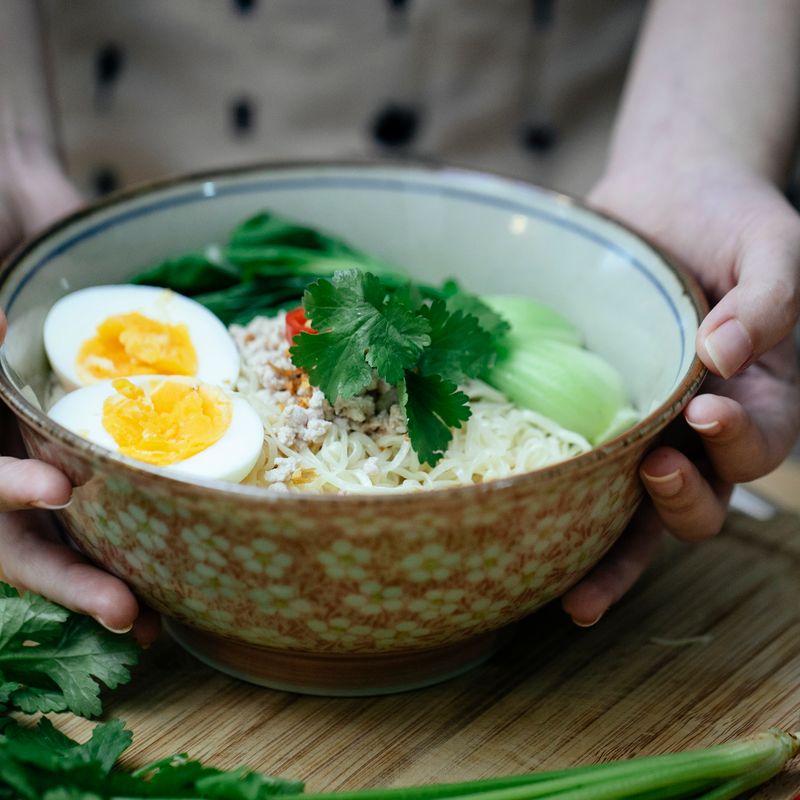
Tantanmen Ramen with Spicy Pork and Bok Choy
A Japanese-style take on dan dan noodles: a creamy sesame-miso broth, savory chili-spiked ground pork, tender bok choy and springy ramen noodles. Rich, nutty and warming, and ready in about 50 minutes.
- Prep
- 20 min
- Cook
- 25 min
- Wait
- 5 min
- Total
- 50 min
- Makes
- 4 large bowls
Steps
Before you start
- Have all ingredients chopped and measured before you turn on the heat; the pork and broth come together quickly.
- Use unsweetened Japanese sesame paste (neri goma) or tahini; do not use sesame oil in its place.
- Bring a separate large pot of water to a boil for the noodles and bok choy. Do not cook noodles in the broth, as the starch will cloud it.
- Chili oil heat varies widely; start with the lower amount and add more at the table.
Boil noodle water
- Fill a 5-quart (5 L) pot about three-quarters full with water and bring to a rolling boil over high heat.
- Leave it uncovered and unsalted or lightly salted, as the broth is already seasoned.
- If you like, warm four ramen bowls by filling them with hot tap water, then empty them just before assembling.
+ Show details− Hide details
Ready when: Water is at a full rolling boil
Tip: Start this first so it is ready when the broth finishes.
Brown the pork
- Heat the neutral oil in a wok or 12-inch (30 cm) skillet over medium-high heat until it shimmers.
- Add the ground pork and break it into small crumbles with a spatula.
- Cook, stirring only occasionally, for 6 to 7 minutes until the liquid evaporates and the pork is browned with crisp edges.
+ Show details− Hide details
Ready when: Pork is deeply browned, with crisp edges and no visible pink or liquid; internal temperature is at least 160°F (71°C)
Tip: Don't crowd or stir constantly, or the pork will steam instead of browning.
Season the pork
- Push the pork to one side and add the garlic, ginger and doubanjiang to the cleared space.
- Stir 30 seconds until fragrant and the oil turns red.
- Mix into the pork, then add the soy sauce, sake and sugar.
- Cook 1 to 2 minutes until the pan is nearly dry and glossy.
- Scrape into a bowl and keep warm.
+ Show details− Hide details
Ready when: Pork looks glossy and almost dry, with a rich savory-spicy smell
Tip: Lower the heat if the garlic starts to darken; burnt garlic turns bitter.
Heat the stock
- In a 3-quart (3 L) saucepan, combine the chicken stock and grated garlic.
- Bring to a gentle simmer over medium heat, about 4 minutes, with small bubbles around the edges.
+ Show details− Hide details
Ready when: Small bubbles break around the edge of the pan
Whisk the sesame base
- In a medium bowl, whisk the sesame paste and miso with about 1/2 cup (120 ml) of the hot stock until completely smooth, then whisk in the soy sauce.
- Pour this back into the saucepan and stir well.
+ Show details− Hide details
Ready when: No lumps of paste remain and the broth looks creamy and uniform
Tip: Thinning the thick paste with a little stock first prevents lumps.
Finish the broth
- Reduce the heat to medium-low and pour in the soy milk.
- Warm for 4 to 5 minutes, stirring now and then, until steaming and hot throughout, about 175°F (80°C).
- Stir in the rice vinegar and toasted sesame oil.
- Taste and add a splash more soy sauce if needed.
- Keep warm on low.
+ Show details− Hide details
Ready when: Broth is steaming and creamy, with no bubbling at the surface
Tip: Do not let it boil after adding soy milk, or it may curdle and separate.
Cook the bok choy
- Add the bok choy halves to the boiling water and cook 1 to 2 minutes until the stems are bright green and just tender.
- Lift out with tongs or a strainer, drain well and set aside, keeping the water at a boil.
+ Show details− Hide details
Ready when: Leaves are vivid green and the thick stems pierce easily with a knife tip
Tip: Pull it out early; it keeps cooking from residual heat.
Cook the noodles
- Add the loosened noodles to the boiling water and cook according to the package, usually 2 to 3 minutes for fresh noodles (4 to 5 for dried), stirring once or twice.
- Drain thoroughly in a strainer, shaking off all the water.
+ Show details− Hide details
Ready when: Noodles are springy with a slight bite in the center but no raw white core
Tip: Drain very well; extra water dilutes the broth.
Assemble the bowls
- Divide the noodles among four warm bowls.
- Ladle about 1 1/2 cups (355 ml) hot broth into each bowl.
- Top with a quarter of the pork, two bok choy halves, and the scallions.
- Drizzle 1 teaspoon chili oil over each bowl and sprinkle with sesame seeds if using.
- Serve immediately with extra chili oil at the table.
+ Show details− Hide details
Ready when: Bowls are steaming, with noodles submerged and toppings arranged on top
Tip: Serve right away; the noodles keep absorbing broth and soften as they sit.
Good to know
Tips
- For a richer, more traditional broth, replace 1 cup (240 ml) of the stock with pork or tonkotsu-style stock.
- Add 1/2 teaspoon ground Sichuan peppercorn to the pork for the tingling, numbing flavor found in many tantanmen.
- Taste the broth before serving: if too thick, thin with a splash of hot stock; if flat, add a little more soy sauce or vinegar.
- Add a soft-boiled egg (cooked 6 1/2 minutes) for extra richness.
Make ahead
The spicy pork and the sesame broth can be made up to 3 days ahead and refrigerated separately. Reheat the broth gently over medium-low heat without boiling. Cook the noodles and bok choy fresh just before serving.
Storage & reheating
Store the pork and broth separately in airtight containers in the fridge for up to 3 days, and freeze the pork up to 2 months. Broth can be frozen up to 1 month, though the texture may be slightly less smooth; whisk while reheating. Reheat the broth over medium-low heat until steaming (do not boil) and the pork in a skillet over medium heat until hot throughout. Leftover cooked noodles don't keep well, so cook noodles fresh.
Substitutions
- ground pork → ground chicken, turkey or crumbled firm tofu. Poultry will be leaner, so add an extra teaspoon of oil; cook to 165°F (74°C) for poultry.
- doubanjiang (chili bean paste) → 1 tablespoon miso plus 1 teaspoon sriracha or chili flakes. Less complex and fermented but still savory and spicy.
- unsweetened soy milk → unsweetened oat milk or additional chicken stock. Stock gives a lighter, thinner broth.
- baby bok choy → spinach or baby choy sum. Spinach needs only 20 to 30 seconds in the boiling water.
More noodle soups
See all →

Find more like this
- Meal
- Dinner
- Cuisine
- Japanese
- Main ingredient
- Ground Pork
- Diet
- Dairy-Free
- Method
- Stovetop
- Quick & Easy
- Easy