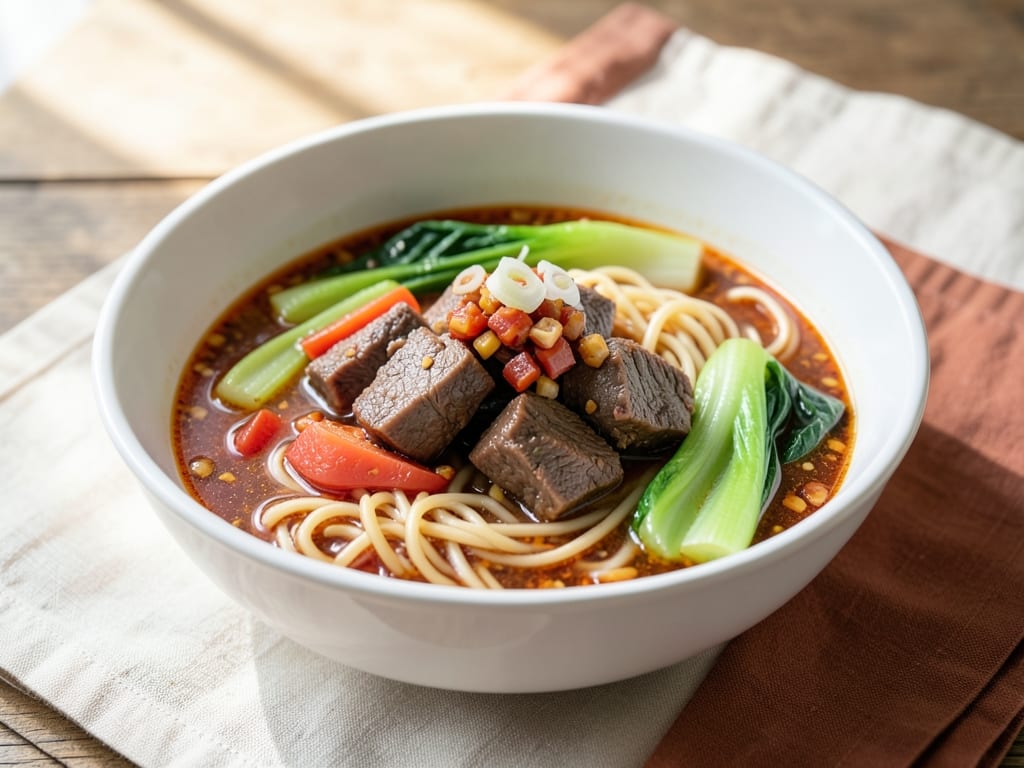
Taiwanese Beef Noodle Soup (Hong Shao Niu Rou Mian)
Tender chunks of beef shank are braised for hours in a deeply savory, mildly spicy broth built on doubanjiang, soy sauce, tomato and warm spices, then ladled over chewy wheat noodles and crisp-tender bok choy.
- Prep
- 45 min
- Cook
- 3 hr 10 min
- Wait
- 20 min
- Total
- 4 hr 15 min
- Makes
- 6 large bowls (about 1½ cups broth, 4–5 pieces of beef and 115 g noodles each)
Steps
Before you start
- Plan on about 4¼ hours start to finish; nearly 2½ hours of that is hands-off braising on the stovetop (no oven needed).
- Doubanjiang (fermented chili-broad bean paste) varies a lot in saltiness, so measure it as written and adjust salt only at the end. Look for a Pixian brand in Asian markets.
- Ask your butcher for whole beef shank (bone-in or boneless), or buy it already cut. Cut pieces should be large (about 2 inches / 5 cm) because they shrink as they braise.
- Use a heavy 5½–6 quart (5–6 L) lidded pot so the beef is mostly submerged during braising.
- Have fresh noodles on hand, or dried thick wheat noodles as a backup. Cook them only just before serving.
Blanch the beef
- Put the beef chunks in the 4–5 quart (4–5 L) pot and add the 8 cups (1.9 L) cold blanching water so the meat is fully covered.
- Set over high heat and bring to a boil, which takes about 10 minutes.
- Reduce to medium and simmer for 3–4 minutes, skimming off the gray foam that rises.
+ Show details− Hide details
Ready when: Heavy gray-brown foam has risen and been skimmed, and the beef surface looks gray and firm.
Tip: Starting in cold water draws out blood and impurities so the final broth is rich but clear, not murky.
Rinse and drain
- Drain the beef into a colander in the sink and rinse each piece under warm running water, rubbing off any scum.
- Discard the blanching water, then wipe out the pot you'll use for braising.
- Pat the beef fairly dry with paper towels.
+ Show details− Hide details
Ready when: Beef pieces are clean with no clinging foam, and the surface feels tacky rather than wet.
Fry the aromatics
- Heat the oil in the clean 5½–6 quart (5–6 L) braising pot over medium heat until it shimmers, about 1 minute.
- Add the ginger, garlic, scallion lengths, star anise, cinnamon, Sichuan peppercorns, bay leaves and dried chilies (if using).
- Stir often for 3–4 minutes.
+ Show details− Hide details
Ready when: The kitchen smells strongly of ginger and spice, and the garlic and scallions are lightly golden at the edges.
Tip: If the garlic darkens past golden brown, lower the heat. Burnt garlic makes the broth bitter.
Fry the doubanjiang
- Push the aromatics to the sides, add the doubanjiang to the center and fry, stirring and mashing it into the oil, for 2 minutes.
- Stir everything together.
+ Show details− Hide details
Ready when: The oil turns deep red and the paste smells toasty and fragrant, not raw.
Tip: Frying the paste in oil is what gives the broth its deep red color and rounded, non-harsh flavor. Don't skip it.
Cook tomatoes and deglaze
- Add the tomato wedges and rock sugar.
- Cook, stirring, for 4–5 minutes until the tomatoes begin to collapse.
- Pour in the Shaoxing wine, scrape up any browned bits from the bottom of the pot, and let it bubble for 1 minute.
+ Show details− Hide details
Ready when: Tomatoes are slumped and softened, the sugar has dissolved, and the sharp smell of alcohol has mostly cooked off.
Add beef and liquids
- Add the blanched beef, regular soy sauce, dark soy sauce and the 8½ cups (2 L) braising water.
- Stir well.
- The liquid should come almost to the top of the beef; add a little more hot water if the meat is exposed.
- Raise the heat to high and bring to a boil, skimming any foam.
+ Show details− Hide details
Ready when: The liquid is at a steady boil and has taken on a deep reddish-brown color.
Braise until tender
- Reduce the heat to low so the liquid barely bubbles, with only a few lazy bubbles breaking the surface.
- Cover with the lid slightly ajar.
- Braise for 2 to 2½ hours, stirring gently every 30 minutes.
- Start checking at 2 hours by piercing a piece with a fork.
+ Show details− Hide details
Ready when: A fork slides into the thickest piece with almost no resistance and the meat is just holding together. Internal temperature is about 200°F (93°C).
Tip: A hard boil makes the beef tough and the broth cloudy. Keep it at the barest simmer.
Rest and skim
- Turn off the heat and let the beef rest in the broth, uncovered, for 20 minutes.
- Use a ladle to skim excess fat from the surface (leave a little for flavor).
- The beef reabsorbs juices and firms slightly so it slices cleanly.
+ Show details− Hide details
Ready when: The surface fat has pooled and been skimmed, and the beef is cool enough to handle.
Strain and season
- Lift the beef onto a cutting board with a slotted spoon.
- Pour the broth through a fine-mesh strainer into a clean pot and discard the solids.
- Cut the beef into ½-inch (1.25 cm) thick slices or leave in large bite-size chunks, trimming any tough bits of silver skin.
- Return the beef to the broth and warm over low heat.
- Taste the broth and add kosher salt, ½ teaspoon at a time, until well seasoned.
+ Show details− Hide details
Ready when: The broth tastes savory and balanced, slightly sweet and spicy, and the beef is hot throughout.
Tip: Season the broth strongly enough that it will still taste good once diluted by the noodles.
Cook bok choy and noodles
- Bring the 13 cups (3 L) cooking water to a rolling boil over high heat.
- Add the bok choy halves and cook for 1–2 minutes, then lift out with a slotted spoon into a bowl.
- Add the noodles to the same water and cook following the package directions, usually 3–5 minutes for fresh noodles, stirring once or twice.
- Drain well.
+ Show details− Hide details
Ready when: Bok choy stems are bright green and just tender when pierced; noodles are chewy with no raw, floury center when you bite one.
Tip: Cook the noodles separately from the soup. Cooking them in the broth clouds it and makes it starchy.
Assemble the bowls
- Divide the noodles among 6 warmed bowls.
- Top each with 4–5 pieces of beef and 2 bok choy halves.
- Ladle about 1½ cups (360 ml) of piping hot broth into each bowl.
- Garnish with scallion greens, and with pickled mustard greens, cilantro and a drizzle of chili oil if using.
- Serve right away.
+ Show details− Hide details
Ready when: Broth is steaming hot and the noodles are fully submerged and loose, not clumped.
Tip: Warm the bowls with hot tap water first so the soup stays hot longer at the table.
Good to know
Tips
- Keep some tendon and silver skin on the shank. It becomes soft and gelatinous during braising and gives the dish its signature texture.
- For a milder soup, use 2 tablespoons of doubanjiang and skip the dried chilies. For more heat, add chili oil at the table.
- Braise at a bare simmer. If the pot boils vigorously, the beef toughens and the broth turns cloudy.
- Don't rush the rest in step 8; sliced too hot, shank crumbles instead of holding its shape.
Make ahead
The braised beef and broth are even better made 1–2 days ahead. Complete through step 9, cool, and refrigerate the beef in the broth. Lift off the solidified fat before reheating. Cook the noodles and bok choy fresh just before serving.
Storage & reheating
Cool the beef and broth within 2 hours. Store in an airtight container in the refrigerator for up to 4 days, or freeze for up to 3 months (leave 1 inch / 2.5 cm headspace). Do not store noodles in the broth. Thaw frozen soup overnight in the refrigerator, then reheat gently in a pot over medium-low heat until steaming hot (165°F / 74°C), about 10–15 minutes. Cooked noodles keep 2 days refrigerated, but are best cooked fresh.
Substitutions
- beef shank → boneless beef chuck or beef short rib, same weight. Chuck is slightly less gelatinous; braise 2–2½ hours. Short rib is richer, so skim more fat.
- Shaoxing rice wine → dry sherry. Use the same amount. Avoid salted 'cooking wines', which add excess salt.
- rock sugar (or light brown sugar) → light brown sugar. Use the same weight. The flavor is slightly more molasses-like.
- fresh thick wheat noodles (or 10 oz / 285 g dried) → dried thick wheat noodles or udon. Use about 285 g (10 oz) dried for 6 bowls and cook per package directions.
More noodle soups
See all →
Find more like this
- Meal
- Dinner
- Cuisine
- Chinese
- Main ingredient
- Beef Roast
- Diet
- Dairy-Free
- Method
- Stovetop
- Season
- Winter Comfort Food