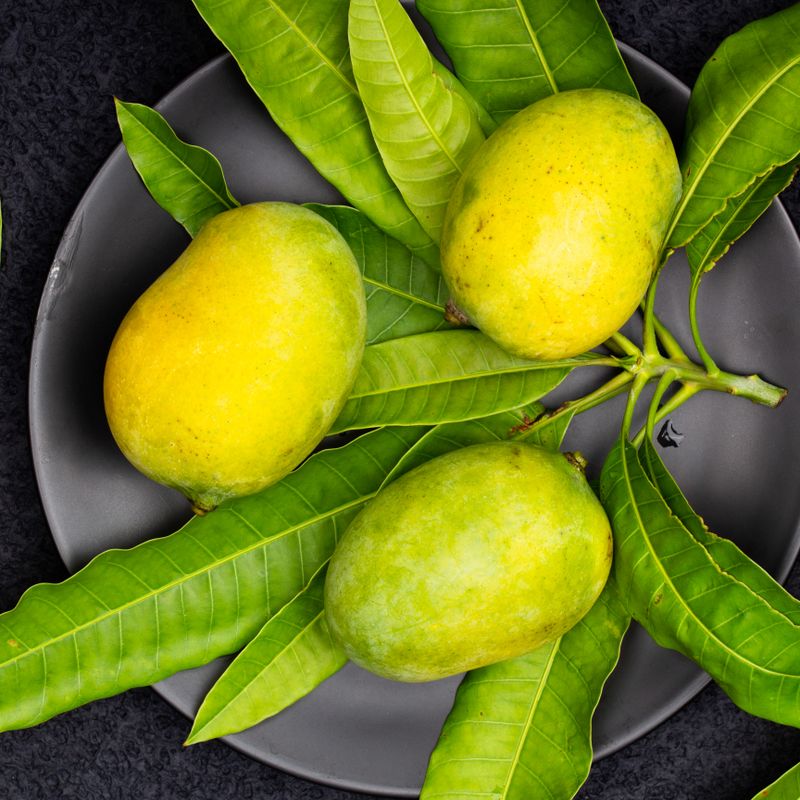
Indian Achaar Mango with Black Salt and Asafoetida
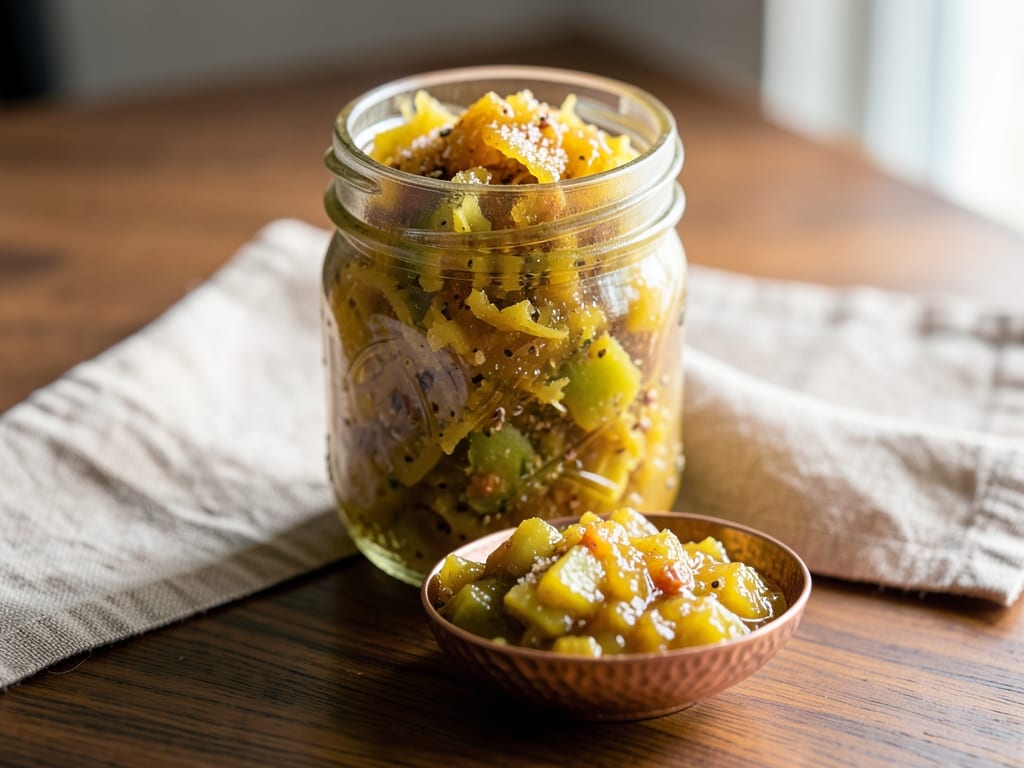
A pungent, tangy fermented mango pickle from Northern India. Green mangoes are cut into wedges, salt-cured, and infused with black salt, asafoetida, mustard seeds, and fenugreek in warm oil. Over days of fermentation, the flavors deepen and meld. Serve as a condiment with rice, dhal, or flatbread—a small spoonful adds sharp, funky complexity to any meal.
- Prep
- 25 min
- Cook
- 5 min
- Wait
- 1 days
- Total
- 1 days
- Makes
- 1 jar (2 cups / 500 ml); about 16 servings of 2 tablespoons each
Steps
Before you start
- Use firm, unripe (green) mangoes—they should resist pressure when squeezed
- Have a clean, dry glass jar with a tight-fitting lid ready (1-liter / 1-quart capacity or larger)
- Do not use iodized salt; black salt and pickling salt are best
- Choose a warm, dry spot indoors (70–80°F / 21–27°C) for fermentation
Prepare the mangoes
- Wash and thoroughly dry the green mangoes.
- Using a sharp knife, cut each mango lengthwise on either side of the pit to create 2 large pieces per mango.
- Cut each piece lengthwise again to form 4 long wedges per mango (8 wedges total per mango).
- You should have 32 wedges.
- Pat them dry with a clean cloth—any excess moisture will dilute the brine and slow fermentation.
+ Show details− Hide details
Ready when: Mangoes cut into uniform long wedges; completely dry
Tip: Do not remove the skin—it helps the mango hold its shape during fermentation
Salt the mangoes
- Combine the black salt (30 g / 2 tablespoons) and pickling salt (23 g / 1.5 tablespoons) in a small bowl.
- In a clean glass jar, layer the mango wedges with the salt mixture, sprinkling salt between layers and ensuring all surfaces are coated.
- Pack them snugly so they are submerged by their own juices.
- Cover loosely and set aside in a warm spot (70–80°F / 21–27°C) for 12 hours.
- The mangoes will release liquid and soften slightly.
+ Show details− Hide details
Ready when: Mangoes have released clear to pale yellow liquid, covering at least halfway up the jar
Tip: If liquid doesn't cover the mangoes after 12 hours, don't worry—the oil will help submerge them
Toast the spices
- Heat the mustard oil in a small saucepan over medium-low heat for about 2 minutes until warm but not smoking.
- Add the mustard seeds (15 g / 1 tablespoon) and fenugreek seeds (4 g / 0.75 teaspoon).
- Toast for 1–2 minutes, stirring constantly, until fragrant and the seeds begin to crackle and pop.
- The oil should smell sharp and peppery.
- Remove from heat and let cool for 2 minutes.
+ Show details− Hide details
Ready when: Seeds crackle, darken slightly, and release peppery aroma; oil is fragrant
Tip: Do not let the seeds burn—they should pop gently, not blacken. Burnt spices will ruin the pickle
Infuse the oil with aromatics
- While the oil is still warm (not hot), stir in the asafoetida powder (1 g / 0.25 teaspoon), turmeric (3 g / 0.5 teaspoon), and red chili powder (5 g / 1 teaspoon).
- Mix well until the spices are fully dissolved in the oil and no lumps remain.
- The oil should turn golden-orange.
- Let it cool to room temperature for about 10 minutes.
+ Show details− Hide details
Ready when: Oil is smooth, homogeneous, and no longer steaming; fragrant spices are fully dissolved
Tip: Add spices to warm (not hot) oil so they don't scorch; cool completely or you'll damage the fermenting mangoes
Combine mangoes and oil
- Pour the cooled spiced oil over the salt-cured mango wedges in the jar, including all the seeds.
- Stir gently with a wooden or stainless-steel spoon to distribute the oil evenly and ensure all mangoes are well coated and submerged.
- The oil should mostly cover the mangoes; some wedges may peek slightly above, which is fine.
- Wipe the rim of the jar clean with a dry cloth.
+ Show details− Hide details
Ready when: All mango wedges are coated in spiced oil and mostly submerged; jar is clean and dry on the outside
Tip: Use a stainless-steel or wooden spoon—metal can react with the salt and discolor the pickle
Ferment the pickle
- Cover the jar with a tight-fitting lid.
- Place it in a warm, dry spot indoors away from direct sunlight (70–80°F / 21–27°C is ideal).
- Over the next 3–5 days, the pickle will ferment: the mangoes will darken, become more tender, and develop a sharper, funkier aroma.
- Open the jar once daily (gently stir if you like), then re-cover.
- You may see slight bubbling or separation of oil—this is normal fermentation.
- By day 5–7, the achaar should taste pungent, tangy, and complex.
+ Show details− Hide details
Ready when: Mangoes are darker, softer, and smell aggressively pungent (like fermented funk and black salt); flavor is sharp and complex, not unpleasantly sour
Tip: Fermentation speed depends on room temperature—warmer = faster. If it smells rotten or shows mold, discard and start again
Test and adjust
- After 5 days of fermentation, taste a small piece of mango (about 1 teaspoon).
- The flavor should be pungent, tangy, and richly salted, with a funky asafoetida note.
- If it tastes too sharp or salty, you can add a little more oil (1–2 tablespoons).
- If it seems under-fermented (too mild or sour), cover and let it sit 2–3 more days.
- Once you're happy with the flavor, the pickle is ready to use.
+ Show details− Hide details
Ready when: Flavor is pungent, complex, and balanced—not overly sour or rotten-smelling
Tip: Taste after day 3 to monitor fermentation; you can eat it earlier if you prefer a sharper, less-mellow flavor
Good to know
Tips
- Green mangoes are essential—ripe mangoes will turn mushy and sweet, not tart. Look for mangoes that are hard, pale green, and show no blush
- Fermentation is faster in warm kitchens (75–80°F / 24–27°C) and slower in cool ones. Patience is key—don't rush it. Under-fermented achaar tastes merely salty and sour; fully fermented achaar is complex and funky
- A small spoonful goes a long way. This is a condiment meant to accent rice, dhal, or flatbread, not eat by the spoonfull. It cuts through rich foods and adds sharp, savory depth
- If white mold appears on the surface, carefully remove it (it's usually harmless), stir, and re-cover. If it smells rotten, putrid, or has black/fuzzy mold, discard the whole batch
Storage & reheating
Room temperature (in a tightly sealed jar, away from sunlight): 2–3 months. The cold will slow fermentation, so you may prefer to keep it on a cool shelf rather than the fridge. Refrigerator (tightly sealed): up to 6 months; flavor and texture will be preserved, though fermentation will nearly stop. Freezer: not recommended (oil separates and texture is lost). Serve at room temperature—spoon out small amounts with a clean, dry utensil and re-seal immediately. It will keep longest in cool conditions with minimal air exposure.
Substitutions
- mustard oil → vegetable oil or coconut oil. Mustard oil gives the traditional peppery bite; vegetable oil is milder and won't develop the same funk, but the pickle will still work. Coconut oil adds sweetness and works well if you prefer a softer flavor
- black salt (kala namak) → additional pickling salt (use 3 tablespoons / 45 g total salt instead). Black salt (kala namak) has a distinctive funky, sulfurous flavor. Plain salt will make a milder, less complex achaar, but it will still ferment and taste good
- fenugreek seeds (methi) → nigella seeds (kalonji) or increase mustard seeds to 1.5 tablespoons. Fenugreek adds a warm, maple-like note. Nigella is earthier. Mustard alone works but will be sharper and less nuanced
- asafoetida powder (hing) → omit or use 0.125 teaspoon (0.5 g) if you find it too strong. Asafoetida (hing) is the signature 'funk' of classic achaar. Start with the full amount; you can always use less next time
More pickles & chutneys
See all →


Find more like this
- Meal
- Snack
- Cuisine
- North Indian
- Main ingredient
- Mangoes
- Quick & Easy
- EasyMake AheadFreezer Friendly