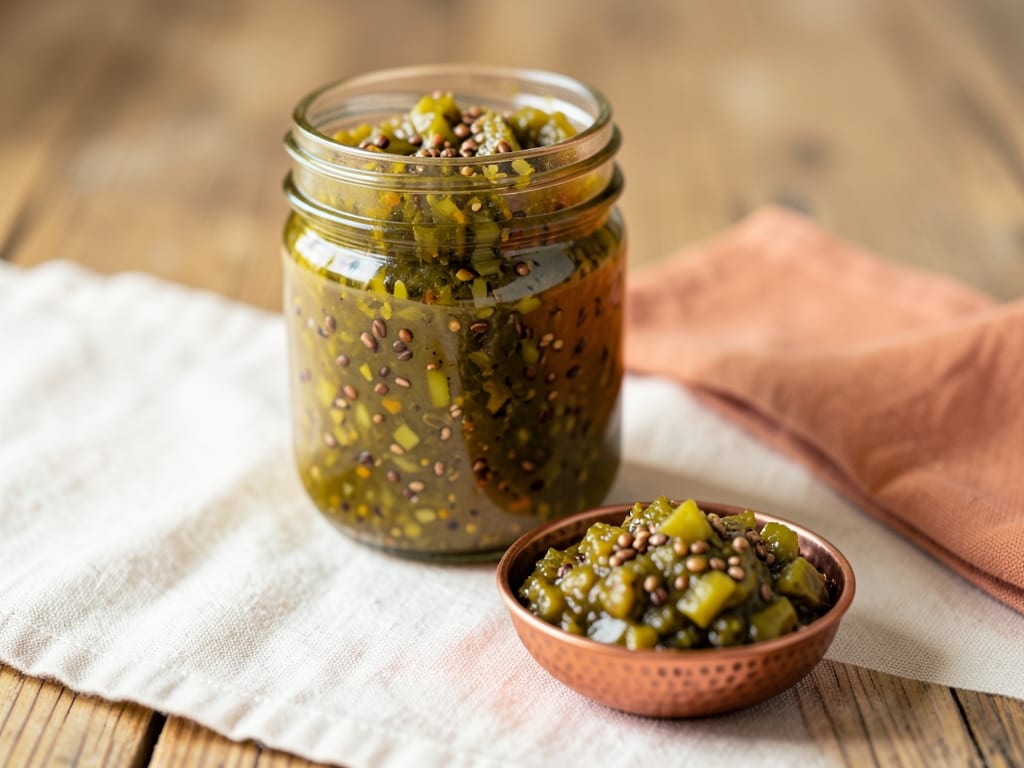
Andhra Avakaya Mango Pickle
Fiery, tangy, mustard-rich raw mango pickle from Andhra Pradesh. Firm green mango chunks are coated in a dry masala of chili, mustard and toasted fenugreek, sun-cured for three days, then matured under a layer of sesame oil.
- Prep
- 1 hr 28 min
- Cook
- 7 min
- Wait
- 10.1 days
- Total
- 10.2 days
- Makes
- About 1.3 kg (1 large 1.5-liter jar, roughly 24 servings of 2 tablespoons)
Steps
Before you start
- Everything that touches the pickle must be completely bone dry: jar, spoons, cutting board, knife, hands. Even a few drops of water can cause mold.
- Choose very hard, sour, dark green mangoes (Totapuri or any pickling variety) with a firm, undeveloped seed. Ripe or sweet mangoes will turn mushy.
- Wash the glass or ceramic jar in hot soapy water and dry it in the sun or in a 200°F (95°C) oven for 15 minutes, then cool fully.
- Plan for about 10 days from start to first serving: 3 days of sun-curing plus about a week of maturing. The pickle tastes best after 2 weeks.
- Wear gloves when handling the chili masala if you have sensitive skin.
Wash and dry mangoes
- Rinse the mangoes under cold water, rubbing off any dirt.
- Wipe each one with a clean towel, then set them on a dry towel in a single layer for 30 minutes so all surface moisture evaporates.
+ Show details− Hide details
Ready when: Skins feel completely dry to the touch, with no beads of water near the stem
Tip: Moisture is the main cause of spoilage in pickles. Do not skip drying.
Heat and cool oil
- Pour the sesame oil into a small saucepan and warm over medium heat for about 4 to 5 minutes until it thins out, smells nutty and just starts to shimmer.
- Do not let it smoke.
- Remove from the heat, pour into a dry bowl or leave in the pan, and let it cool to room temperature while you cut the mangoes and dry them (about 2 hours).
+ Show details− Hide details
Ready when: Oil looks thinner and shimmers with a light nutty aroma, but is not smoking
Tip: Warm oil would cook the mustard and mango, so it must be fully cool before use.
Cut mango pieces
- Stand each mango on a dry board and cut it with a heavy knife into 1-inch (2.5 cm) cubes, cutting through the hard seed shell so that each piece has skin on one side.
- Discard the soft white inner kernel and any fibrous bits.
- You should have about 1 kg of pieces.
- Spread them on a dry towel in a single layer and let them air-dry for 2 hours, turning once, until the cut surfaces look matte and not wet.
+ Show details− Hide details
Ready when: Cut faces look dull and dry, not glossy or damp
Tip: Choose a stainless steel or ceramic knife; avoid carbon steel, which can discolor the mango.
Toast and grind fenugreek
- Heat a small dry skillet over medium-low heat.
- Add the fenugreek seeds and toast for 1 to 2 minutes, shaking the pan constantly, until they turn golden and smell nutty.
- Tip onto a plate and cool completely, then grind to a fine powder in a dry spice grinder.
+ Show details− Hide details
Ready when: Seeds are light golden and fragrant, not dark brown
Tip: Over-toasted fenugreek turns very bitter, so pull it as soon as it colors.
Mix the masala
- In a large dry bowl, whisk together the salt, mustard powder, chili powder, ground fenugreek and turmeric until the color is even and no lumps remain.
+ Show details− Hide details
Ready when: Masala is a uniform deep red with no pale streaks
Tip: Break up any salt or mustard clumps with the back of a dry spoon.
Coat mango with masala
- Add the dried mango pieces and the garlic, if using, to the masala.
- Pour in half of the cooled oil (about ½ cup / 125 ml).
- Toss with a dry spoon for 2 to 3 minutes until every piece is thickly coated in a paste-like masala.
+ Show details− Hide details
Ready when: No dry masala is left in the bottom of the bowl and each piece is evenly coated
Tip: Reserve the remaining oil for the top layer later.
Pack the jar
- Spoon the coated mango into the dry jar in layers, pressing gently with a dry spoon to remove air pockets.
- Scrape any masala from the bowl into the jar.
- Leave 2 inches (5 cm) of headspace.
- Cover the mouth with a clean cotton cloth secured by a rubber band, then set the lid loosely on top.
+ Show details− Hide details
Ready when: Jar is filled about three-quarters full with mango compacted and no big gaps
Tip: Leave headspace because the mango releases juice and the level rises.
Sun-cure for three days
- Set the jar in a sunny, dry spot (a sunny windowsill or balcony, bringing it in before dusk or if rain threatens) for 3 days.
- Once a day, stir thoroughly from the bottom with a dry spoon, about 5 minutes each time.
- The salt will draw juice out of the mango and the masala will become a loose, glossy red gravy.
- Keep the cloth on between stirrings.
+ Show details− Hide details
Ready when: Mango pieces have turned slightly olive and softened at the edges but still feel firm when pressed, and the gravy is syrupy
Tip: In cold or humid weather, cure on a warm shelf for 4 to 5 days instead.
Add oil layer
- Stir the pickle once more, then press the pieces down so they are submerged.
- Pour the remaining cooled oil (about ½ cup / 125 ml) over the top so there is a ½-inch (1 cm) layer of oil covering the mango.
- Wipe the rim with a dry paper towel and close the lid tightly.
+ Show details− Hide details
Ready when: All mango and masala are covered by a ½-inch (1 cm) layer of oil
Tip: If the oil is not covering the surface after a week, top up with extra cooled sesame oil.
Mature before serving
- Store the sealed jar in a cool, dark cupboard for 7 days, shaking or stirring gently with a dry spoon every 2 days.
- The mango will soften slightly and the flavors will meld.
- Serve with hot rice, ghee and curd, or with dosa and idli.
- Always use a dry spoon.
+ Show details− Hide details
Ready when: Mango is tender but not mushy, the oil has turned deep red, and the aroma is sharp, tangy and nutty
Tip: The pickle tastes best after 2 weeks.
Good to know
Tips
- Use hard, sour mangoes with an undeveloped seed shell; soft or semi-ripe ones turn mushy.
- Never use a wet spoon. Keep a dedicated dry spoon next to the jar.
- If you see white fuzzy mold, discard the pickle. A little white salt crystal or cloudy oil is normal.
- For a milder pickle, reduce the chili powder to ½ cup (65 g), but do not reduce the salt, which preserves the mango.
Make ahead
"Make during mango season (April to June) and mature for 2 weeks. The pickle keeps improving for several weeks and can be made months before it is needed."
Storage & reheating
"Room temperature: up to 6 months in a cool, dark cupboard in a tightly sealed jar with the mango always covered by oil. Refrigerator: up to 12 months, though the oil may solidify, so let the jar sit at room temperature for 20 minutes before serving. Freezer: not recommended. No reheating is needed; serve at room temperature using a dry spoon only."
Substitutions
- cold-pressed sesame (gingelly) oil → cold-pressed groundnut (peanut) oil. Gives a milder, less nutty flavor; traditional Andhra versions use either.
- hot red chili powder (Guntur style) → half Kashmiri chili powder and half hot chili powder. Keeps the bright red color with less heat.
- yellow or brown mustard powder → whole mustard seeds, ground fine. Use the same weight (100 g); grind in a dry grinder in short bursts and cool before mixing.
- coarse sea salt or pickling salt → fine non-iodized salt. Use about 20% less by volume (about 5 tbsp) because fine salt packs more densely.
More pickles & chutneys
See all →
Find more like this
- Meal
- Lunch
- Cuisine
- South Indian
- Main ingredient
- Mangoes
- Quick & Easy
- Make Ahead