French White Wine Court Bouillon
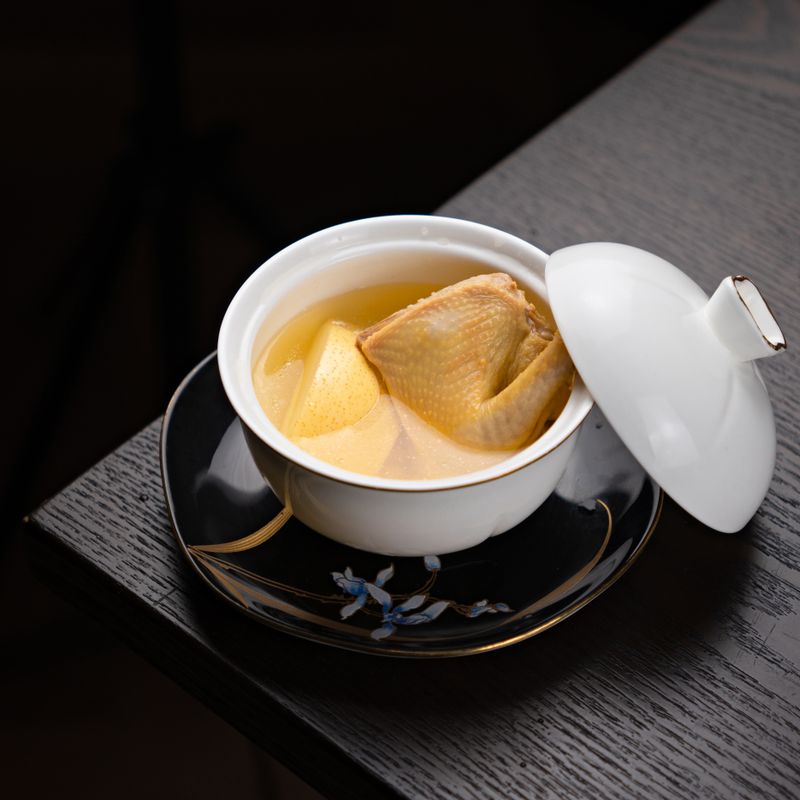
A classic French aromatic broth made with white wine, vegetables, and herbs. Court bouillon is the traditional poaching liquid for delicate fish, seafood, and occasionally vegetables. This version balances acidity and subtle vegetable sweetness with fresh herbs and a hint of peppercorn heat. Ready in under an hour and freezes beautifully for future use.
- Prep
- 15 min
- Cook
- 30 min
- Wait
- 5 min
- Total
- 50 min
- Makes
- About 1 quart (1 liter) of strained broth
Steps
Before you start
- Have a fine-mesh strainer ready
- Gather all vegetables and herbs before you begin
- Use a dry white wine (Sauvignon Blanc or Pinot Grigio work well)
- This broth is best made fresh, but can be prepared up to 2 days ahead
Combine liquids and vegetables
- Pour the cold water and white wine into a large 4-quart pot.
- Add the onion halves (skin-on), carrot pieces, celery, and leek pieces.
- Bring to a gentle simmer over medium-high heat, about 5–7 minutes.
- You should see small bubbles breaking the surface, not a rolling boil.
+ Show details− Hide details
Ready when: Surface shows small, gentle bubbles; no rolling boil
Tip: Keep the heat moderate—a vigorous boil can make the broth cloudy. You want a peaceful simmer.
Add herbs and season
- Once simmering, add the parsley stems and leaves, thyme sprigs, bay leaf, and whole black peppercorns.
- Give the pot a gentle stir to distribute the herbs evenly.
- Reduce the heat to low and maintain a very gentle simmer.
+ Show details− Hide details
Tip: Don't add salt yet—you'll season to taste after straining, since the broth will concentrate slightly.
Simmer and infuse
- Maintain a bare simmer—just 1 or 2 bubbles rising per second—for 20 minutes.
- This gentle, sustained heat extracts flavor from the vegetables and herbs without clouding the broth or boiling off the wine's delicate aromatics.
+ Show details− Hide details
Ready when: Broth smells fragrant; vegetables are soft and pale
Tip: Resist the urge to increase heat. Slow infusion produces a clear, clean-tasting broth; rushing it makes it cloudy.
Strain the broth
- Remove the pot from heat and let it rest for 2 minutes to allow sediment to settle.
- Place a fine-mesh strainer over a large bowl and slowly pour the broth through, leaving the solids in the pot.
- Do not press the vegetables—let gravity do the work for the clearest broth.
- Discard the solids.
+ Show details− Hide details
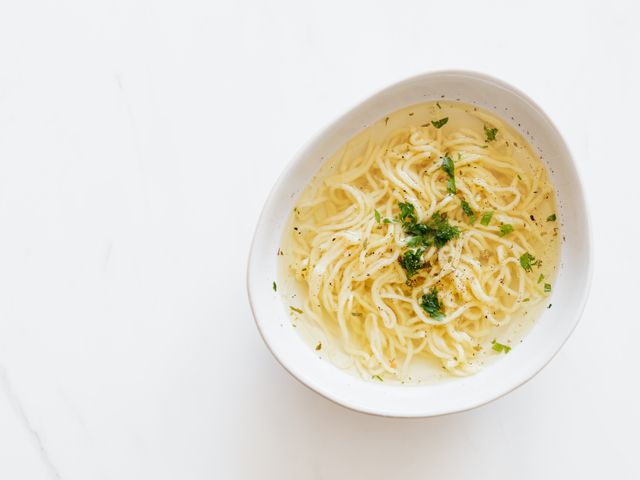
Ready when: All liquid is strained; broth is clear to pale yellow
Tip: Never squeeze or press the vegetables through the strainer—that releases bitter compounds and clouds the broth.
Season to taste
- Pour the strained broth back into the pot (or a clean bowl if serving cold).
- Taste it and add kosher salt gradually, stirring well between additions.
- Season conservatively—you can always add more, but you cannot remove it.
- The broth should taste pleasant and balanced: the wine should be present but not overwhelming, with a clean vegetable undertone.
+ Show details− Hide details
Ready when: Broth tastes balanced with no harsh edges; salt enhances without dominating
Tip: Taste several times. If the wine flavor feels too acidic, a pinch more salt will round it out; if it feels flat, a few more peppercorns make a difference.
Good to know
Tips
- This broth is most famous for poaching whole fish or fillets. Its acidity and delicate flavor enhance rather than mask the fish. Use it to poach salmon, sole, turbot, cod, or shrimp.
- For a darker, more robust broth (if you prefer to poach meatier fish or use it in sauces), sauté the onion halves cut-side down in butter for 3–4 minutes until browned before adding water and wine.
- Save the strained broth in ice cube trays and freeze. Pop out frozen cubes and store in a freezer bag for easy 2–3 tablespoon portions to enrich sauces or vegetable broths.
- If your broth tastes too acidic, it may be too concentrated. Add a splash of additional water and retaste. Never add cream or butter to 'fix' acidity—that masks the problem rather than solving it.
Make ahead
Yes. Court bouillon can be made up to 2 days ahead and refrigerated, or frozen for up to 3 months. Make it, let it cool to room temperature, then pour into an airtight container or ice cube trays for easy portioning. Thaw gently on the stove or in the refrigerator before using.
Storage & reheating
Room temperature: up to 2 hours (not recommended for safety). Refrigerator: up to 2 days in an airtight container. Freezer: up to 3 months in an airtight container or ice cube trays. To reheat: thaw overnight in the refrigerator or gently warm on the stovetop over medium-low heat until steaming. Do not boil.
Substitutions
- fresh thyme sprigs → Fresh tarragon (1.5 sprigs) or fresh chervil (3 small sprigs). Tarragon adds an anise-like note that pairs beautifully with fish; chervil is more delicate and traditional in classical French cuisine.
- dry white wine → Dry vermouth (1.5 cups / 360 ml) or additional water with 2 tablespoons (30 ml) fresh lemon juice. Vermouth adds herbal complexity; the lemon-water option is lighter and better for very delicate fish like sole.
- leek, white and light green parts → Extra onion (0.5 medium onion) or fennel bulb (0.25 cup / 40 g, sliced). Onion adds sweetness; fennel contributes a subtle licorice note that complements seafood.
- black peppercorns → Coriander seeds (0.5 teaspoon / 1.5 g) or white peppercorns (0.5 teaspoon / 2 g). Coriander adds warmth; white pepper is milder and keeps the broth paler in color.