
French Beef Consommé with Vermicelli
A refined, crystal-clear beef consommé clarified using the classic French raft method, finished with delicate vermicelli pasta. This elegant soup begins with beef broth that is slowly simmered with egg whites, raw beef, and finely diced vegetables to create a natural filter that yields a pristine, richly flavored consommé. The raft—a traditional clarification technique—traps all impurities while allowing the broth to bubble through, resulting in a golden, transparent soup. This consommé is traditionally served as a refined first course, embodying classical French culinary technique and precision.
- Prep
- 25 min
- Cook
- 1 hr 5 min
- Wait
- 10 min
- Total
- 1 hr 40 min
- Makes
- 4 servings (5–6 cups consommé)
Steps
Before you start
- Chill all raft ingredients and the beef broth completely in the refrigerator—they must be very cold to ensure proper raft formation and clarification.
- Have fine cheesecloth or a chinois (conical strainer) ready for straining; line it carefully.
- Do not stir the broth once the raft begins to form; stirring will break it up and cloud the consommé irreversibly.
- Read the entire method before starting; consommé-making is a classical technique that requires patience, attention, and understanding of the clarification process.
- Plan for about 100 minutes of total time, with about 35 minutes of passive simmering while the raft filters the broth.
Prepare the raft components
- Finely dice the onion, carrot, celery, and tomato.
- Keep all ingredients—ground beef, egg whites, vegetables, and beef broth—as cold as possible.
- You may even place them in the freezer for 10 minutes if needed.
- The temperature of these ingredients is critical for successful raft formation and proper clarification of the broth.
+ Show details− Hide details
Ready when: All vegetables are finely and uniformly diced; all ingredients remain very cold
Tip: Chill your bowl in the freezer while you prep; cold ingredients are essential for forming a proper raft that will clarify the broth.
Create the raft mixture
- In a cold mixing bowl, combine the ground beef, egg whites, diced onion, diced carrot, diced celery, diced tomato, and Herbes de Provence.
- Using a whisk or fork, gently blend the mixture until just combined—aim for a loose, choppy texture with visible pieces, not a homogeneous paste.
- The texture is important; it allows the raft to rise and filter properly when heated.
+ Show details− Hide details
Ready when: Raft ingredients are loosely combined with visible chunks; mixture is not smooth or paste-like
Tip: Don't overmix the raft. The chunky texture helps it rise and form a filtration layer; a smooth paste will not clarify properly.
Add raft to cold broth
- Pour the cold beef broth into a large heavy-bottomed stockpot (8-quart / 7.5-liter capacity).
- Gently add the raft mixture to the cold broth, stirring a few times to distribute it evenly throughout.
- The cold temperature is critical—never begin with warm broth, as this prevents proper raft formation and clarification.
+ Show details− Hide details
Ready when: Raft mixture is distributed throughout the cold broth
Tip: Start with ice-cold broth and raft; this ensures the raft will form properly and clarify the consommé as it heats.
Heat to a gentle simmerOven 350°F / 175°C
- Place the pot on the stovetop over medium heat (around 350°F / 175°C setting if using an electric stovetop).
- Slowly heat the broth with the raft, stirring occasionally with a wooden spoon.
- As the mixture warms, the egg whites will begin to coagulate and the raft will start to rise to the surface, trapping impurities.
- This process takes about 10–15 minutes.
- Once you see steam rising from the liquid and the first small bubbles forming at the edges, reduce the heat to medium-low.
+ Show details− Hide details
Ready when: Raft has risen to the surface and broth is beginning to steam; first small bubbles are visible at the edges
Tip: Stir gently and frequently during heating; once bubbles form and the raft rises, stop stirring to avoid breaking up the raft, which would cloud the entire pot.
Simmer and clarifyOven 200°F / 95°C
- Once the raft has risen and formed a crust on top of the simmering broth, reduce the heat to low (around 180–200°F / 80–95°C).
- Maintain a very gentle simmer for 35–40 minutes.
- The raft acts as a natural filter—the broth will bubble up slowly through it, leaving all impurities trapped in the raft layer.
- You may see small bubbles forming at the edges of the raft; this is normal and desired.
- Do not stir or disturb the raft during this entire time, as this will break it up and cloud the consommé irreversibly.
- The broth will gradually become clearer and take on a beautiful golden hue.
+ Show details− Hide details
Ready when: Broth is crystal clear and golden; no cloudiness is visible; raft remains intact on the surface
Tip: Resist the urge to stir or taste during this time. The consommé is a patient process; if you break the raft, cloudiness will develop and the broth will not fully clarify. This is the most critical step.
Strain through cheesecloth
- Line a fine-mesh sieve or chinois with cheesecloth (use a double layer for best results).
- Very carefully ladle the clear consommé from the pot through the lined strainer into a clean pot, leaving the raft undisturbed at the bottom of the original pot.
- Pour very slowly and gently—speed and carelessness at this step are your enemies.
- Discard the raft.
- Once strained, taste the consommé and season carefully with salt and black pepper.
- If desired for a traditional finish, add 1 tablespoon of cognac or dry sherry, which adds subtle depth.
+ Show details− Hide details
Ready when: Consommé is completely clear and strained; raft is discarded; consommé is seasoned to taste
Tip: Pour slowly to avoid stirring up sediment or breaking through the cheesecloth too quickly. If the consommé is still slightly cloudy, carefully pour it through clean cheesecloth again—this is worth the extra care.
Cook the pasta separately
- While the consommé clarifies or just before serving, bring a small pot of salted water to a boil over high heat.
- Once boiling, add the vermicelli and cook for 6–8 minutes, or until al dente—tender but with a slight bite remaining.
- Drain the cooked pasta in a fine-mesh sieve and set aside.
- Cooking the pasta in a separate pot prevents starch from clouding the refined consommé and keeps the presentation pristine.
+ Show details− Hide details
Ready when: Vermicelli is tender but still slightly firm to the bite
Tip: Cook the pasta in its own pot so starch doesn't enter and cloud the clear consommé. Drain it well and use it fresh.
Reheat and serve
- If the consommé has cooled while you prepared the pasta, gently reheat it over medium heat, stirring occasionally, until it is steaming throughout (about 5–10 minutes).
- Do not allow it to boil.
- Pour the hot consommé into warm serving bowls (8–10 oz / 240–300 ml per person).
- Divide the cooked vermicelli among the bowls, or offer it on the side for diners to add themselves.
- Garnish lightly with fresh chives if desired.
- Serve immediately while hot to showcase the elegant clarity and temperature of the consommé.
+ Show details− Hide details
Ready when: Consommé is steaming and hot throughout; no cold spots remain
Tip: Serve immediately in warm bowls to maintain the elegant presentation, clarity, and ideal serving temperature. This is a refined dish and deserves careful, thoughtful finishing.
Good to know
Tips
- Consommé is a classical French technique that demands patience and precision. Never stir once the raft forms; stirring will break it apart and cloud the entire pot irreversibly. This is the defining technique of consommé-making.
- The quality of your base beef broth is crucial to the final consommé. Use homemade beef stock or the best store-bought version you can find; premium ingredients yield a consommé with superior depth and clarity.
- The traditional garnish for beef consommé is fine vermicelli, but other garnishes are equally authentic: brunoise (fine dice) of vegetables, profiteroles (small pastry puffs), truffle julienne, or a simple quenelle of beef marrow. These enhance the presentation of this elegant dish.
- For an impressive restaurant-style presentation, serve the consommé in warm consommé cups (shallow bowls with handles) or small heatproof bowls, garnished with a tiny bundle of vermicelli or a single herb leaf. The clarity and golden color of the consommé is itself a garnish.
Make ahead
Yes, the consommé can be clarified and strained up to 2 days ahead. Cool it completely, cover it with plastic wrap or an airtight lid, and refrigerate. Reheat gently on the stovetop over medium heat, stirring occasionally, until steaming before serving. The consommé will gel or become aspic-like when cold due to the gelatin from the beef; this is completely normal and desirable. Cook the vermicelli fresh just before serving for best texture.
Storage & reheating
Consommé (without pasta): Store in an airtight container in the refrigerator for up to 3 days. It will gel or become aspic-like when cold due to gelatin; this is normal and indicates quality. To reheat, thaw in the refrigerator if frozen, then gently warm on the stovetop over medium heat, stirring occasionally, until steaming (about 10 minutes). Freezer: Up to 3 months in an airtight freezer-safe container. Thaw overnight in the refrigerator before reheating. Cooked vermicelli: Best served fresh, but can be stored in an airtight container in the refrigerator for up to 1 day and briefly reheated in a pot of hot water just before serving.
Substitutions
- Cold beef broth → Homemade beef stock or high-quality store-bought beef stock. Stock is often less concentrated than broth. If using stock, increase the Herbes de Provence by 1/4 teaspoon for deeper flavor.
- Lean ground raw beef → Ground veal or ground chicken. Veal produces a lighter, more delicate consommé; chicken creates a lighter broth with subtle poultry flavor. Adjust seasonings accordingly.
- Vermicelli pasta → Orzo, pastina, small pasta shells, or julienned vegetables (carrots, celery, turnips). Cook pasta according to package directions. Julienned vegetables should be blanched briefly in boiling salted water before adding to the consommé.
- Herbes de Provence → 1/4 teaspoon dried thyme + 1/4 teaspoon dried marjoram + pinch of dried oregano and savory, mixed together. This combination replicates the flavor profile of Herbes de Provence and can be added directly to the raft.
More broths
See all →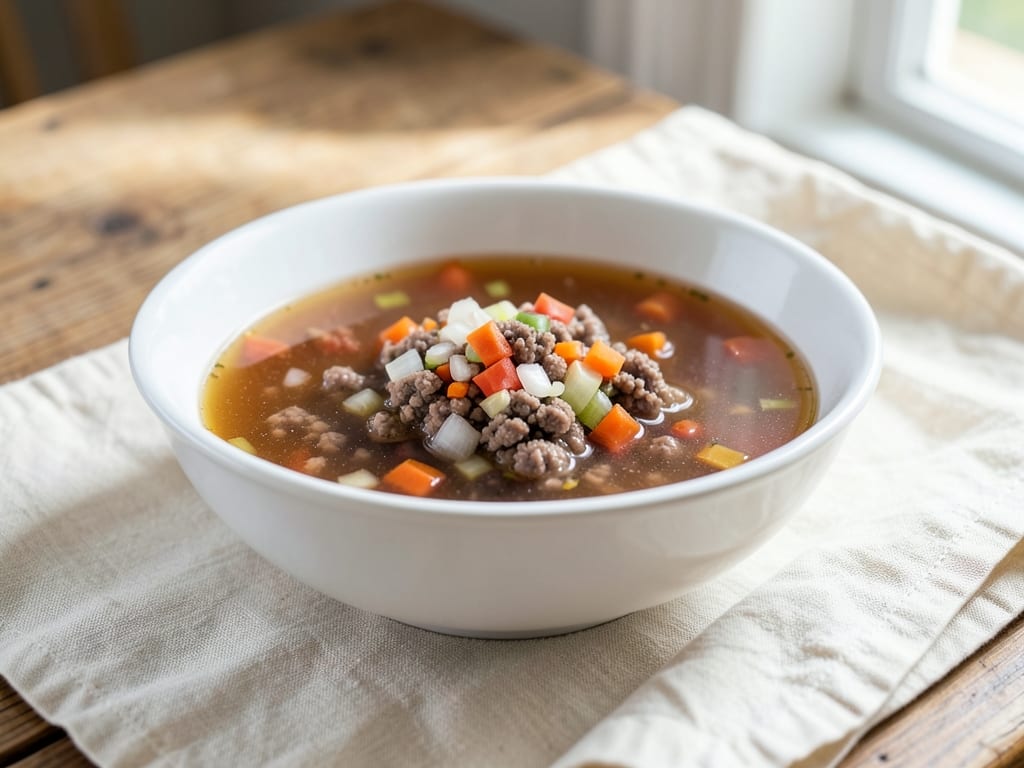
Find more like this
- Meal
- Dinner
- Cuisine
- French
- Main ingredient
- Ground BeefPasta
- Method
- Stovetop