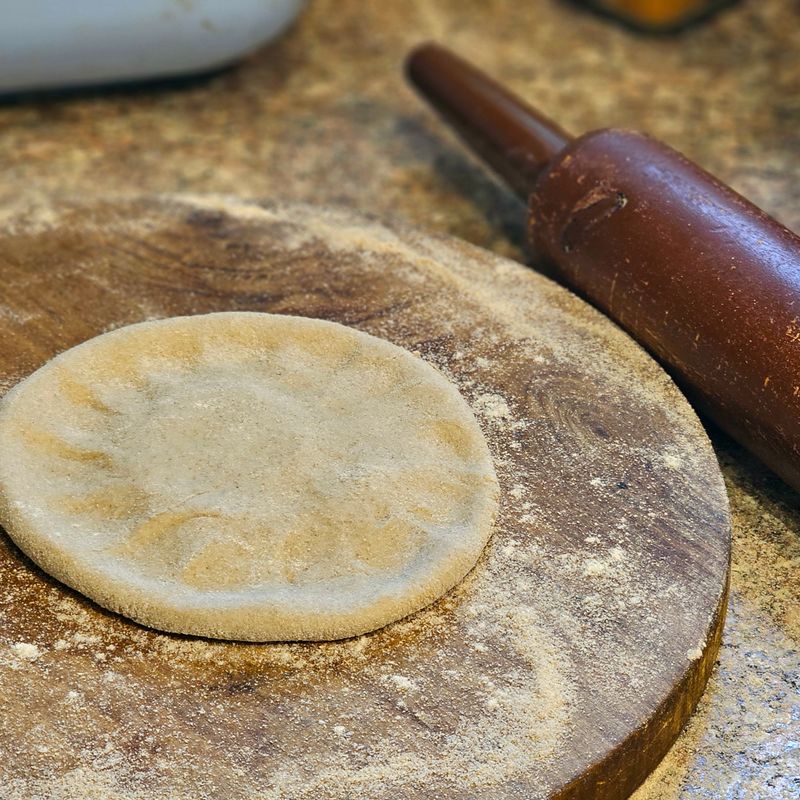
Buckwheat Flatbread Dough
A quick, rustic Eastern European dough made with nutty buckwheat flour and strong all-purpose flour. This simple dough comes together in minutes with a straightforward knead-and-rest method, requiring no yeast or long fermentation. The result is an earthy, slightly dense dough perfect for griddle-cooked flatbreads with excellent flavor and satisfying texture.
- Prep
- 10 min
- Cook
- —
- Wait
- 15 min
- Total
- 25 min
- Makes
- 4 flatbreads (about 1 lb / 450g dough)
Steps
Before you start
- Gather all ingredients and place them within reach of your work station.
- Ensure your mixing bowl is large enough to comfortably stir the dough (at least 3 quarts / 3 liters).
- Note that buckwheat flour absorbs water differently than wheat flour, so you may not need all the water listed.
Mix flours and salt
- Combine buckwheat flour, all-purpose flour, and salt in a large bowl.
- Whisk together for about 1 minute until the salt is evenly distributed and there are no lumps of buckwheat flour.
- This ensures consistent seasoning throughout the dough.
+ Show details− Hide details
Ready when: No visible clumps; flours look evenly combined and fine.
Tip: Buckwheat flour can clump during storage, so break up any small lumps with the whisk.
Add water and oil
- Create a small well in the center of the flour mixture.
- Pour in about ¼ cup (60ml) of the room-temperature water and, if using, the 1 tablespoon (15ml) of neutral oil, and stir with a wooden spoon until the liquid is absorbed.
- Add the remaining water a little at a time, stirring after each addition, until a shaggy, wet dough forms.
- The dough should come together but still look slightly lumpy.
+ Show details− Hide details
Ready when: Shaggy dough with no dry flour visible in the bowl.
Tip: Add water slowly—buckwheat flour absorbs water at a different rate than wheat flour, so you may not need all of it.
Check and adjust hydration
- Squeeze a small piece of dough between your fingers.
- If it's very dry and crumbly, sprinkle additional water one tablespoon at a time, stirring gently.
- If it's sticky and clinging to your fingers, dust with a tablespoon of all-purpose flour and mix in.
- The dough should feel like soft bread dough—moist but not sticky to the touch.
+ Show details− Hide details
Ready when: Dough is cohesive and slightly moist but not sticky.
Tip: Humidity in your kitchen will affect hydration significantly, so this adjustment step is important for success.
Knead 5–7 minutes
- Turn the dough onto a clean, lightly floured work surface.
- Knead by folding the dough toward you and pressing with the heel of your hand, then rotating a quarter turn.
- Repeat this motion for 5–7 minutes.
- The dough should gradually become smoother, more elastic, and less sticky.
- You'll feel it develop slight firmness and see a subtle sheen on the surface.
+ Show details− Hide details
Ready when: Smooth, slightly elastic surface; holds shape when poked; no longer tears easily.
Tip: This is a quick-knead dough—don't overwork it. Stop as soon as it's smooth; this dough doesn't need the development that bread dough requires.
Rest the dough
- Place the dough back in the mixing bowl or on the work surface.
- Cover it loosely with a clean kitchen towel or plastic wrap.
- Let it rest at room temperature for 10–15 minutes.
- During this time, the buckwheat flour will fully hydrate and the gluten network will relax, making the dough easier to shape and cook.
+ Show details− Hide details
Ready when: Dough looks slightly more relaxed and feels easier to handle.
Tip: Don't skip this rest—it makes a significant difference in how the dough behaves during rolling and cooking.
Divide into portions
- Once rested, divide the dough into 4 equal portions.
- Using your hands, shape each portion into a loose ball by tucking the edges underneath and rolling gently on the work surface.
- You should have 4 smooth balls of dough, each about the size of a tennis ball (approximately 110–115g each).
- The dough is now ready to be rolled out and cooked on a hot griddle or cast iron skillet.
+ Show details− Hide details
Ready when: Four equal, smooth balls of dough with no cracks.
Tip: If you're not using the dough immediately, keep the portions covered with a towel and use within 1–2 hours for best results.
Good to know
Tips
- Buckwheat flour absorbs water differently than all-purpose flour due to its density and starch composition. Always add water gradually and check the dough's moisture before using all of it—humidity may mean you need slightly less.
- The rest period is crucial for this dough. Even though brief (10–15 minutes), it allows the buckwheat flour to fully hydrate and gives the all-purpose flour gluten time to relax, making the dough far easier to shape and cook.
- This dough should be firmer than bread dough but not dry. A good test is to squeeze a small piece: it should hold together easily without crumbling, and shouldn't stick to your fingers.
- Freshly made dough cooks best and yields the most tender flatbreads. If refrigerated, always bring to room temperature for 15–20 minutes before cooking, as cold dough is stiff and difficult to roll or shape.
Make ahead
Dough can be made up to 8 hours ahead and refrigerated, covered tightly. Bring to room temperature for 15–20 minutes before using, as cold dough is stiff and difficult to shape.
Storage & reheating
Covered dough lasts in the refrigerator for up to 3 days. Use at room temperature within 1–2 hours for best texture and workability. Once cooked into flatbreads, store in an airtight container at room temperature for up to 2 days, or freeze for up to 3 months; reheat briefly on a griddle or in a skillet.
Substitutions
- buckwheat flour → Millet flour or sorghum flour. Use the same weight (100g) for similar nuttiness and texture; results may be slightly sweeter with sorghum.
- all-purpose flour → Spelt flour. Use 1 cup (130g) spelt and ⅓ cup (40g) all-purpose flour to maintain structure, as spelt is weaker than all-purpose flour.
- water → Buttermilk or plain yogurt thinned with water. Use ⅔ cup (160ml) buttermilk plus 2 tbsp (30ml) water for a tangier dough with added richness and tenderness.
- neutral oil such as vegetable or light olive oil → Melted butter. Use the same amount (1 tbsp / 15g) for a richer, more traditional Eastern European flavor and golden browning.
More flatbread doughs
See all →
Find more like this
- Meal
- Lunch
- Quick & Easy
- 30-Minute5 Ingredients or LessEasyBeginner