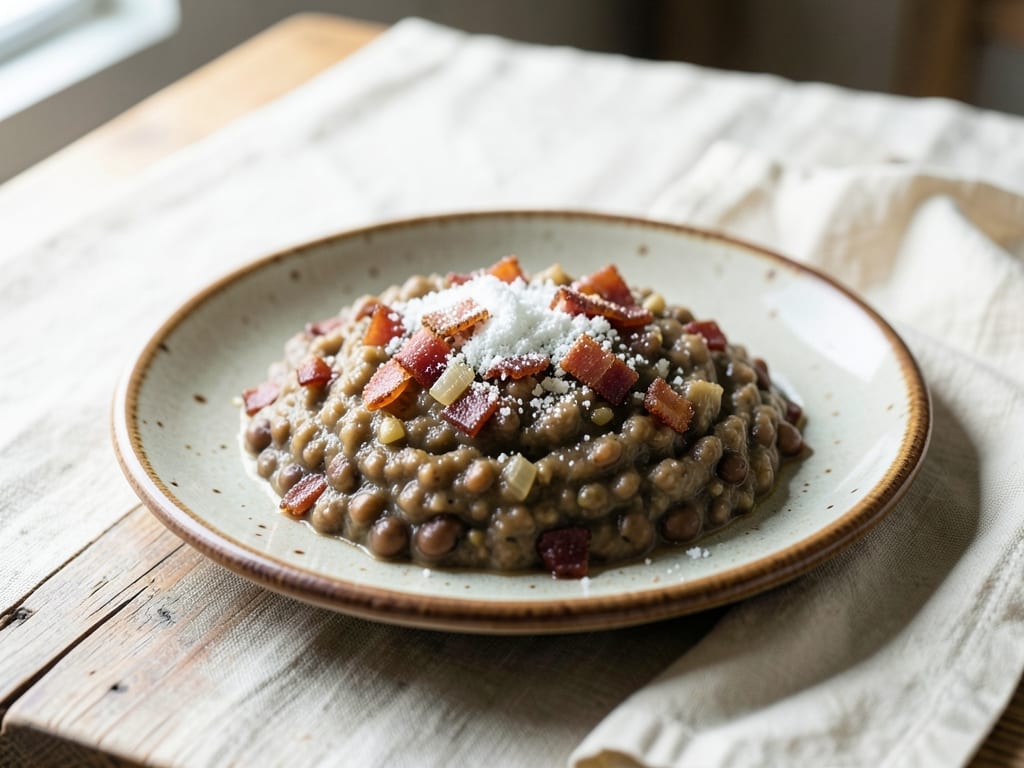
Brazilian Tutu de Feijão
A silky-smooth Brazilian mashed bean dish enriched with crispy bacon, sautéed onion and garlic, and finished with toasted manioc flour. Tutu de feijão is savory comfort food—equally at home on a weeknight table or at a festive churrasco. The key to its texture is balancing creamy beans with the slight graininess of farinha de mandioca, which adds body and authentic flavor.
- Prep
- 20 min
- Cook
- 1 hr 25 min
- Wait
- 10 min
- Total
- 1 hr 55 min
- Makes
- About 5 cups
Steps
Before you start
- If using dried beans, soak them overnight in cold water or do a 1-hour quick soak (boil 2 minutes, rest 1 hour)
- Have all ingredients prepped and within reach before you start cooking
- Manioc flour can clump—whisk it with a little cold water or broth first to avoid lumps
Cook the beans
- Drain the soaked beans and place them in a large pot.
- Add 8 cups (1900 ml) of water or broth, bringing to a boil over high heat.
- Reduce heat to medium and simmer, partially covered, for 60–75 minutes, until the beans are very tender and beginning to fall apart when stirred.
- Stir occasionally and skim any foam that rises to the surface.
- The beans should be soft enough to mash easily with the back of a spoon.
- Season with a pinch of salt near the end of cooking.
- Do not drain the beans; you'll use the cooking liquid to adjust consistency.
+ Show details− Hide details
Ready when: Beans break apart easily when pressed; liquid is slightly creamy from starch
Tip: Don't skip the soak—it reduces cooking time and digestive discomfort. If beans aren't tender after 75 minutes, continue simmering in 10-minute intervals.
Render the bacon
- While the beans finish cooking (or as they near doneness), heat a large skillet over medium-high heat.
- Add the bacon pieces and cook, stirring occasionally, until the edges are crispy and the fat has rendered, about 8–10 minutes.
- Remove the bacon with a slotted spoon and set aside on a paper towel, leaving 3–4 tablespoons of bacon fat in the pan.
+ Show details− Hide details
Ready when: Bacon is crispy and golden; fat pools in the bottom of the pan
Tip: Don't overcrowd the skillet; render the bacon in one layer so it crisps rather than steams.
Sauté aromatics
- Reduce heat to medium.
- Add the diced onion to the bacon fat and cook, stirring often, for 5–6 minutes until the onion is softened and translucent at the edges.
- Add the minced garlic and cook for another 1–2 minutes, stirring constantly, until fragrant.
- You should smell sweet caramelized onion and toasted garlic.
+ Show details− Hide details
Ready when: Onion is soft and beginning to color; garlic is fragrant and light golden
Tip: Watch the garlic carefully—if it browns too quickly, the whole dish will taste bitter. Lower heat slightly if needed.
Combine beans and aromatics
- Carefully pour the beans (with their cooking liquid) into the skillet with the onion and garlic mixture.
- Stir well to combine, breaking up some of the beans with the back of a wooden spoon as you stir.
- You want a mixture that is creamy but still has some bean pieces visible.
- Cook over medium heat for 3–4 minutes, stirring gently, until the beans and aromatics are evenly distributed.
+ Show details− Hide details
Ready when: Beans and onion are fully combined; mixture is creamy and warm throughout
Tip: Don't over-mash; tutu should have texture, not be a smooth purée.
Toast and incorporate manioc flour
- Pour the manioc flour into a small bowl or measuring cup.
- If you see clumps, whisk briefly with a splash of cold broth or water.
- Slowly sprinkle the manioc flour into the bean mixture while stirring constantly with a wooden spoon.
- The flour will thicken the dish and give it its characteristic grainy, creamy texture.
- Stir for 2–3 minutes over medium heat, breaking up any lumps that form.
- The mixture should pull away slightly from the sides of the skillet when you stir.
- If it seems too thick, thin it with a little reserved bean cooking liquid, ¼ cup (60 ml) at a time.
+ Show details− Hide details
Ready when: Manioc flour is fully incorporated with no raw, floury taste; mixture is creamy and holds together when spooned
Tip: Add the flour slowly so you can control the thickness—it's easier to add more liquid than to fix something too thick.
Season and finish
- Taste the tutu and season generously with salt and freshly ground black pepper.
- Fold in the reserved crispy bacon.
- If using, stir in the butter for extra richness and the fresh cilantro for brightness.
- Cook for another minute, stirring gently, until everything is heated through.
- The tutu should be creamy, savory, and smell of bacon, garlic, and toasted manioc.
+ Show details− Hide details
Ready when: Seasonings are evenly distributed; butter melts into the mixture; flavors are balanced and rich
Tip: Add cilantro at the very end so it stays bright green and doesn't cook down.
Rest and serve
- Remove the skillet from heat and let the tutu rest for 5 minutes.
- This allows the flavors to meld and the texture to set slightly.
- Transfer to a serving bowl or platter and serve warm alongside grilled meats, rice, and salad.
Good to know
Tips
- Use canned beans for a quicker version: drain 3 (15 oz / 425 g) cans of carioca or pinto beans and rinse well. Skip step 1 and start at step 2. Total time drops to about 30 minutes.
- Manioc flour is available at Latin grocery stores, international sections of larger supermarkets, or online. It's worth seeking out for authentic flavor, but cassava flour is a reliable backup.
- The texture matters: tutu should be creamy with grains of manioc flour visible and felt on the tongue—not smooth like refried beans. Resist over-stirring once the flour is in.
- Serve tutu at the center of a Brazilian meal alongside feijoada, churrasco grilled meats, rice, orange slices, and farofa (toasted cassava flour). It's also delicious with simple grilled chicken.
Make ahead
Tutu can be made up to 2 days ahead. Cool completely, cover, and refrigerate. Reheat gently on the stovetop over medium-low heat, stirring often and adding a splash of broth if it has thickened too much. Do not microwave, as manioc flour can become gritty with dry heat.
Storage & reheating
Room temperature (if serving within 1 hour): cover loosely. Refrigerator: transfer to an airtight container and store for up to 3 days. Freezer: freeze in an airtight container or freezer bag for up to 2 months. Thaw overnight in the refrigerator and reheat gently on the stovetop with a splash of broth, stirring frequently.
Substitutions
- dried carioca beans (or pinto beans) → Pinto beans, borlotti beans, or kidney beans (1:1 ratio). Carioca beans (brown beans) are traditional and have mild, earthy flavor, but other dried beans work if canned beans are unavailable. Avoid black beans—their stronger flavor dominates the dish.
- manioc flour (farinha de mandioca) → Cassava flour or tapioca flour (use 1 cup / 120 g to start; they are less dense than manioc flour). Cassava and tapioca are drier and absorb liquid differently. Start with 25% less and add more if needed to reach the right consistency.
- bacon strips → Pancetta, linguiça sausage, or smoked ham (diced). Pancetta gives a milder pork flavor; linguiça adds spice; ham is leaner. All are common regional variations. Use the same weight.
- fresh cilantro leaves → Flat-leaf parsley or green onion tops. Cilantro is traditional but optional. Parsley offers a mild herbaceous note; green onion adds sharpness. Use fresh, not dried.
More bean sides
See all →
Find more like this
- Meal
- Dinner
- Main ingredient
- Kidney BeansBacon
- Diet
- Sugar-Free
- Method
- Stovetop