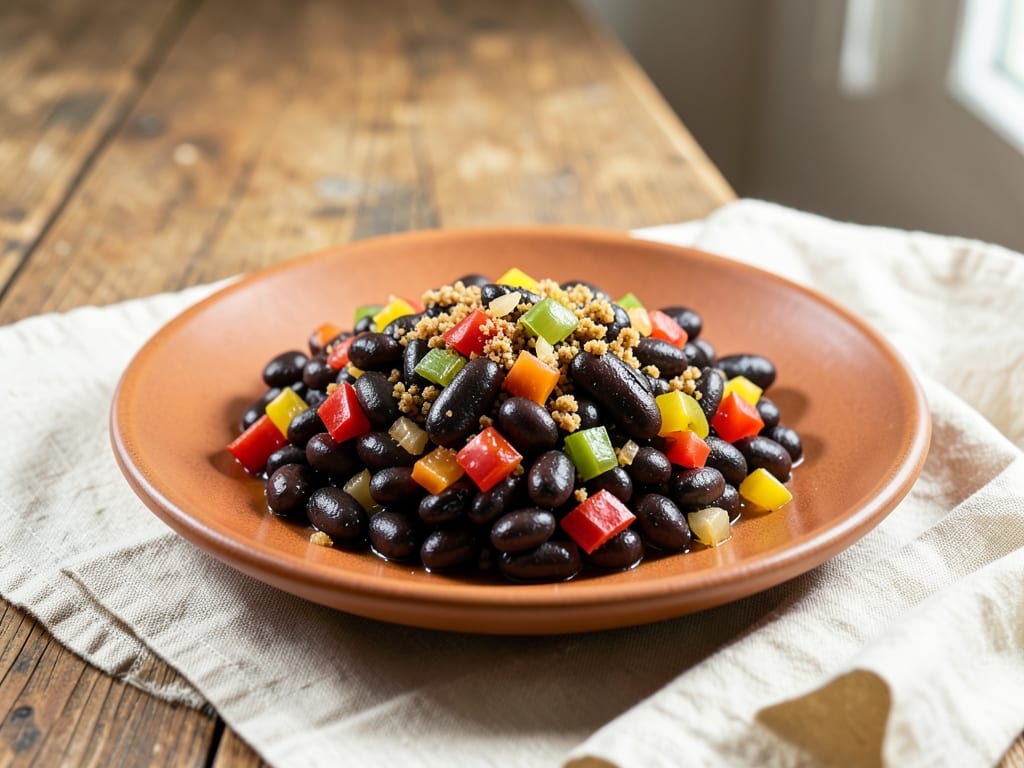
Venezuelan Caraotas Negras
Venezuelan caraotas negras are deeply savory, slightly sweet black beans slow-cooked with papelón (unrefined cane sugar), sautéed aromatics, and warm spices. The beans break down into a creamy sauce that is quintessentially Venezuelan—a staple side dish served alongside arepas, rice, or breakfast specialties. The combination of softened onion, bell pepper, garlic, and cumin creates a deeply savory base, while papelón adds a subtle molasses-like sweetness and complexity that elevates simple beans into comfort food.
- Prep
- 10 min
- Cook
- 32 min
- Wait
- 2 hr 20 min
- Total
- 3 hr 2 min
- Makes
- About 4½ cups (6 servings of ¾ cup each)
Steps
Before you start
- Soak 1 lb dried black beans overnight (8–12 hours) in cold water; drain and rinse before cooking.
- Dice all vegetables (1 onion, 1 red pepper, 3 garlic cloves) before turning on the stove.
- Use a large pot with at least 6-quart capacity—beans expand and splatter if the pot is too small.
- Have papelón grated or crumbled and ready to add (can be done while beans cook).
Boil beans and skim foam
- Place drained beans in your large pot and cover with 8 cups fresh cold water.
- Bring to a boil over high heat (about 3–5 minutes).
- Once boiling, immediately start skimming off the gray foam that rises to the surface using a spoon.
- Continue skimming for 2–3 minutes until foam stops forming.
- Pour off any remaining foam on the surface.
+ Show details− Hide details
Ready when: Water is at a rolling boil and foam stops forming
Tip: Skimming the foam early prevents a cloudy, murky broth and removes bitter-tasting impurities.
Simmer beans gently
- Reduce heat to medium-low so the beans maintain a very gentle simmer with small bubbles breaking the surface.
- Partially cover the pot to speed cooking slightly while still allowing steam to escape.
- Let the beans simmer for about 55 minutes, stirring occasionally (every 15 minutes or so) to ensure even cooking.
- Add a splash of water if the beans become exposed above the liquid.
- While the beans simmer, prepare the sofrito mixture in the next step.
+ Show details− Hide details
Ready when: Beans are soft but not fully tender yet; they should still have some resistance when bitten
Tip: Keep the heat gentle—a rolling boil will cause beans to burst and toughen rather than soften evenly.
Sauté aromatics for sofrito
- While the beans simmer (starting around the 45-minute mark of cooking), heat 2 tbsp olive oil in a small skillet over medium heat.
- Add the diced yellow onion and cook for 3–4 minutes, stirring occasionally, until softened and just beginning to turn golden at the edges.
- Add the diced red bell pepper and cook for another 2–3 minutes.
- Stir in the minced garlic and 1 tsp ground cumin, cooking for about 30 seconds until very fragrant.
- The sofrito should be ready in about 9 minutes total.
+ Show details− Hide details
Ready when: Onion is soft and golden, garlic is very fragrant, pepper is tender
Tip: Don't brown the vegetables too heavily; they should be soft and aromatic, not caramelized or dark.
Stir sofrito into beans
- Pour the sofrito mixture (including the oil) directly into the simmering beans.
- Stir well for about 1–2 minutes to distribute the aromatics throughout the beans and liquid.
- The beans should have simmered for about 1 hour total by now.
- Return to a gentle simmer and let cook for another 30 minutes, stirring occasionally to ensure nothing sticks to the bottom.
- At this point, the beans should be mostly soft but not completely falling apart.
+ Show details− Hide details
Ready when: Sofrito is evenly mixed in, beans are soft but still hold their shape when stirred
Add papelón for sweetness
- At about the 1.5-hour mark of total cooking (after the sofrito has simmered for about 30 minutes), prepare the papelón.
- If it's in one solid piece, grate it on a box grater or crumble it by hand into small pieces.
- Add the 2.5 oz papelón to the bean pot and stir well for 2–3 minutes until it is completely dissolved.
- The cooking liquid should take on a slightly darker, richer appearance.
- Continue simmering the beans.
+ Show details− Hide details
Ready when: Papelón is fully dissolved into the liquid; liquid appears darker and richer
Tip: Papelón is naturally crumbly and dissolves easily into the warm bean liquid within a minute or two.
Finish cooking until creamy
- Continue simmering the beans for another 45–50 minutes until completely tender—a bean should break easily when pressed against the side of the pot with a spoon.
- The cooking liquid should reduce and thicken into a creamy, starchy sauce clinging to the beans.
- The beans should look more like a thick bean stew than a soupy broth.
- Stir occasionally (every 10–15 minutes) to prevent sticking on the bottom.
- If the mixture still seems too soupy after 50 minutes, increase heat slightly to medium or simmer a few minutes longer.
+ Show details− Hide details
Ready when: Beans break easily when pressed with a spoon, liquid is creamy and thickened, and little to no soupy broth remains visible
Tip: The creamy, thick consistency is the defining characteristic of authentic caraotas negras—don't stop cooking too early or the beans will be too brothy.
Season beans
- Remove the pot from heat.
- Taste the beans and season with fine sea salt and fresh cracked black pepper.
- Start with 1.5 tsp salt and add more gradually to your preference, stirring well.
- Let rest for 2–3 minutes to allow the salt and pepper to fully distribute throughout.
- Taste again and adjust seasoning as needed.
+ Show details− Hide details
Ready when: Flavor is balanced and seasoned to your taste
Tip: Taste before adding all the salt; the papelón's natural sweetness may require less salt than you'd normally use in a bean dish.
Good to know
Tips
- Don't skip the soaking step—it reduces cooking time and makes beans more digestible. If you're in a rush, use the quick-soak method: boil beans for 2 minutes, remove from heat, let sit covered for 1 hour, then drain and proceed with the recipe.
- Black beans vary in size and dryness; older beans may take longer to cook. After the papelón has dissolved, check beans frequently by pressing one between a spoon and the side of the pot. They're done when they break easily.
- Caraotas negras are best served warm, shortly after cooking, so the beans have the creamiest consistency. However, they keep beautifully in the fridge and can be gently reheated.
- These beans are traditionally served alongside arepas (corn patties), white rice, or fresh cheese (queso fresco) for a complete Venezuelan meal.
Make ahead
Cook up to 4 days ahead and refrigerate in an airtight container. The flavor actually improves after a day, as the spices and papelón meld further into the beans.
Storage & reheating
Room temperature: Up to 2 hours. Refrigerator: Up to 5 days in an airtight container. Freezer: Up to 3 months in a freezer-safe container. Reheat gently on the stovetop over medium-low heat, stirring occasionally and adding a splash of water if needed to restore the creamy consistency. Alternatively, microwave in a covered container in 30-second intervals, stirring between intervals.
Substitutions
- Papelón (unrefined cane sugar) → Brown sugar. Use the same weight (2.5 oz / 70g), or about 1/4 cup packed brown sugar. Papelón adds a unique molasses-like sweetness; brown sugar is less complex but works well as a substitute.
- Dried black beans → Canned black beans (4 cans, 15 oz each). Drain and rinse canned beans first. Skip the boiling and initial simmering; start with step 3 (make sofrito), add sofrito to canned beans, add papelón after 10 minutes, then simmer all together for only 30–40 minutes. Yield will be similar.
- Ground cumin → 1/2 tsp cumin + 1/4 tsp ground coriander. Coriander adds a citrusy, warm note that complements papelón nicely if you prefer a slightly less intense cumin flavor.
- Red bell pepper → Orange or yellow bell pepper. Use the same quantity; the flavor profile will be similar, with slightly less sweetness.
More bean sides
See all →
Find more like this
- Meal
- Breakfast
- Main ingredient
- Black Beans
- Method
- Stovetop
- Quick & Easy
- Easy