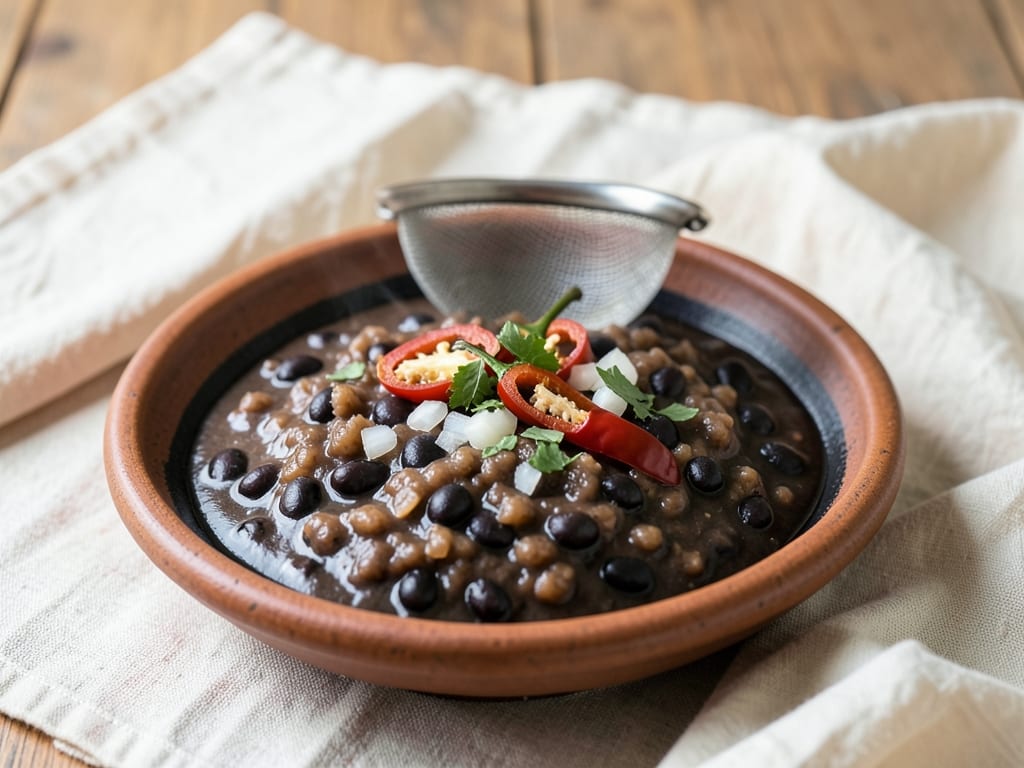
Yucatecan Frijol Colado
Frijol colado is a Yucatecan version of refried beans—black beans slowly mashed with lard and onion, then strained through a fine sieve to create a luxuriously smooth, creamy consistency. Aromatic epazote and optional habanero chile add traditional flavor and depth. This elegant side dish is served throughout the Yucatan Peninsula alongside cochinita pibil, grilled meats, and fresh tortillas.
- Prep
- 8 min
- Cook
- 22 min
- Total
- 30 min
- Makes
- About 2½ cups (600 ml), serves 4 as a side dish
Steps
Before you start
- Have cooked black beans ready—use canned beans (drained and rinsed) or prepare beans from scratch in advance
- Gather fresh epazote if available; if not, have cilantro and ground cumin on hand for a substitute
- Use a heavy-bottomed pot or Dutch oven to prevent sticking and ensure even cooking
- Measure and prep all ingredients before you start, so you can work quickly once heat is applied
Prepare all ingredients
- Drain and rinse the cooked black beans if using canned.
- Finely dice the yellow onion into ¼-inch (6 mm) pieces.
- Pull the epazote leaves from the stems and roughly chop them.
- Halve the habanero lengthwise; remove the seeds if you prefer milder heat, or leave them for more spice.
+ Show details− Hide details
Ready when: All ingredients are prepped and ready
Tip: Prepare everything ahead so you can work quickly once you start cooking
Heat lard in pot
- In a large heavy-bottomed pot (3–4 quart / 3–4 liter), heat 3 tablespoons (43 g) of lard over medium heat.
- Let it melt completely and shimmer, about 1–2 minutes total.
+ Show details− Hide details
Ready when: Lard is melted and shimmering but not smoking
Tip: Keep heat at medium; don't let the lard smoke, as this prevents burnt flavor in the finished dish
Cook diced onion
- Add the finely diced onion to the hot lard.
- Stir frequently with a wooden spoon, cooking for about 5 minutes until the onion is soft and translucent.
- It should smell fragrant and sweet but should not be browned.
+ Show details− Hide details
Ready when: Onion is soft, translucent, and fragrant
Tip: Stir regularly to prevent browning, which would make the finished beans taste bitter
Add beans and chile
- Pour the drained black beans into the pot along with the halved habanero.
- Stir everything together well, making sure the beans are coated with the hot lard.
- The mixture should be moist and easy to stir.
+ Show details− Hide details
Ready when: Beans are evenly coated with lard and habanero is submerged
Mash and simmer beans
- Using a wooden spoon or bean masher, gradually press the beans against the inside wall of the pot, breaking them down into a chunky purée.
- This takes about 5–7 minutes.
- Once the beans are mostly broken down but still retain some texture, stir in the chopped epazote.
- Season with kosher salt and freshly ground black pepper to taste.
- Continue simmering over medium heat for another 5–7 minutes, stirring often, until the mixture is creamy and well combined.
- If it becomes too thick to stir easily, add warm broth ¼ cup (60 ml) at a time, stirring after each addition.
+ Show details− Hide details
Ready when: Beans are mostly broken down into a chunky purée; mixture is creamy and cohesive
Tip: Mash gradually rather than all at once—the resulting texture should be chunky, not smooth, before straining
Strain through fine mesh
- Remove the pot from heat.
- Discard the habanero (or chop it finely and stir back in if you want more heat).
- Working in batches, use the back of a spoon or a spatula to push the bean mixture through a fine-mesh strainer.
- This step is essential for traditional frijol colado—it creates the smooth, luxuriously creamy texture that distinguishes it from regular refried beans.
- The strained result should be thick and spreadable with no visible bean pieces, taking about 5–10 minutes total.
+ Show details− Hide details
Ready when: All bean mixture has passed through strainer; result is smooth and creamy
Tip: If the mixture cools and becomes hard to push through, reheat it gently over low heat for 1–2 minutes first
Finish and serve
- Return the strained beans to the pot and reheat gently over low heat for 1–2 minutes.
- Taste and adjust seasoning with additional salt and pepper if needed.
- If the beans have thickened and become stiff, thin with a splash of warm broth (a few tablespoons at a time), stirring until it reaches a creamy, spreadable consistency.
- Transfer to a serving bowl and serve hot.
- Frijol colado is traditionally served as a side dish alongside Yucatecan specialties like cochinita pibil, fresh tortillas, or grilled meats.
+ Show details− Hide details
Ready when: Mixture is heated through; consistency is smooth and creamy
Tip: Add broth gradually in small amounts—you can always add more but cannot remove it once added
Good to know
Tips
- Don't over-mash too quickly—gradual mashing creates better texture than pureeing all at once
- The straining step is essential to traditional frijol colado; it creates the signature smooth, creamy consistency that distinguishes it from regular refried beans
- Adjust consistency with warm broth gradually; you can always add more but cannot remove it once added
- If fresh epazote is unavailable, the combination of cilantro and a small pinch of cumin is your best substitute
Make ahead
Frijol colado can be made up to 2 days ahead and refrigerated in an airtight container. Reheat gently over low heat, stirring often and thinning with a splash of warm broth if needed to restore creaminess.
Storage & reheating
Room temperature: up to 2 hours. Refrigerator: up to 3 days in an airtight container. Freezer: up to 3 months; thaw in the refrigerator overnight and reheat over low heat, stirring often and adding warm broth to restore texture. Note: texture may become slightly more grainy after freezing, but flavor remains excellent.
Substitutions
- fresh epazote → 2 tablespoons fresh cilantro plus ¼ teaspoon ground cumin. Provides herbaceous flavor; while different from epazote, this combination captures some of its mineral quality
- rendered pork lard → unsalted butter or neutral vegetable oil (3 tablespoons / 43 g or 45 ml). More accessible alternatives; rendered lard is traditional and contributes authentic rich flavor
- fresh habanero chiles → jalapeño or serrano chile, or omit entirely. Adjusts heat level from mild (jalapeño) to moderate (serrano) to none; habanero is traditional to Yucatecan cuisine
- cooked black beans → cooked pinto beans (same amount). Similar texture when strained; slightly different earthy flavor, but still produces excellent results
More bean sides
See all →
Find more like this
- Meal
- Dinner
- Cuisine
- Mexican
- Main ingredient
- Black Beans
- Method
- Stovetop