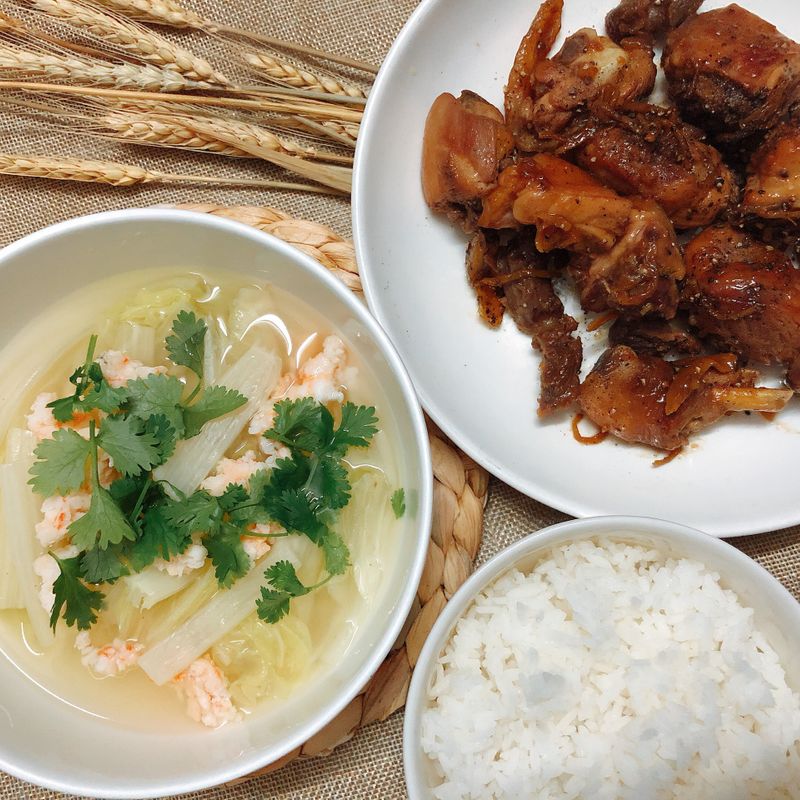
Vietnamese Caramelized Pork and Daikon Chowder
A Vietnamese-style braise combining tender pork shoulder with caramelized onions and silky daikon radish in a savory-sweet broth infused with fish sauce and garlic. The caramel adds depth and richness while keeping the broth light and fragrant. Served over steamed rice with fresh scallions and cilantro.
- Prep
- 20 min
- Cook
- 1 hr 15 min
- Wait
- 15 min
- Total
- 1 hr 50 min
- Makes
- 4 servings (about 9 cups total)
Steps
Before you start
- Cut pork shoulder into 1½-inch (4 cm) cubes and pat very dry with paper towels—this helps it brown properly
- Peel daikon radish and cut into 1-inch (2.5 cm) cubes; set aside
- Measure all ingredients before you begin, especially the caramel—it goes quickly
- Have a slotted spoon and wooden spoon at hand for stirring the caramel
Sear the pork
- Heat the vegetable oil in a large 5-quart pot over medium-high heat (about 2 minutes).
- Working in two batches so as not to crowd the pan, add the pork cubes and sear until golden brown on two sides, about 4–5 minutes per batch.
- Use a slotted spoon to transfer to a clean plate.
- The pork doesn't need to be cooked through, just browned.
+ Show details− Hide details
Ready when: Pork cubes are golden brown on at least two sides
Tip: Dry pork creates a better crust. Don't stir constantly—let each side sit for 2 minutes to develop color.
Make the caramel
- Lower heat to medium.
- Add the sugar directly to the empty pot (no water yet).
- Stir frequently with a wooden spoon as it melts and turns deep amber, about 5–6 minutes.
- Watch carefully—caramel burns quickly.
- When it reaches a dark copper color and smells sweet-toasty (not burnt), immediately pour in 2 tablespoons of the water to stop the cooking.
- The caramel will bubble and seize slightly; stir until smooth, then remove from heat for 1 minute.
+ Show details− Hide details
Ready when: Caramel is deep amber (like iced tea) and smells sweet and toasty, not acrid
Tip: Have the water measured and nearby before you start. Caramel goes from perfect to burnt in seconds—don't step away.
Build the base broth
- Return the pot to medium heat and add the sliced onion.
- Stir for 2 minutes to coat in the caramel.
- Add the minced garlic and stir for 1 minute until fragrant.
- Pour in the remaining 3¾ cups (890 ml) of water and scrape the bottom of the pot to dissolve any caramelized bits.
- Bring to a simmer, about 3–4 minutes.
+ Show details− Hide details
Ready when: Broth simmers gently with small bubbles breaking the surface
Tip: Deglazing the pot captures all the caramel flavor—scrape gently so you don't scratch the pan.
Return pork and season
- Add the seared pork back to the pot, along with the daikon radish cubes.
- Stir in the fish sauce and black pepper.
- Bring to a gentle boil, then reduce heat to medium-low and establish a steady simmer with just occasional bubbles rising to the surface.
+ Show details− Hide details
Ready when: Liquid simmers gently with one or two bubbles at a time breaking the surface
Tip: Keep the simmer gentle—a rolling boil will toughen the pork and cloud the broth.
Braise until tender
- Partially cover the pot with a lid (leave a small gap for steam to escape) and simmer for 50–55 minutes.
- Stir occasionally and check that the pork is becoming very tender—it should break apart easily when pressed with a spoon.
- The daikon should be soft and have absorbed the broth's color.
- Skim any foam or impurities that rise to the surface during the first 10 minutes.
- An instant-read thermometer inserted into the thickest pieces should read 145°F (63°C) or higher for food safety.
+ Show details− Hide details
Ready when: Pork is fork-tender and breaks apart easily; daikon is soft throughout and translucent; pork reaches 145°F (63°C) internally
Tip: If broth is boiling hard, reduce heat a notch. The slower the simmer, the more tender the meat.
Add scallion whites and finish
- Add the white parts of the scallions to the pot.
- Simmer uncovered for 3–4 minutes to soften them slightly and let their flavor infuse the broth.
- Taste and adjust seasoning with additional fish sauce (a teaspoon at a time) if needed—the broth should taste balanced between savory, sweet, and umami.
+ Show details− Hide details
Ready when: Scallion whites are soft and translucent at the edges
Tip: Save the green scallion tops for garnish—they'll stay fresher and brighter raw.
Rest and serve
- Remove from heat and let the chowder rest for 5 minutes.
- Ladle into bowls and serve over steamed white rice.
- Garnish with the reserved green scallion tops and fresh cilantro (if using).
- A squeeze of lime is optional but traditional.
+ Show details− Hide details
Ready when: Chowder is piping hot and fragrances are fully developed
Tip: Resting allows flavors to integrate. The longer the broth sits, the deeper its taste becomes.
Good to know
Tips
- The caramel is the soul of this dish—don't skip it or rush it. A proper deep-amber caramel creates a subtle sweetness that makes the pork and broth taste rich and layered.
- If your caramel hardens after you pour in the water, return the pot to low heat and stir until it becomes smooth again. This is normal.
- For a lighter, brothier chowder, add an extra ½ cup (120 ml) of water after the initial braise. For a more concentrated, gravy-like finish, simmer uncovered for the last 5 minutes.
- Serve with steamed jasmine rice and a small dish of lime wedges on the side. A drizzle of fish sauce and a pinch of chili flakes at the table let guests adjust flavor to their taste.
Make ahead
Prepare the chowder up to 1 day ahead. Cool to room temperature, then refrigerate in an airtight container. The flavors actually deepen overnight. Reheat gently over medium heat, stirring occasionally, until steaming (about 10 minutes). Do not boil. Add fresh scallion greens and cilantro just before serving.
Storage & reheating
Room temperature: up to 2 hours. Refrigerator: up to 4 days in an airtight container. Freezer: up to 2 months in a freezer-safe container; thaw overnight in the fridge before reheating. Reheat gently over medium heat until hot through, about 8–10 minutes, stirring occasionally.
Substitutions
- daikon radish, peeled → turnips or potatoes (1-inch cubes). Turnips offer similar sweetness and texture; potatoes will be starchier and heartier. Add 5 minutes to cooking time for potatoes.
- pork shoulder, cut into 1½-inch (4 cm) cubes → beef chuck or beef short ribs. Beef will need 60–70 minutes to reach tenderness. Flavor will be deeper and less delicate.
- fish sauce → soy sauce (use 2 tablespoons) plus 1 teaspoon of anchovy paste. Soy sauce alone will make the broth less funky and umami-rich; anchovy paste restores depth.
- fresh cilantro leaves → mint or basil. Mint adds brightness; basil adds an herbal note. Either works well as a fresh garnish.
More chowders
See all →

Find more like this
- Meal
- Dinner
- Main ingredient
- Pork Shoulder
- Method
- Stovetop
- Quick & Easy
- One-Pot