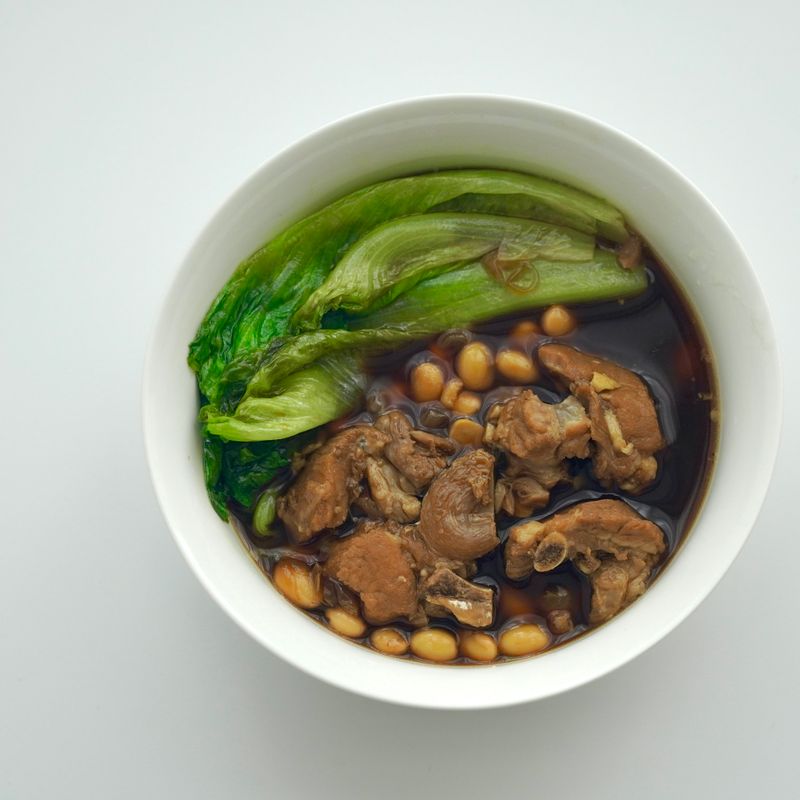
Chinese Sichuan Peppercorn Pork and Bok Choy Chowder
A warming, umami-rich chowder built on braised pork belly, aromatic Sichuan peppercorns, and tender bok choy. The doubanjiang (spicy bean paste) and ginger create a deeply flavored broth with the distinctive numbing and tingling sensation that makes Sichuan cuisine distinctive. Finished with scallions and a touch of sesame oil, this is comfort food with serious depth.
- Prep
- 15 min
- Cook
- 1 hr
- Wait
- 10 min
- Total
- 1 hr 25 min
- Makes
- 4 servings (about 1½ cups per bowl)
Steps
Before you start
- Cut pork belly into bite-sized pieces and pat dry
- Measure all ingredients before starting (mise en place)
- Have chicken or pork stock ready
- Bok choy cleaned and separated into leaves and stems
Toast peppercorns
- Heat a large Dutch oven (5-quart / 4.7 L) over medium heat.
- Add the 1.5 tbsp (15 g) Sichuan peppercorns and toast for about 1 minute, stirring often, until fragrant.
- Watch carefully—they can burn quickly.
- Set aside on a small plate.
+ Show details− Hide details
Ready when: Peppercorns become fragrant, with a slight aroma
Tip: Toasting blooms the peppercorns' flavor; don't let them smoke or turn black
Sear the pork
- Increase heat to medium-high and add 1 tbsp (15 ml) neutral oil.
- Working in two batches to avoid crowding, sear the 1.5 lbs (680 g) pork belly cubes for 2–3 minutes per batch, turning once, until lightly golden on at least two sides.
- Transfer to a plate.
- Do not cook through—they will finish braising later.
+ Show details− Hide details
Ready when: Pork cubes are golden brown on the outside; still pink inside
Tip: Pat pork dry before searing; moisture prevents browning. Don't move pieces around—let them rest 1 minute per side
Build the base
- Reduce heat to medium.
- In the same pot, add 3 tbsp (30 g) minced ginger and 4 minced garlic cloves.
- Stir constantly for about 1 minute until fragrant.
- Add 2 tbsp (30 g) doubanjiang and stir well, coating everything in the paste.
- Cook for 1 more minute, breaking up any clumps.
+ Show details− Hide details
Ready when: Mixture is aromatic and the paste is fully integrated
Tip: Don't let the garlic or ginger scorch; they should soften and become fragrant, not brown
Deglaze and add stock
- Pour in 6 cups (1420 ml) stock, stirring to loosen any browned bits from the pot bottom.
- Add the reserved toasted Sichuan peppercorns and 1.5 tbsp (22 ml) soy sauce.
- Bring to a simmer, stirring occasionally.
+ Show details− Hide details
Ready when: Liquid simmers with gentle bubbles around the edge; no rolling boil
Tip: Simmer gently—a full boil can make the pork tough and cloud the broth
Return pork and braise
- Return the seared pork belly to the pot along with any accumulated juices.
- Stir well, ensuring the pork is submerged.
- Lower heat to medium-low and partially cover with a lid (leave it slightly ajar).
- Simmer for 35–40 minutes, until the pork is tender and reaches an internal temperature of 145°F (63°C) when checked with an instant-read thermometer.
- Skim off any foam or fat that rises to the surface during the first 5 minutes.
+ Show details− Hide details
Ready when: Pork is fork-tender and yields easily; internal temperature reads 145°F (63°C); broth is glossy and rich
Tip: A partially covered pot lets moisture escape slowly, concentrating flavor while preventing the broth from reducing too much
Add bok choy stems
- Add the bok choy stems (the thicker, white/pale parts) to the broth.
- Stir gently to distribute them.
- Simmer for 3 minutes.
+ Show details− Hide details
Ready when: Stems are just barely tender when pierced with a fork
Tip: Add stems before leaves; they need more time to cook through
Finish with greens
- Add the bok choy leaves to the pot and stir gently.
- Simmer, uncovered, for 2–3 minutes until the leaves are wilted but still vibrant green.
+ Show details− Hide details
Ready when: Leaves are tender and dark green; no crispness remains
Tip: Don't overcook the leaves or they'll turn drab olive and lose texture
Season and finish
- Remove from heat.
- Drizzle in 1 tbsp (15 ml) dark sesame oil and stir well.
- Taste the broth and adjust seasoning with white pepper (if using) or a pinch more soy sauce if needed.
- The broth should have a warming tingle from the Sichuan peppercorns, balanced heat from the doubanjiang, and umami depth from the pork and stock.
+ Show details− Hide details
Ready when: Broth is well-balanced, aromatic, and glossy
Tip: Add sesame oil off heat so its delicate aroma isn't lost to heat
Serve
- Ladle the chowder into bowls, dividing the pork, bok choy, and broth evenly (about 1½ cups / 360 ml per serving).
- Scatter sliced scallions over the top.
+ Show details− Hide details
Tip: Serve immediately while the chowder is steaming hot
Good to know
Tips
- The Sichuan peppercorn 'numbing' sensation (called máláwěi in Mandarin) builds slowly and lingers. If you find it too intense, reduce the amount to 1 tbsp (10 g).
- Doubanjiang varies in heat level by brand; start with 2 tbsp and taste as you go. You can always add more after braising, but you can't remove it.
- For a thicker chowder, simmer uncovered for the last 5 minutes of braising to reduce the liquid slightly. For brothier results, add another cup (240 ml) of stock.
- Don't discard the rendered pork fat on the surface of the cooled broth—it's deeply flavorful and can be used to start the base when reheating.
Make ahead
Prepare the chowder up to the end of step 5 (after braising the pork, before adding bok choy). Cool, cover, and refrigerate for up to 3 days. Reheat gently over medium-low heat for 8–10 minutes, then add the bok choy stems and leaves as in steps 6–7.
Storage & reheating
Room temperature: keep warm and consume within 2 hours. Refrigerator: store in an airtight container for up to 3 days; the pork meat keeps well, though the bok choy will soften. Freezer: freeze the broth and pork (without bok choy) for up to 2 months in freezer bags or containers. To reheat from frozen, thaw overnight in the fridge, then warm gently on the stovetop over medium-low heat for 10–12 minutes, adding fresh bok choy as you would for a freshly made batch.
Substitutions
- pork belly, skin removed, cut into ¾-inch (2 cm) cubes → boneless pork shoulder (butt), cut into ¾-inch cubes. Leaner but still flavorful; reduce braising time slightly to 30–35 minutes since it has less marbling
- doubanjiang (spicy broad bean paste) → 2 tbsp (30 g) spicy gochujang mixed with 1 tsp miso paste. Korean-Chinese fusion flavor; slightly different heat profile but similar umami depth
- bok choy, trimmed → Chinese broccoli (gai lan) or spinach (add spinach only in the last 30 seconds to prevent overcooking). Gai lan has a pleasant bitterness; spinach wilts faster so add it last
- chicken or pork stock → vegetable stock or water. Water will be less rich; use 5¾ cups and add 1 extra tbsp soy sauce to boost umami
More chowders
See all →
Find more like this
- Meal
- Lunch
- Cuisine
- Sichuan
- Main ingredient
- Pork Shoulder
- Method
- Stovetop