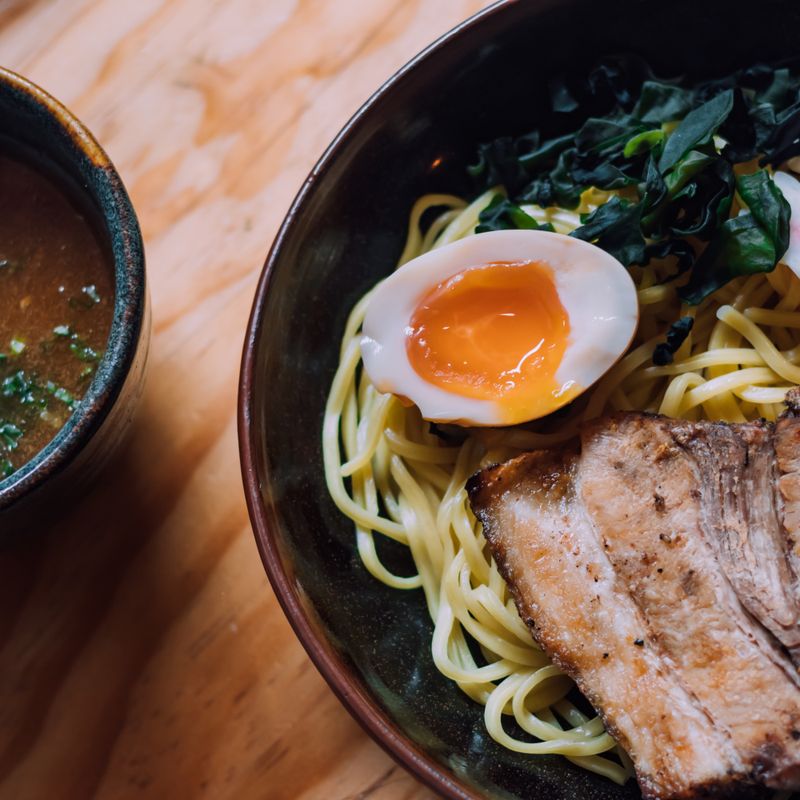
Japanese Ramen Broth and Chashu Pork Chowder
A rich, deeply flavored ramen-style chowder featuring melt-in-your-mouth chashu pork braised in a savory shoyu broth infused with mirin, sake, and aromatics. Topped with chewy ramen noodles, bamboo shoots, soft-boiled eggs, and scallions for a restaurant-quality bowl that's entirely made at home.
- Prep
- 25 min
- Cook
- 3 hr
- Wait
- 30 min
- Total
- 3 hr 55 min
- Makes
- 4 large bowls (about 2 cups each)
Steps
Before you start
- Bring 2 cups of water to boil for the soft-boiled eggs and set aside—they'll cook while the broth simmers
- Read through both the broth and pork timing so you can time the noodles correctly at the end
- Have all aromatics prepped and ready before you begin braising the pork
Sear the pork
- Heat 1 tbsp (15 ml) oil in a large heavy-bottomed pot or Dutch oven over medium-high heat.
- Pat the 2.5 lb (1134 g) pork shoulder completely dry with paper towels.
- Once oil shimmers, place the pork in the pot and sear on all sides for 8–10 minutes total, turning every 2–3 minutes, until deeply browned.
- You're building flavor through the Maillard reaction, so don't be afraid of color.
+ Show details− Hide details
Ready when: Pork is golden-brown and caramelized on all sides
Tip: Don't move the pork constantly; let each side sit for 2–3 minutes to develop a crust.
Build the braising liquid
- Remove the pork and set aside.
- Pour off all but 1 tbsp of fat from the pot.
- Add the smashed ginger and garlic and cook for 1–2 minutes over medium heat, stirring gently, until fragrant.
- Pour in 0.5 cup (120 ml) sake, scraping the bottom of the pot to release any browned bits.
- Let it simmer for 1 minute to cook off alcohol.
- Add 0.5 cup (120 ml) soy sauce, 0.25 cup (60 ml) mirin, 1 tbsp (12 g) sugar, and 6 cups (1440 ml) dashi or chicken stock.
- If using kombu, add it now.
- Stir to combine.
+ Show details− Hide details
Ready when: Liquid is fragrant and thoroughly combined with caramelized bits dissolved
Tip: Scraping the fond (brown bits) from the pot adds deep umami to your broth.
Return pork and braise
- Return the seared pork to the pot, skin-side up if possible.
- Add the halved scallion whites.
- Bring to a gentle simmer, then reduce heat to low.
- The liquid should barely bubble—no rolling boil.
- Cover partially (lid tilted so steam can escape) and braise for 2 hours, turning the pork every 30 minutes so it cooks evenly and stays submerged.
+ Show details− Hide details
Ready when: Pork is fork-tender and a thermometer inserted at the thickest point reads 190°F (88°C); meat shreds easily
Tip: Turn the pork every 30 minutes to ensure even cooking and flavor absorption.
Soft-boil the eggs
- While the pork braises, bring 2 cups (480 ml) water to a boil in a small saucepan.
- Gently lower in 4 large eggs and cook for 6–7 minutes: 6 minutes gives a jammy yolk with a barely set white, 7 minutes yields a firmer but still-soft yolk.
- Transfer to an ice bath immediately to stop cooking.
- Once cool, peel gently under running water, starting from the wider end where the air pocket sits.
+ Show details− Hide details
Ready when: Egg whites are set and opaque; yolk is creamy or jammy depending on time
Tip: Start your timer the moment the eggs hit the boiling water for consistent results.
Remove pork and strain broth
- Once the pork is tender, transfer it to a cutting board and let rest for 5 minutes.
- Strain the braising liquid through a fine-mesh sieve into a clean pot, discarding the solids (ginger, garlic, scallions, kombu).
- Skim any excess fat from the surface with a ladle or spoon if you prefer a lighter broth (or leave it for more richness).
- You should have about 5–6 cups (1200–1440 ml) of broth.
+ Show details− Hide details
Ready when: Broth is clear and fragrant, solids are separated
Tip: If the broth cools slightly, it's easier to skim fat from the surface.
Slice and warm the pork
- Once the pork has rested, slice it against the grain into ¼-inch (6 mm) thick slices.
- Gently reheat the strained broth over medium heat until steaming but not boiling.
- Add the pork slices back in and simmer for 2–3 minutes to warm them through, then remove them with tongs and set aside.
- The broth is now ready for serving.
+ Show details− Hide details
Ready when: Pork slices are warmed through and broth steams gently
Tip: Slice against the grain to keep the meat tender; too-thin slices may fall apart in the broth.
Cook the ramen noodles
- Bring a large pot of water to a rolling boil.
- Add 10 oz (280 g) ramen noodles and cook according to package directions—usually 3–4 minutes for fresh, 4–5 for dried.
- Stir occasionally to prevent sticking.
- Drain in a colander and divide among four large bowls.
+ Show details− Hide details
Ready when: Noodles are tender but with a slight bite; no hard white core remains when bitten
Tip: Cook noodles fresh, just before serving, so they don't become mushy from sitting in hot broth.
Warm the bamboo shoots
- While the noodles cook, gently warm 1 cup (150 g) drained bamboo shoots in a small saucepan with a splash of the hot broth (about ¼ cup / 60 ml) over medium heat for 2 minutes.
- This flavors them lightly without drying them out.
+ Show details− Hide details
Ready when: Bamboo shoots are steaming and fragrant
Tip: Don't overcook bamboo shoots; they should stay tender and crisp, not mushy.
Assemble the bowls
- Ladle 1.5 cups (360 ml) of the hot broth over the noodles in each bowl.
- Arrange a portion of the warm chashu pork slices on top.
- Add a few warm bamboo shoots to each bowl.
- Place a soft-boiled egg half on the side (you can halve the eggs or leave them whole).
- Scatter the thinly sliced scallion greens over the top and add nori and sesame seeds if using.
- Serve immediately.
+ Show details− Hide details
Ready when: Bowls are assembled, broth is steaming, all components are warm and visible
Tip: Assemble bowls right before serving so everything stays at the perfect temperature.
Good to know
Tips
- For deeper umami, make or buy dashi from scratch or use dashi powder dissolved in hot water. It transforms the broth.
- Don't skip the searing step—it builds the caramelized flavors that make this broth special.
- The pork can be braised a full day ahead; the flavors deepen as it sits in the broth.
- Soft-boiled egg yolk color is a visual cue: cut one open when you think it's done. You'll quickly learn your preference.
Make ahead
You can braise the pork and make the broth up to 2 days ahead. Store both in separate airtight containers in the fridge. Reheat the broth gently over medium-low heat, then warm the sliced pork in it for 2–3 minutes before serving. Soft-boil the eggs on the day you serve the chowder for best texture. Noodles should be cooked fresh just before serving.
Storage & reheating
Store braised pork and broth separately in airtight containers in the refrigerator for up to 2 days or frozen for up to 3 months. To reheat, thaw overnight in the fridge if frozen, then warm the broth gently over medium heat and add the pork slices, simmering for 2–3 minutes. Cook noodles fresh and soft-boil eggs fresh each time you serve.
Substitutions
- dashi stock (or low-sodium chicken stock) → low-sodium chicken or vegetable stock. The broth will be slightly less umami-forward but still delicious. Use 1:1 ratio.
- mirin (sweet rice wine) → 2 tbsp honey or 1.5 tbsp brown sugar mixed with 1 tsp water. Adds sweetness and gloss. Reduce amount slightly as substitute is more intense.
- fresh or dried ramen noodles → fresh or dried udon noodles, or thin egg noodles. Udon will be chewier; egg noodles lighter. Adjust cooking time per package.
- canned bamboo shoots, drained → sliced mushrooms (shiitake or cremini), sautéed, or bok choy halves blanched. Maintains the vegetable component and Japanese flavor profile.
More chowders
See all →
Find more like this
- Meal
- Dinner
- Cuisine
- Japanese
- Main ingredient
- Pork Shoulder
- Diet
- Dairy-Free
- Method
- Stovetop