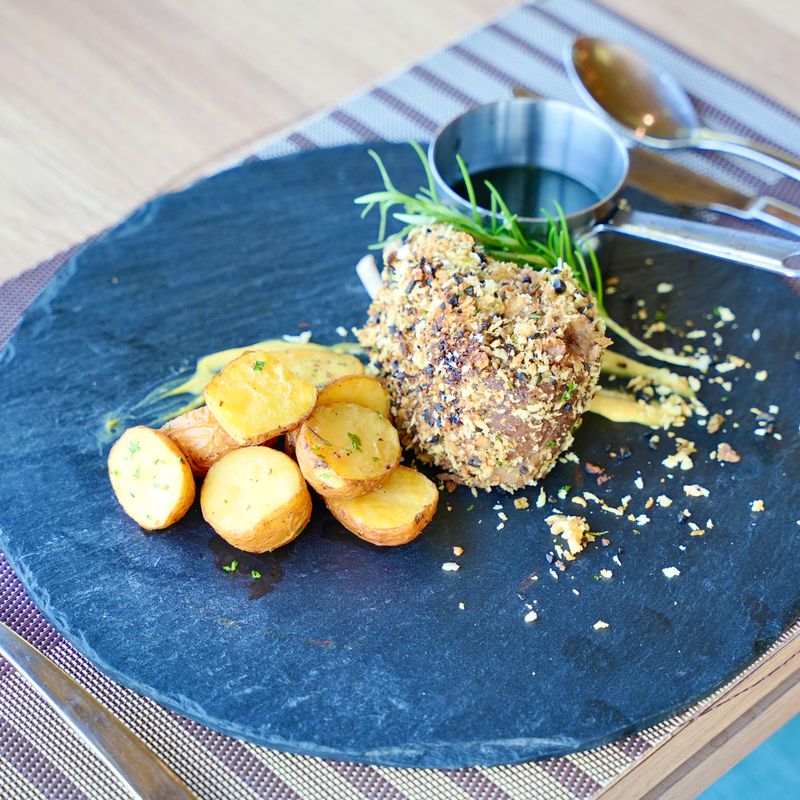
Venezuelan Arepa-Crusted Roasted Pork Loin
A showstopping roasted pork loin coated with a crispy arepa crust infused with garlic and cilantro. The corn flour crust becomes golden and crunchy while the interior stays tender and juicy. This Venezuelan-inspired main combines the comforting flavors of arepa dough with slow-roasted pork, creating a stunning centerpiece with a satisfying textural contrast.
- Prep
- 20 min
- Cook
- 50 min
- Wait
- 15 min
- Total
- 1 hr 25 min
- Makes
- 1 pork loin (6 servings)
Steps
Before you start
- Preheat oven to 425°F (220°C)
- Pat pork loin dry with paper towels to help the crust adhere
- Have precooked arepa flour (corn flour) on hand—do not use raw cornmeal
- Allow pork to reach room temperature for 30 minutes before roasting
Season the pork
- Rub the pork loin on all sides with 1 tsp sea salt and ½ tsp black pepper, working the seasonings into all crevices and the top surface.
- Let sit at room temperature for 10 minutes so the salt penetrates the meat.
+ Show details− Hide details
Ready when: Pork is evenly seasoned
Tip: Dry pork allows the arepa crust to adhere properly and creates better browning
Make the arepa crust mixture
- In a small bowl, combine 1.5 cups arepa flour, minced garlic, chopped cilantro, ½ tsp cumin, ¼ tsp smoked paprika, ½ tsp sea salt, and ¼ tsp black pepper.
- Stir well to distribute the seasonings evenly throughout the flour.
- The mixture should be dry and uniform in color.
+ Show details− Hide details
Ready when: All ingredients are evenly combined with no visible lumps
Tip: Use precooked arepa flour (not raw cornmeal) so the crust cooks through before the pork overcooks
Coat the pork with crust
- Rub 2 tbsp of olive oil all over the seasoned pork loin, covering the entire surface.
- Pour the arepa flour mixture onto a shallow plate or cutting board.
- Roll the oiled pork in the flour mixture, pressing gently so the coating adheres to the oil, turning to coat all sides and the ends evenly.
- Pat any remaining flour onto the top and sides to create an even layer.
+ Show details− Hide details
Ready when: Pork is completely coated in a thin, even layer of arepa flour
Tip: The oil helps the flour crust stick; if it's too dry, it won't adhere during roasting
Sear the pork
- Heat 1 tbsp olive oil in a large heavy roasting pan over medium-high heat until shimmering, about 2 minutes.
- Carefully place the coated pork loin in the pan and sear for 3–4 minutes per side (turning once), until the arepa crust is golden-brown and crispy.
- Work quickly so the crust doesn't burn; adjust heat if needed.
+ Show details− Hide details
Ready when: Arepa crust is golden-brown and crispy on all exposed sides
Tip: Don't overcrowd the pan or move the meat too early; let it develop color before turning
Add broth and roastOven 425°F / 220°C
- Pour the beef broth into the roasting pan around (not over) the pork, avoiding the top crust.
- Insert a meat thermometer into the thickest part of the loin without touching bone.
- Place the pan in a preheated 425°F (220°C) oven.
+ Show details− Hide details
Ready when: Broth is simmering gently around the pork
Tip: Keep broth away from the top crust so it stays crispy while the meat roasts gently
Roast until doneOven 425°F / 220°C
- Roast uncovered for 35–45 minutes, depending on thickness and your oven.
- The pork is done when the meat thermometer reads 145°F (63°C) for medium doneness.
- The arepa crust will deepen in color and become even crispier during roasting.
- If the crust browns too quickly, loosely tent the top with foil.
+ Show details− Hide details
Ready when: Meat thermometer reads 145°F (63°C) in the thickest part; crust is deeply golden and crispy
Tip: Invest in an accurate meat thermometer; pork should never be overcooked to dry, and this ensures perfectly juicy results
Rest the pork
- Remove the roasting pan from the oven and transfer the pork loin to a carving board.
- Tent loosely with foil and let rest for 10–15 minutes.
- This allows juices to redistribute throughout the meat, keeping it tender when sliced.
+ Show details− Hide details
Ready when: Pork is resting peacefully, still warm
Tip: Skipping this step wastes the flavorful juices; they run out onto the cutting board instead of staying in the meat
Make a quick pan sauce
- While the pork rests, place the roasting pan on the stove over medium-high heat.
- Scrape up any flavorful browned bits from the bottom with a wooden spoon, stirring for 2–3 minutes.
- Simmer until the liquid reduces to about ¾ cup, concentrating the flavors.
- Taste and adjust seasoning with salt and pepper if needed.
+ Show details− Hide details
Ready when: Liquid is glossy, reduced by about a quarter, and coats the back of a spoon
Tip: The flavorful pan drippings are liquid gold; don't skip this step as it creates an excellent sauce
Carve and serve
- Using a sharp carving knife, slice the pork loin crosswise against the grain into ½-inch-thick slices.
- Arrange on a serving platter and drizzle with the pan sauce.
- Serve warm, garnishing with a small handful of fresh cilantro if desired.
+ Show details− Hide details
Ready when: Slices are neat, evenly sized, and show a light pink center
Tip: Carve against the grain so each slice is tender; the arepa crust will crackle when you cut into it
Good to know
Tips
- Arepa flour (harina de maíz P.A.N.) is precooked, unlike regular cornmeal. Using the wrong product will result in a gritty, raw-tasting crust—look for 'P.A.N.' on the bag or buy it at a Latin market.
- A meat thermometer is non-negotiable here. Pork at 145°F is safe, tender, and juicy; overcooking to 160°F produces dry, tough meat.
- For a deeper golden crust, place the rested pork under a hot broiler for 1–2 minutes just before serving, watching carefully to avoid burning.
- Pair this with traditional Venezuelan sides like arepas with cheese, black beans, or a fresh avocado and tomato salad for an authentic experience.
Make ahead
The arepa crust mixture can be prepared up to 4 hours ahead and stored in an airtight container at room temperature. The pork can be seasoned and brought to room temperature 1 hour before cooking, but coat it with the arepa flour just before searing for the best crust."
Storage & reheating
Store leftover cooked pork in an airtight container in the refrigerator for up to 3 days. Reheat slices gently in a low oven (300°F / 150°C) for 10–15 minutes until warmed through; avoid the microwave as it toughens the meat. The arepa crust will soften slightly when refrigerated but is still delicious cold or reheated. Leftover pan sauce keeps in the fridge for up to 2 days; reheat gently on the stovetop.
Substitutions
- precooked arepa flour (corn flour / harina de maíz P.A.N. or similar) → finely ground polenta or cornmeal mixed with 1 tbsp all-purpose flour per cup for better binding. Use precooked polenta only; raw cornmeal won't crisp properly before the pork finishes cooking
- fresh cilantro, leafy stems → fresh parsley or a mix of parsley and chives. Cilantro is traditional in Venezuelan cuisine, but use parsley if you dislike cilantro's soapy taste
- beef or chicken broth → chicken broth or vegetable broth. Beef broth provides deeper flavor, but any broth works; avoid salted broths if possible and adjust seasoning at the end
- ground cumin → ground oregano or a pinch of ground coriander. Cumin is essential to Venezuelan flavor, but oregano adds a Mediterranean twist if you prefer
More roasts
See all →
Find more like this
- Meal
- Dinner
- Cuisine
- Caribbean
- Main ingredient
- Pork Shoulder
- Method
- Oven