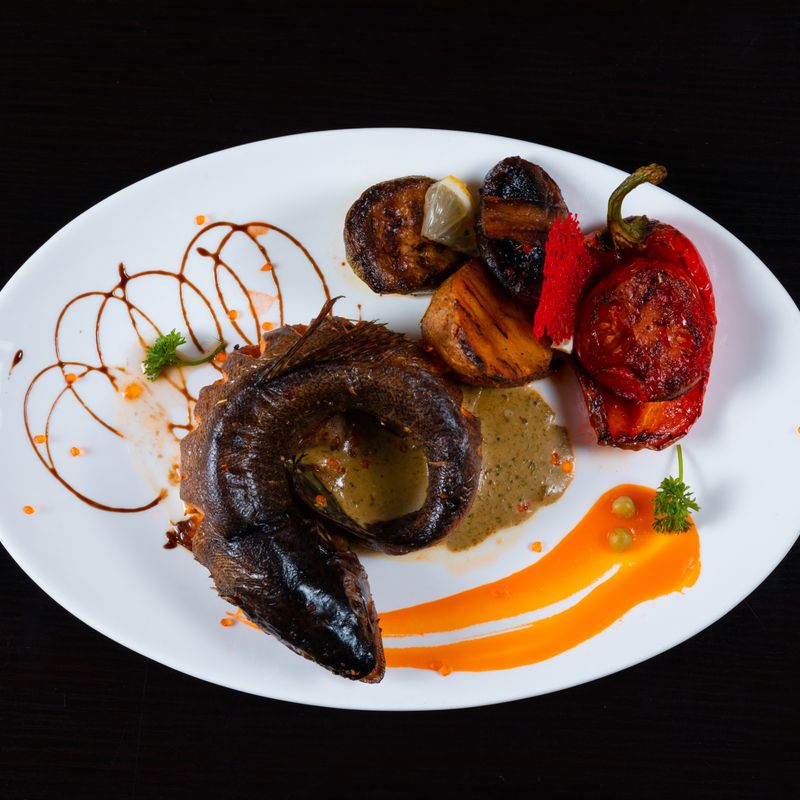
Haitian Sauce Roasted Goat
A slow-roasted goat shoulder infused with a vibrant Haitian seasoning paste of scotch bonnet peppers, garlic, thyme, and allspice. The meat roasts low and slow until fork-tender, basting in its own juices and the aromatic sauce. Deeply savory with bright heat and warm spice, this is classic Caribbean comfort food that feeds a crowd.
- Prep
- 20 min
- Cook
- 4 hr
- Wait
- 30 min
- Total
- 4 hr 50 min
- Makes
- 6 servings (1 goat shoulder, approximately 4–5 lb / 1.8–2.3 kg)
Steps
Before you start
- Pat the goat shoulder dry with paper towels (moisture prevents browning)
- Bring the meat to room temperature for 1 hour before roasting
- Preheat your oven to 325°F (163°C) with the rack in the lower-middle position
- Have a 5-quart (4.7 L) braising pan or Dutch oven ready
Build the seasoning paste
- In a food processor or with a mortar and pestle, combine the seeded scotch bonnets, garlic cloves, onion, thyme leaves, crushed allspice, 1 teaspoon of salt, and freshly ground black pepper.
- Pulse or grind until a coarse, fragrant paste forms.
- Add 1 tablespoon of the olive oil to help it come together.
- Taste and adjust salt and pepper as needed.
+ Show details− Hide details
Ready when: paste is coarse and fragrant, clinging together
Tip: Wear food-prep gloves when handling scotch bonnets to protect your hands from the intense capsaicin oils. Do not touch your face.
Season and score the meat
- Place the dried goat shoulder on a cutting board.
- Using a sharp knife, score the skin in a crosshatch pattern (cuts about ¼ inch / 6 mm deep).
- Rub the entire surface—skin, meat crevices, and bone—with the remaining 2 tablespoons of olive oil, then generously apply the seasoning paste, working it into all crevices and under the skin where possible.
- Season any exposed meat with the remaining 1 teaspoon of salt and more black pepper.
+ Show details− Hide details
Ready when: meat is evenly coated with paste and scored
Tip: Scoring the skin helps the seasoning penetrate and renders the skin during cooking. Work paste under the skin with your fingers for maximum flavor absorption.
Preheat and searOven 325°F / 165°C
- Preheat the oven to 325°F (163°C).
- Heat the Dutch oven over medium-high heat for 2 minutes until hot.
- Carefully place the seasoned goat shoulder skin-side down into the pot and sear for 4–5 minutes until the skin browns deeply and chars slightly.
- Do not move it—let the bottom develop a rich crust.
- Flip and sear the other side (bone side) for 3–4 minutes.
- You should hear a strong sizzle; if it quiets, the pan is hot enough already.
+ Show details− Hide details
Ready when: skin is golden-brown and charred in spots, fat has rendered
Tip: Do not move the meat while searing the first side; moving it prevents a good crust from forming. The moisture from the paste may cause sputtering—this is normal and desired.
Build the braising liquid
- Remove the browned goat to a plate.
- Pour off all but 1 tablespoon of fat from the pot (keep the browned bits on the bottom).
- Add the orange juice and lime juice to the pot, scraping the bottom with a wooden spoon to dissolve all the crusty, flavorful bits (this is called deglazing).
- Stir in the stock and soy sauce.
- The liquid should smell bright, savory, and complex.
+ Show details− Hide details
Ready when: pan bottom is clean, liquid is uniform and fragrant
Tip: Deglaze thoroughly—those browned bits (fond) contain huge flavor. Use a wooden spoon to scrape and dissolve every bit into the liquid.
Return meat and begin braisingOven 325°F / 165°C
- Return the seared goat shoulder to the pot, skin-side up.
- The liquid should come up about halfway up the meat—if it's too shallow, add a splash more stock.
- Cover the Dutch oven with its lid and transfer to the preheated 325°F (163°C) oven.
- The meat will braise for 3.5 to 4 hours, depending on the size and age of the animal.
+ Show details− Hide details
Ready when: after 3.5 hours, meat should be fork-tender and nearly falling off the bone
Tip: Do not open the oven door frequently. Each time you open it, heat escapes and cooking time extends. Use the oven light to peek if needed.
Check and baste at halfway pointOven 325°F / 165°C
- After 1 hour 45 minutes of braising, carefully open the oven and using a basting brush or large spoon, baste the exposed meat with the braising liquid.
- The meat should be releasing its juices and the sauce should smell savory and deep.
- Re-cover and return to the oven.
+ Show details− Hide details
Ready when: meat is releasing juices, sauce is flavorful
Tip: If the braising liquid is reducing too quickly (evaporating), add a splash more stock. If it seems thin, continue—it will concentrate in the final step.
Finish braising and check donenessOven 325°F / 165°C
- After 3.5 hours total, carefully open the oven.
- The goat should be very tender—insert a fork into the thickest part; it should meet almost no resistance.
- Use an instant-read meat thermometer to check the internal temperature at the thickest part away from bone; it should read 185–190°F (85–88°C) for fully tender, fall-apart meat.
- If it's not quite there, re-cover and braise for another 15–20 minutes, then check again.
+ Show details− Hide details
Ready when: fork slides through meat with no resistance; internal temperature 185–190°F (85–88°C)
Tip: Avoid checking too early; goat meat needs time to become tender. Younger animals cook faster; older ones may need the full 4 hours.
Rest and reduce the sauce
- Remove the Dutch oven from the oven and transfer the goat shoulder carefully to a serving platter.
- Tent loosely with foil and let rest for 20–30 minutes while you finish the sauce.
- Place the pot on the stovetop over medium-high heat and bring the braising liquid to a gentle simmer.
- Simmer uncovered for 10–15 minutes, stirring occasionally, until the sauce has reduced by about one-third and tastes rich and concentrated.
- It should coat the back of a spoon lightly.
+ Show details− Hide details
Ready when: sauce is glossy, reduced, and coats a spoon; no raw alcohol taste
Tip: Resting the meat allows carryover cooking and lets the juices reabsorb into the fibers, keeping the meat moist. Do not skip this step.
Finish and serve
- Pour the reduced sauce over or around the rested goat shoulder on the serving platter.
- Taste the sauce for seasoning—it should be savory, with heat from the scotch bonnets, warmth from allspice, and brightness from the citrus.
- Add a pinch more salt or a splash of lime juice if needed.
- Garnish with sliced scallions if using.
- Serve hot with rice, boiled green bananas, or fried plantains.
+ Show details− Hide details
Ready when: platter is ready to serve; sauce is glossy and fragrant
Tip: If the meat has cooled, you can cover the platter loosely and warm it in a 200°F (93°C) oven for 10 minutes before serving, then add the sauce at table.
Good to know
Tips
- Goat meat has a stronger, more mineral taste than lamb or beef; this is not a flaw—the acidic citrus and aromatic spices are designed to balance and enhance it. Embrace the characteristic flavor.
- If you cannot find fresh scotch bonnets, frozen ones (thawed) work well; canned are softer and less ideal. Dried scotch bonnets can be rehydrated in warm water for 15 minutes, then seeded and used, but fresh are best for this recipe.
- This dish is traditionally served with white rice (to soak up the sauce), boiled or fried green bananas, or fried plantains. It is also excellent over mashed potatoes or with warm flatbread.
- For a spicier dish, leave the seeds in one of the scotch bonnets. For a milder version, remove all seeds and reduce the peppers to 2.
Make ahead
The seasoning paste can be made up to 2 days ahead and stored in an airtight container in the refrigerator. The entire dish can be braised 1 day ahead: let it cool, cover, and refrigerate. Reheat gently in a 325°F (163°C) oven for 30–40 minutes, covered, until warmed through. The sauce will be even more flavorful after a day.
Storage & reheating
Refrigerate leftovers in an airtight container for up to 4 days. The meat will become even more tender as it cools and sits in the sauce. Freeze in a freezer-safe container for up to 3 months. Thaw overnight in the refrigerator and reheat gently in a 325°F (163°C) oven, covered, for 30 minutes until warmed through.
Substitutions
- bone-in goat shoulder → lamb shoulder or beef chuck roast. Goat is traditional and lean with a distinctive flavor; lamb is richer and slightly sweeter; beef is more common in North America but lacks goat's complexity. All work with this braising method—adjust cooking time for size.
- scotch bonnet peppers → habanero or Caribbean red peppers. Scotch bonnets are fruity and intensely hot; habaneros are slightly less fruity but similar heat. Both are traditional in Haitian cooking. Reduce to 2 peppers if heat-sensitive.
- whole allspice berries → 1/2 teaspoon ground allspice plus a pinch of cinnamon and clove. Crushed whole berries provide a fresher, more nuanced flavor; ground allspice is fine if that's what you have. A tiny pinch of cinnamon adds warmth if using ground.
- fresh orange juice → pineapple juice or additional lime juice. Orange juice adds tropical sweetness and acid; pineapple is more traditional in some Caribbean recipes. Lime alone is sharper and less fruity but still delicious.
More roasts
See all →
Find more like this
- Meal
- Dinner
- Cuisine
- Caribbean
- Main ingredient
- Lamb Shoulder
- Method
- Oven