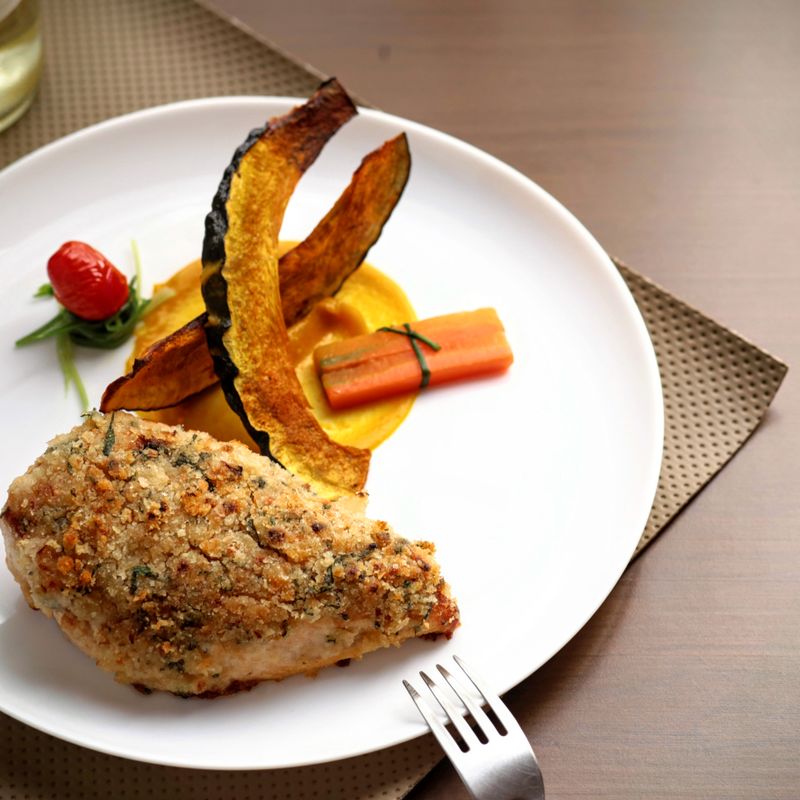
Guyanese Seasoning Roasted Chicken with Roti Crust
A vibrant Guyanese-inspired roasted chicken rubbed with a fragrant spice paste of cilantro, garlic, turmeric, and scotch bonnet pepper, then wrapped in a flaky roti crust and roasted until golden. The roti creates a crispy, protective shell while the chicken inside stays juicy and deeply flavored. Serve hot with lime wedges and fresh cilantro.
- Prep
- 30 min
- Cook
- 1 hr 15 min
- Wait
- 15 min
- Total
- 2 hr
- Makes
- 1 whole chicken, serves 4
Steps
Before you start
- Remove chicken from refrigerator 30 minutes before roasting to bring to room temperature
- Preheat oven to 425°F (220°C)
- Pat chicken dry with paper towels inside and out—this ensures crispy skin
- Have all spice paste ingredients prepped and measured before you begin
Make the spice paste
- In a small food processor, combine the cilantro, garlic cloves, turmeric, scotch bonnet pepper, lime juice, oil, cumin, salt, and black pepper.
- Pulse until a smooth, wet paste forms (about 1 minute).
- If using a mortar and pestle, mince the garlic and cilantro finely, seed and chop the pepper, then combine all ingredients and grind into a paste.
- Set aside.
+ Show details− Hide details
Ready when: Paste is smooth and thoroughly combined with no large chunks
Tip: Don't skip mashing the scotch bonnet fully—it distributes heat and flavor evenly throughout the chicken
Season the chicken
- Pat the chicken dry inside and out with paper towels.
- Place it breast-side up on a cutting board.
- Rub the spice paste all over the outside of the chicken, getting into the skin folds and under the thighs.
- Rub a generous spoonful inside the cavity as well.
- Let the seasoned chicken rest for 5 minutes while you prepare the roti.
+ Show details− Hide details
Ready when: Chicken is thoroughly coated with green-gold spice paste
Tip: Don't be shy with the paste—the more you apply, the more flavor you'll get on the crispy skin
Wrap chicken in roti
- Lay out two sheets of rolled roti dough on your work surface, slightly overlapping them to form a cross.
- Place the seasoned chicken in the center, breast-side up.
- Fold the roti sheets over the chicken, wrapping it completely but leaving the top of the breast exposed for browning.
- Use additional roti scraps to seal any gaps.
- Brush the roti-wrapped chicken all over with melted ghee or butter.
- Transfer to a 13×9-inch roasting pan.
+ Show details− Hide details
Ready when: Chicken is completely enclosed in roti with ghee coating visible
Tip: Leave the top of the breast uncovered so it browns directly in the oven for better texture and color
Roast at high heatOven 425°F / 220°C
- Place the roasting pan in a preheated 425°F (220°C) oven.
- Roast for 25 minutes until the roti is golden brown and starts to crisp.
- The roti will puff slightly as the chicken cooks underneath.
+ Show details− Hide details
Ready when: Roti is golden brown on top and sides
Tip: Don't open the oven door during this phase—consistent heat helps the roti crisp evenly
Lower heat and continue roastingOven 350°F / 175°C
- Reduce the oven temperature to 350°F (175°C).
- Roast for another 45–50 minutes, until the internal temperature at the thickest part of the thigh (not touching bone) reaches 165°F (74°C) when measured with an instant-read thermometer.
- The roti will darken further and become very crispy.
- If the roti begins to burn before the chicken is done, loosely tent it with aluminum foil.
+ Show details− Hide details
Ready when: Instant-read thermometer reads 165°F (74°C) in the thickest part of the thigh; roti is dark golden and crackly
Tip: Insert the thermometer into the thickest part of the inner thigh without touching bone—this is the last part to cook
Rest and serve
- Remove the chicken from the oven and let it rest in the pan for 10–15 minutes.
- This allows the juices to redistribute throughout the meat.
- Carefully transfer the roti-wrapped chicken to a cutting board or serving platter.
- Crack and peel away some of the roti to reveal the golden, spiced skin beneath.
- Cut the chicken into pieces if desired.
- Serve hot with lime wedges and fresh cilantro sprigs on the side.
+ Show details− Hide details
Ready when: Roti is still warm and crispy; chicken is very tender and hot throughout
Tip: Let the chicken rest—cutting too soon will cause juices to run out and the meat will be drier
Good to know
Tips
- Scotch bonnets are quite hot—start with half if you prefer less spice, and add more paste later. Wear gloves when handling them and avoid touching your face
- A free-range or pastured chicken will have more flavor and a more substantial texture than factory-farmed birds. It's worth the investment for this dish
- Don't skip patting the chicken dry before seasoning; moisture prevents good skin crisping and even browning
- Make a double batch of the spice paste and freeze half in an ice-cube tray for up to 3 months—it's wonderful on grilled fish, shrimp, or roasted vegetables
Make ahead
Prepare the spice paste up to 1 day ahead and store it in an airtight container in the refrigerator. Bring it to room temperature before using. The roti dough can be rolled out and stacked with parchment paper between sheets up to 4 hours ahead; keep refrigerated until ready to wrap the chicken.
Storage & reheating
Store leftover roasted chicken with the roti in an airtight container in the refrigerator for up to 3 days. To reheat, wrap loosely in foil and warm in a 325°F (163°C) oven for 15–20 minutes until heated through. Do not microwave, as this will soften the roti crust. Leftover chicken (without the roti) can be frozen for up to 2 months; thaw in the refrigerator overnight before reheating.
Substitutions
- scotch bonnet or habanero pepper → 1 seeded jalapeño or 1 teaspoon cayenne pepper. This will be noticeably milder; adjust to taste. Cayenne gives heat without fresh pepper flavor
- store-bought roti or paratha dough, thawed if frozen → phyllo dough (6–8 sheets, brushed with ghee and layered) or puff pastry sheets. Phyllo and puff pastry will be crispier and more delicate than roti; adjust wrapping technique accordingly
- fresh cilantro leaves, loosely packed → fresh flat-leaf parsley or a mix of parsley and mint. Cilantro is traditional in Guyanese cuisine, but parsley provides herbaceous flavor without the polarizing soap-like taste some detect
- ghee or melted unsalted butter → coconut oil or any neutral cooking oil. Ghee adds richness traditional to the region; coconut oil echoes Caribbean flavors; neutral oil works but adds less flavor
More roasts
See all →
Find more like this
- Meal
- Dinner
- Cuisine
- Caribbean
- Main ingredient
- Whole Chicken
- Diet
- HalalSugar-Free
- Method
- Oven