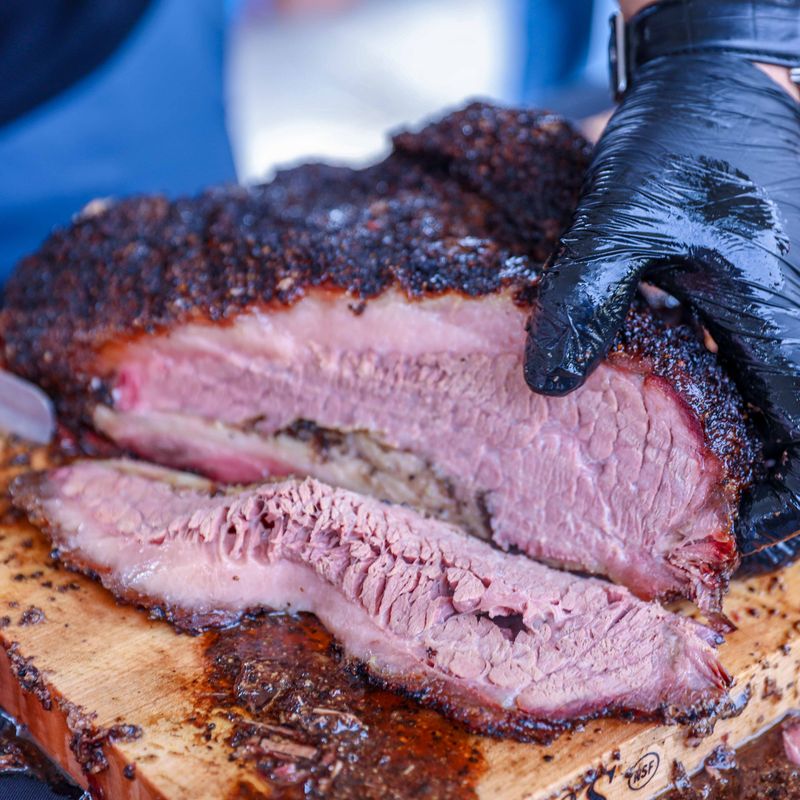
Trinidadian Seasoning Roasted Beef Brisket
A tender, fall-apart beef brisket infused with the bold, aromatic flavors of Trinidad and Tobago. Fresh cilantro, garlic, lime, and scotch bonnet peppers create a fragrant seasoning paste that penetrates the meat during a slow roast. Finished with a rich pan sauce, this showstopper is perfect for family gatherings and celebrations.
- Prep
- 25 min
- Cook
- 5 hr
- Wait
- 30 min
- Total
- 5 hr 55 min
- Makes
- 1 brisket (8 servings)
Steps
Before you start
- Remove beef brisket from refrigerator 1 hour before roasting to bring to room temperature
- Preheat oven to 300°F (150°C)
- Pat the brisket dry with paper towels—this helps browning
- Have a heavy roasting pan with a fitted lid ready
Make the seasoning paste
- Combine cilantro, garlic, scotch bonnet pepper, lime juice, olive oil, ground cumin, ground coriander, and thyme leaves in a medium bowl.
- Stir until it forms a thick paste.
- Season generously with salt and black pepper to taste.
- Set aside.
+ Show details− Hide details
Ready when: paste is fragrant and well combined
Tip: Wear gloves when handling the scotch bonnet pepper to avoid irritation from the oils
Rub and score the brisket
- Place the room-temperature brisket on a clean work surface, fat side up.
- Using a sharp knife, score the fat cap in a crosshatch pattern, cutting about ¼ inch (6 mm) deep—this helps the seasoning penetrate and allows fat to render.
- Rub the seasoning paste all over the brisket, covering the top, sides, and as much of the underside as you can reach.
- Work the paste into the meat with your fingers.
- Season the bare meat areas lightly with additional salt and pepper.
+ Show details− Hide details
Ready when: entire brisket is evenly coated with the green seasoning paste
Tip: Don't be shy with the seasoning—the paste should coat the meat generously for maximum flavor
Sear the brisket
- Heat the roasting pan over medium-high heat on the stovetop until it is very hot and a drop of water evaporates immediately.
- Carefully place the brisket fat side down in the pan.
- Sear for 4–5 minutes without moving it, until the fat cap is deeply browned and caramelized.
- Flip the brisket and sear the meat side for 3–4 minutes until well browned.
- Remove the brisket and set aside on a plate.
+ Show details− Hide details
Ready when: both the fat cap and meat side are deeply browned and caramelized
Tip: Don't move the brisket while searing—let it sit to develop a flavorful crust
Build the braising liquid
- In the same hot roasting pan, scatter the quartered onions.
- Pour in the beef broth, scraping the bottom of the pan with a wooden spoon to release all the flavorful browned bits.
- Return the seared brisket to the pan, fat side up, nestling it among the onions.
- The broth should come partway up the sides of the brisket—about 1½ to 2 inches (4–5 cm) up the meat.
+ Show details− Hide details
Ready when: broth is simmering and all browned bits are dissolved
Tip: Don't add too much liquid—the brisket should braise, not boil
Cover and roast low and slowOven 300°F / 150°C
- Bring the liquid to a gentle simmer on the stovetop.
- Cover the roasting pan tightly with its lid or heavy-duty foil.
- Transfer to the preheated 300°F (150°C) oven.
- Roast for 4 to 5 hours.
- After 2 hours, flip the brisket so the meat side is now down in the liquid, re-cover, and continue roasting.
+ Show details− Hide details
Ready when: meat reaches 190–195°F (88–90°C) on an instant-read thermometer inserted into the thickest part; it should be fork-tender
Tip: Check the brisket at the 3-hour mark; if the liquid is reducing too quickly, add ½ cup (120 ml) more broth
Check for donenessOven 195°F / 90°C
- At the 4-hour mark, insert an instant-read meat thermometer into the thickest part of the brisket without touching bone or pan.
- The internal temperature should reach 190–195°F (88–90°C).
- Pierce the meat with a fork—it should shred easily with gentle pressure.
- If it's not tender enough, re-cover and roast for another 30 minutes, then check again.
+ Show details− Hide details
Ready when: internal temperature of 190–195°F (88–90°C); meat shreds easily with a fork
Tip: Don't skip the temperature check—undercooked brisket will be tough, while a few extra minutes ensures tenderness
Rest and make pan sauce
- Remove the roasting pan from the oven and place it on the stovetop over low heat.
- Transfer the brisket to a shallow resting board or platter and tent loosely with foil.
- Let it rest for 20–30 minutes.
- Meanwhile, strain the pan liquid into a small saucepan, discarding the onions.
- Skim off excess fat from the surface if desired, or leave some for richness.
- Gently simmer the liquid over medium-low heat for 3–5 minutes to concentrate the flavors slightly.
- Taste and adjust seasoning with salt and pepper as needed.
+ Show details− Hide details
Ready when: pan sauce is warm and lightly thickened, with rich color
Tip: Resting is crucial—it allows the juices to redistribute through the meat, making it tender and juicy when carved
Slice and serve
- Using a sharp knife, slice the brisket against the grain into ½-inch (1.3 cm) thick slices.
- Arrange on a serving platter and drizzle generously with the warm pan sauce.
- Garnish with chopped green onions if desired.
- Serve immediately while hot.
+ Show details− Hide details
Ready when: brisket is sliced evenly against the grain and glistens with sauce
Tip: Slicing against the grain is essential—it shortens the muscle fibers and ensures tender, easy-to-chew pieces
Good to know
Tips
- Start with a room-temperature brisket—this ensures even cooking throughout. Remove it from the refrigerator 1 hour before roasting
- Don't skip the searing step. The caramelized crust adds deep, savory flavor that slow roasting alone cannot achieve
- A meat thermometer is your best friend. Brisket is done at 190–195°F (88–90°C), not at a fixed time, because size and shape vary
- This dish pairs beautifully with coconut rice, steamed green vegetables, or Trinidadian roti and can be made a day ahead for even more tender, flavorful meat
Storage & reheating
Store leftovers in an airtight container in the refrigerator for up to 4 days. Reheat gently in a low oven (300°F / 150°C) with a little broth or water to keep it moist, or slice and warm in a skillet with a splash of broth over medium-low heat. Leftover brisket freezes well for up to 3 months—wrap slices individually and store in freezer bags. Thaw in the refrigerator overnight and reheat as directed above.
Substitutions
- scotch bonnet pepper → habanero pepper or 2 medium jalapeños. Habanero has similar heat and fruity notes; jalapeños are milder. Adjust quantity to taste preference
- fresh cilantro, leaves and tender stems → fresh parsley. Cilantro is traditional in Trinidad, but flat-leaf parsley offers similar herbal freshness if cilantro is unavailable
- low-sodium beef broth → water with 1 tbsp soy sauce and ½ tsp salt per cup. Adds umami depth if broth is not on hand
- fresh lime juice → lemon juice or white vinegar. Lime is bright and Caribbean; lemon or vinegar work but shift the flavor slightly
More roasts
See all →
Find more like this
- Meal
- Dinner
- Cuisine
- Caribbean
- Main ingredient
- Beef Roast
- Method
- Oven
- Occasion
- Family Gatherings