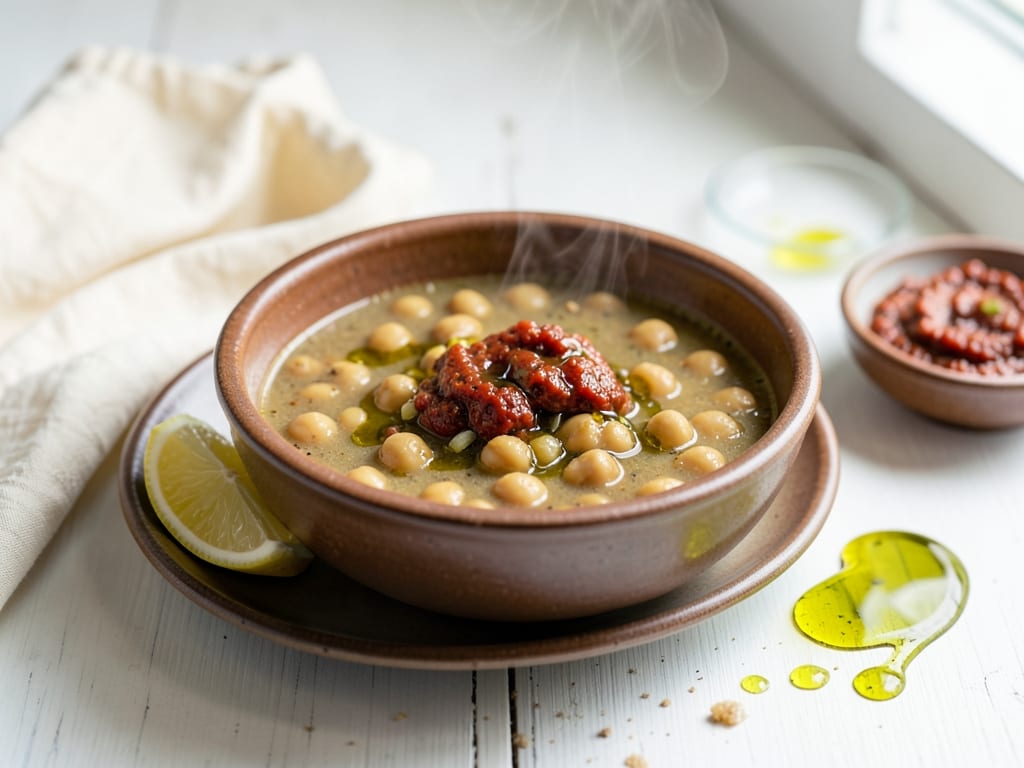
Tunisian Chickpea and Garlic Broth (Lablabi-Style)
A deeply savory, silky chickpea broth in the style of Tunisian lablabi: slow-simmered chickpeas, mellow garlic, and cumin, finished off the heat with a sharp raw-garlic and harissa paste, lemon, and good olive oil. Eat it as a soup, or ladle it over torn stale bread.
- Prep
- 25 min
- Cook
- 1 hr 20 min
- Wait
- 8 hr 5 min
- Total
- 9 hr 50 min
- Makes
- About 2 liters (8 cups), 6 generous bowls
Steps
Before you start
- Start the chickpeas the night before, or at least 8 hours ahead. They need a long soak for a creamy texture.
- Use a heavy 5-quart (4.7 L) pot with a lid. A thin pot scorches the chickpeas on the bottom.
- Old dried chickpeas stay firm. If yours have been in the pantry for more than a year, plan on an extra 20 to 30 minutes of simmering.
- Have a small bowl, a mortar, or a cutting board ready for the garlic paste. It goes in at the very end and is not cooked.
Soak the chickpeas
- Put the rinsed chickpeas in a large bowl.
- Add the 6 cups (1400 ml) soaking water, 2 tsp salt, and the baking soda, and stir until the salt dissolves.
- The chickpeas should be covered by at least 2 inches (5 cm) of water because they will double in size.
- Leave on the counter for 8 to 12 hours.
+ Show details− Hide details
Ready when: Chickpeas are plump, about double in size, and no longer wrinkled
Tip: In a warm kitchen, soak in the fridge so the chickpeas don't ferment.
Drain and rinse
- Pour the chickpeas into a colander and drain well.
- Rinse under cold running water for 30 seconds, shaking the colander, to wash off the baking soda and loosened skins.
- Transfer to the pot.
+ Show details− Hide details
Ready when: Water runs clear and no soapy foam remains
Tip: Don't skip the rinse. Leftover baking soda leaves a faint metallic taste.
Bring to a boil
- Add the 8 cups (1900 ml) simmering water, smashed garlic, olive oil, ground cumin, and caraway (if using) to the pot.
- Bring to a boil over high heat, about 8 minutes.
- Skim off the grayish foam that rises with a slotted spoon or skimmer.
+ Show details− Hide details
Ready when: Water is at a full rolling boil and the surface foam has been skimmed away
Tip: Skimming now keeps the finished broth clean-tasting and clear.
Simmer until creamy
- Reduce the heat to low so the surface barely bubbles, with just a few lazy bubbles at a time.
- Cover the pot with the lid slightly ajar.
- Simmer 60 to 75 minutes, stirring every 20 minutes and adding hot water if the chickpeas are no longer covered by at least 1 inch (2.5 cm).
- Do not salt the pot yet.
+ Show details− Hide details
Ready when: A chickpea mashes easily when pressed between two fingers, with a creamy center and no chalky bite
Tip: A hard boil splits the skins and makes the broth cloudy. Keep it at a gentle simmer.
Make the garlic paste
- During the last 15 minutes of simmering, mash the 4 garlic cloves with ¼ tsp salt in a mortar, or chop them finely and smear with the flat of a knife, until the paste is smooth.
- Scrape into a small bowl and stir in the harissa, 1 tsp cumin, 2 tbsp olive oil, and lemon juice until loose and well blended.
+ Show details− Hide details
Ready when: Paste is smooth, brick red, and pourable like a thick sauce
Tip: Raw garlic is the point here. It gives lablabi its sharp, bright bite, so don't cook it.
Thicken and season
- Scoop out 1 cup of chickpeas with a little broth and mash them with a fork or masher to a rough purée.
- Stir back into the pot along with 2 tsp salt.
- Raise the heat to medium-low and simmer, uncovered, for 10 minutes.
+ Show details− Hide details
Ready when: Broth looks slightly creamy and lightly coats the back of a spoon
Tip: Salting after the chickpeas are soft keeps their skins tender.
Finish off the heat
- Remove the pot from the heat.
- Stir in the garlic-harissa paste.
- Cover and let stand 5 minutes so the flavors meld.
- Taste and add salt, a pinch at a time, until the broth tastes rounded and bright.
+ Show details− Hide details
Ready when: Broth smells strongly of garlic and cumin with a clear lemony lift
Tip: If it tastes flat, add salt first, then more lemon juice, a teaspoon at a time.
Serve
- Ladle into 6 warm bowls, getting plenty of chickpeas in each.
- Drizzle each with a little olive oil and scatter on parsley if using.
- Serve with lemon wedges and extra harissa on the side.
+ Show details− Hide details
Ready when: Broth is steaming hot and glossy with oil
Tip: For a traditional lablabi, put torn stale bread in the bowl first and ladle the broth over it.
Good to know
Tips
- The baking soda is the secret to creamy chickpeas with tender skins. Don't add more than ½ tsp or they can turn mushy.
- Mashing a cup of chickpeas into the broth thickens it without flour or cream.
- Add the garlic-harissa paste off the heat. Boiling it dulls the flavor and removes the fresh bite.
- Lablabi is traditionally topped with a soft-cooked egg, capers, olives, or canned tuna. Add any of these for a fuller meal.
Make ahead
"Soak and simmer the chickpeas (steps 1 to 4) up to 3 days ahead and refrigerate in their broth. Reheat gently, then do steps 5 to 7 just before serving so the garlic stays fresh and sharp."
Storage & reheating
"Room temperature: up to 2 hours. Fridge: airtight container for up to 4 days. The broth thickens as it sits. Freezer: up to 3 months in airtight containers, leaving 1 inch (2.5 cm) of headspace. Thaw overnight in the fridge. Reheat in a pot over medium-low heat, adding a splash of water, until steaming. Add a little fresh lemon juice and olive oil after reheating."
Substitutions
- dried chickpeas → 3 cans (15 oz / 400 g each) chickpeas, drained and rinsed. Skip steps 1 and 2. Simmer with the garlic, oil, and spices in 6 cups (1400 ml) water for 25 minutes, and reduce the salt to 1 tsp at first.
- harissa paste → 1 tbsp tomato paste plus 1 tsp red pepper flakes and ½ tsp paprika. Gives similar color and heat, but with less depth of flavor.
- cold water, for simmering → Light vegetable or chicken stock. Makes a richer broth. Reduce the added salt and taste before seasoning.
- fresh lemon juice → Lime juice or 2 tbsp white wine vinegar. Use the vinegar a little at a time and taste.