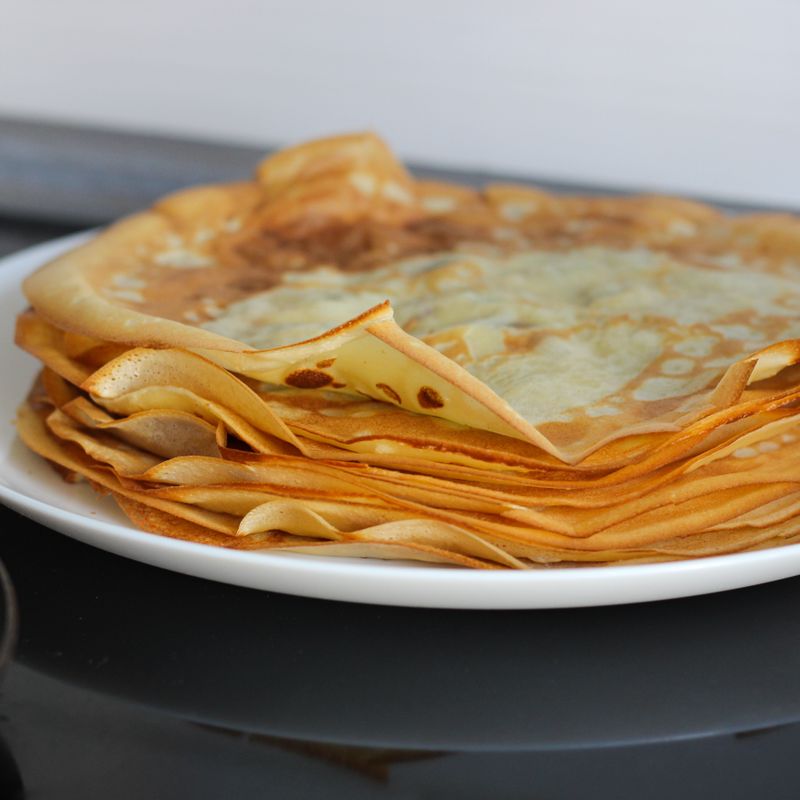
Thin French Crêpes
Delicate, lacy-edged French crêpes with a buttery flavor and tender, pliable texture. The batter comes together in a blender and rests briefly, then cooks in under a minute per crêpe. Fill them with sweet or savory toppings.
- Prep
- 15 min
- Cook
- 25 min
- Wait
- 30 min
- Total
- 1 hr 10 min
- Makes
- About 12 crêpes (8-inch/20 cm), serving 4
Steps
Before you start
- Melt the butter and let it cool slightly so it won't scramble the eggs.
- Bring the eggs and milk to room temperature (about 20 minutes out of the fridge) for a smoother batter.
- Plan for a 30-minute rest for the batter; it can also rest overnight in the fridge.
- Expect the first crêpe to be a test; it's normal to adjust heat and batter amount after it.
Blend the batter
- Add the eggs, milk, water, flour, salt, and sugar (if using) to a blender in that order.
- Blend on medium for 20–30 seconds, until completely smooth.
- Scrape down the sides and blend 5 seconds more.
- If mixing by hand, whisk the eggs, milk, and water together, then whisk in the flour, salt, and sugar until no lumps remain.
+ Show details− Hide details
Ready when: Batter is smooth with no visible flour lumps.
Tip: Add liquids first so flour doesn't cake at the bottom of the blender.
Add the butter
- With the blender on low, pour in the 3 tablespoons melted, slightly cooled butter and blend for 5 seconds just to combine.
- Pour the batter into a pitcher or bowl.
+ Show details− Hide details
Ready when: Batter looks glossy and uniform, like thin heavy cream.
Tip: Butter that is too hot can partly cook the eggs.
Rest the batter
- Cover and refrigerate the batter for at least 30 minutes (up to 24 hours).
- Resting lets the flour hydrate and the bubbles settle, giving tender crêpes that don't tear.
- Stir gently before using.
+ Show details− Hide details
Ready when: Batter is thin, pourable, and coats the back of a spoon lightly.
Tip: If it thickened while resting, whisk in 1–2 tablespoons water.
Heat the pan
- Set an 8- to 10-inch nonstick skillet over medium heat for 2 minutes.
- Lightly brush or wipe with some of the 1 tablespoon pan butter.
+ Show details− Hide details
Ready when: A drop of batter sizzles gently on contact.
Tip: If the butter browns quickly, lower the heat slightly.
Pour and swirl
- Pour about 3 tablespoons (45 ml) of batter into the center of the pan while lifting it off the heat.
- Immediately tilt and swirl so the batter coats the bottom in a thin, even layer.
- Return the pan to the heat.
+ Show details− Hide details
Ready when: Batter covers the whole pan bottom in a thin, even layer.
Tip: If you see holes, fill them with a drop of batter. If the crêpe is thick, thin the batter with a little water.
Cook first side
- Cook for 45–60 seconds, until the surface looks matte rather than shiny, the edges turn golden and lift from the pan, and the underside is lightly golden with a lacy pattern.
+ Show details− Hide details
Ready when: Top looks dry and edges curl slightly; underside is light golden.
Tip: The first crêpe is often pale or uneven; adjust the heat and move on.
Flip and finish
- Loosen the edge with a thin spatula, then slide it under and flip (or flip with your fingertips).
- Cook the second side for 15–20 seconds, until it has a few light golden spots.
- Slide onto a plate.
+ Show details− Hide details
Ready when: Second side has light golden spots and the crêpe slides freely.
Tip: The second side cooks much faster than the first.
Repeat and stack
- Repeat with the remaining batter, re-greasing the pan lightly only every 2–3 crêpes and stirring the batter before each pour.
- Stack the crêpes on the plate; they won't stick.
- Cover loosely with a clean towel to keep them warm and pliable.
- You should get about 12 crêpes.
+ Show details− Hide details
Ready when: A neat stack of about 12 thin, pliable crêpes.
Tip: Lower the heat if crêpes brown before the batter sets.
Fill and serve
- Serve warm, folded in halves or quarters, or rolled around fillings such as lemon and sugar, jam, Nutella and banana, or ham and Gruyère.
Good to know
Tips
- Batter should be as thin as heavy cream; thin it with a little water if it feels thick.
- Use a nonstick pan and wipe it with butter only occasionally to keep crêpes lacy rather than greasy.
- Tilt the pan immediately after pouring; the batter sets within seconds.
- Omit the sugar for savory fillings.
Make ahead
"Batter keeps covered in the fridge up to 24 hours; stir and thin with a splash of water before cooking. Cooked crêpes can be made up to 2 days ahead."
Storage & reheating
"Room temperature: up to 2 hours, covered. Fridge: stack with parchment between layers and wrap airtight for up to 3 days. Freezer: wrap airtight with parchment between layers for up to 2 months; thaw overnight in the fridge. Reheat in a lightly buttered skillet over medium-low heat for 15–20 seconds per side, or microwave stacked under a damp towel for 20–30 seconds."
Substitutions
- whole milk → unsweetened oat or almond milk. Works as a dairy-free option; crêpes may be slightly less rich.
- all-purpose flour → 1:1 gluten-free baking flour blend. Rest the batter 1 hour and add a splash more liquid if it thickens.
- unsalted butter → neutral oil (3 tablespoons). Reduces buttery flavor but keeps the crêpes tender.
- water → additional milk. Makes slightly richer, softer crêpes.
More pancakes & waffles
See all →

Find more like this
- Meal
- Breakfast
- Cuisine
- French
- Main ingredient
- Eggs
- Diet
- VegetarianHalal
- Method
- Stovetop
- Quick & Easy
- 5 Ingredients or LessMake Ahead