Easy Pancakes with Pancake Mix and Vanilla
Fluffy, golden griddle pancakes made from a boxed complete pancake mix, upgraded with real milk, an egg, butter, and a splash of vanilla for a rich, bakery-style flavor in about 30 minutes.
- Prep
- 7 min
- Cook
- 19 min
- Wait
- 5 min
- Total
- 31 min
- Makes
- 10 pancakes (about 4 inches / 10 cm each), cooked in 3 batches
Steps
Before you start
- Take the egg and milk out of the fridge about 15 minutes ahead if you can; room-temperature ingredients blend more smoothly into the mix.
- Check your box: this recipe is written for a 'complete' mix (just add water), which usually calls for about 1 cup water per 2 cups mix. Here, ¾ cup milk plus the egg, butter, and vanilla add up to roughly the same total liquid. Brands vary, so if your box calls for noticeably more or less water per cup of mix, adjust the milk and judge the batter by the consistency described in step 3.
- Set a wire rack on a baking sheet and keep it near the stove for holding finished pancakes warm.
- Plan on 3 batches of 3 to 4 pancakes, about 6 minutes each. The 5-minute batter rest happens while the griddle preheats, so it adds no extra time.
- Lumps are fine. Overmixing makes tough, flat pancakes.
Whisk wet ingredients
- In a large bowl, whisk the egg until the yolk and white are fully blended.
- Add the ¾ cup (180 ml) milk, vanilla extract, and 1 tablespoon cooled melted butter and whisk for about 20 seconds until evenly combined.
+ Show details− Hide details
Ready when: Mixture looks uniform with no streaks of egg white.
Tip: Let the melted butter cool for a minute first so it doesn't scramble the egg or clump when it meets cold milk.
Add the mix
- Add the 2 cups (240 g) pancake mix to the bowl all at once.
- Stir with a rubber spatula or whisk for about 10 to 15 seconds, just until no dry flour remains.
- The batter will be thick and slightly lumpy.
+ Show details− Hide details
Ready when: No dry streaks remain; small pea-sized lumps are fine.
Tip: Stop mixing as soon as the flour disappears. Overmixed batter makes rubbery pancakes.
Rest batter, heat griddleOven 200°F / 95°C
- Let the batter rest for 5 minutes so the mix hydrates and starts to bubble.
- During this rest, set the griddle or skillet over medium heat (about 350°F / 175°C on an electric griddle) to preheat, and heat the oven to 200°F (95°C) for keeping pancakes warm.
- After resting, check the batter: it should be thick but pourable, slowly plopping off a spoon in a ribbon that holds briefly.
- If it is stiff and does not fall, stir in milk 1 tablespoon at a time (up to 2 tablespoons).
+ Show details− Hide details
Ready when: A few drops of water flicked onto the griddle sizzle and dance before evaporating. The batter looks thicker with a few small bubbles.
Tip: Mixes absorb liquid at different rates. If the batter is thin and runny, whisk in 1 to 2 tablespoons more mix; don't overmix.
Grease the griddle
- Add about 1 teaspoon of butter or oil to the hot griddle and spread it with a folded paper towel or the butter itself into a thin, even film.
- Wipe away any excess so the pancakes brown evenly rather than fry.
+ Show details− Hide details
Ready when: Butter foams gently but does not brown or smoke.
Tip: If the butter browns instantly, lower the heat slightly and wait a minute.
Pour the batter
- Scoop ¼ cup (60 ml) of batter per pancake onto the griddle, leaving about 2 inches (5 cm) between them.
- Cook 3 to 4 pancakes per batch (10 pancakes total over 3 batches).
- Gently nudge each into a round with the back of the measuring cup if needed.
+ Show details− Hide details
Ready when: Batter spreads to about 4 inches (10 cm) across and begins to look matte at the edges.
Tip: Don't press or smooth the batter flat; it traps air that makes pancakes fluffy.
Cook first side
- Cook undisturbed for 2 to 3 minutes.
- Watch for bubbles forming across the surface and popping, leaving small holes, and for the edges to turn dull and set.
+ Show details− Hide details
Ready when: Bubbles on top have popped and stay open, edges look dry and set, and the underside lifts easily with a spatula to show a golden brown color.
Tip: Peek under one pancake before flipping. If it is pale, give it another 30 seconds.
Flip and finish
- Slide a wide spatula under each pancake and flip in one confident motion.
- Cook the second side for 1 to 2 minutes, until golden brown and the pancake springs back when lightly pressed in the center.
- The center should reach 160°F (71°C).
+ Show details− Hide details
Ready when: Both sides are an even golden brown and the center springs back when gently pressed.
Tip: Flip only once. Pressing down with the spatula squeezes out the air and makes pancakes dense.
Keep warm, cook remainingOven 200°F / 95°C
- Transfer the first batch to the wire rack on the baking sheet in the 200°F (95°C) oven, in a single layer.
- Wipe the griddle, add another teaspoon of butter, and cook the remaining batter in 2 more batches, repeating steps 4 to 7.
- Each batch takes about 6 minutes (about 3 minutes first side, 1 to 2 minutes second side, plus greasing and portioning), so allow about 12 minutes for both.
- Lower the heat slightly if pancakes brown before the centers set.
+ Show details− Hide details
Ready when: All batter used, giving about 10 evenly golden pancakes.
Tip: Don't stack warming pancakes; they steam and turn soggy. A rack keeps both sides crisp-edged.
Serve
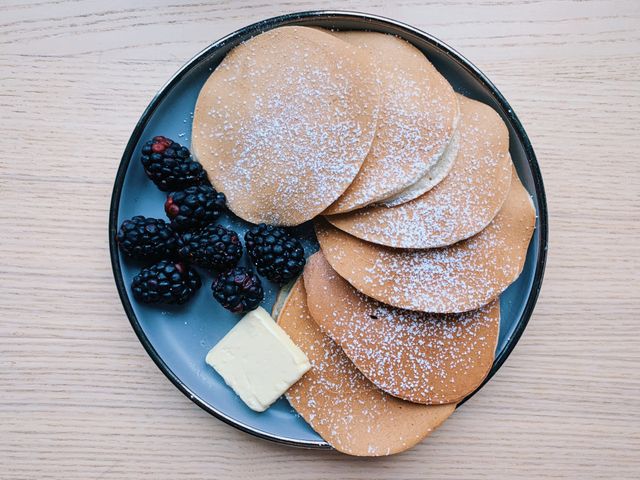
- Stack 2 to 3 pancakes per plate and top with a pat of butter if you like.
- Serve right away with warm maple syrup.
+ Show details− Hide details
Tip: Warm the syrup for 20 to 30 seconds in the microwave so it doesn't cool the pancakes.
Good to know
Tips
- Use a ¼-cup measure for uniform pancakes that finish cooking at the same time.
- The first pancake is a test: if it browns too fast, lower the heat; if it is pale after 3 minutes, raise it slightly. If it spreads much wider than 4 inches, the batter is too thin; whisk in 1 to 2 tablespoons more mix.
- For extra fluffy pancakes, don't skip the 5-minute batter rest.
- Fold in ½ cup (about 85 g) blueberries or mini chocolate chips after mixing for variations, adding a bit more cooking time per side.
Make ahead
Cooked pancakes can be made up to 2 days ahead and reheated. The batter is best used within 30 minutes, as it loses lift as it sits, so mix it fresh.
Storage & reheating
Room temperature: up to 2 hours. Fridge: cool completely, then store in an airtight container or zip-top bag with parchment between layers for up to 3 days. Freezer: freeze in a single layer on a tray for 1 hour, then bag for up to 2 months. Reheat: toast from frozen or chilled in a toaster until hot and lightly crisp, or microwave 20 to 30 seconds per pancake (covered with a damp paper towel) until steaming.
Substitutions
- whole milk → Unsweetened oat or soy milk, or buttermilk. Non-dairy milks work 1:1. Buttermilk gives a tangier, tender pancake; you may need 1 to 2 extra tablespoons if the batter is too thick.
- pure vanilla extract → Vanilla bean paste (2 teaspoons) or ½ teaspoon ground cinnamon. Paste gives visible vanilla flecks; cinnamon makes a warmly spiced version.
- large egg → ¼ cup (60 g) unsweetened applesauce. Pancakes will be slightly denser and softer. Skip the 160°F check, but cook until the center is set.
- unsalted butter or neutral oil → Avocado or canola oil. Higher smoke point means less browning of the fat and a cleaner, more even color.