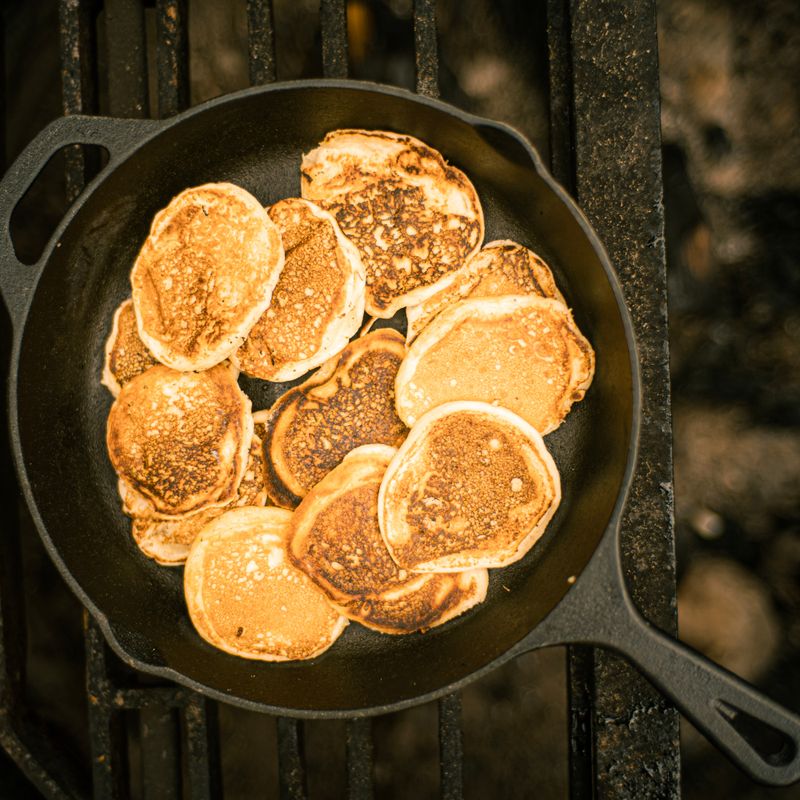
Classic Buttermilk Pancakes Baked in a Skillet
One thick, fluffy buttermilk pancake baked in a hot cast-iron skillet, with crisp buttery edges and a tender, custardy middle. Slice it into wedges and pour warm maple syrup over the top. You get a full pancake breakfast without standing at the stove flipping batches.
- Prep
- 15 min
- Cook
- 22 min
- Wait
- 15 min
- Total
- 52 min
- Makes
- 1 large pancake (4 generous wedges or 6 smaller ones)
Steps
Before you start
- Take the buttermilk and eggs out of the fridge 30 minutes ahead so they are close to room temperature. Cold buttermilk makes the melted butter clump.
- Position an oven rack in the center and remove any rack above it. The skillet goes in the oven while it preheats.
- The skillet and its handle will be extremely hot (400°F/200°C). Keep oven mitts within reach, and leave a mitt or towel on the handle as a reminder after you take it out.
- Measure the flour by spooning it into the cup and leveling it off, or weigh it. Scooping packs the flour and makes the pancake dense.
Heat oven and skilletOven 400°F / 205°C
- Place the empty 10-inch (25 cm) cast-iron skillet on the center rack and preheat the oven to 400°F (200°C).
- Leave the skillet in while the oven heats and while you mix the batter, so it is fully hot when the batter goes in.
+ Show details− Hide details
Ready when: Oven reads 400°F (200°C) and the skillet has been inside for at least 15 minutes by the time you pour the batter.
Tip: If your oven heats slowly, mix the batter first and put the skillet in right away. It needs at least 15 minutes to heat through.
Whisk dry ingredients
- In a large bowl, whisk together the flour, sugar, baking powder, baking soda and salt for about 30 seconds.
- Break up any lumps of baking soda against the side of the bowl.
+ Show details− Hide details
Ready when: The mixture is uniformly pale with no visible streaks or clumps.
Whisk wet ingredients
- In a medium bowl, whisk the eggs until the yolks and whites are fully combined, about 20 seconds.
- Whisk in the room-temperature buttermilk and vanilla.
- Slowly stream in the warm melted butter while whisking constantly.
+ Show details− Hide details
Ready when: The liquid is smooth and evenly pale yellow, with no visible butter globs or egg strands.
Tip: If the butter is hot, it can scramble the eggs. Cool it 5 minutes first. If small butter flecks form from cold buttermilk, that is fine and they will melt in the oven.
Combine into batter
- Pour the wet mixture into the dry ingredients.
- Use a rubber spatula to fold and stir just until no dry flour is visible, about 15 to 20 strokes.
- The batter will be thick and lumpy.
+ Show details− Hide details
Ready when: No dry flour pockets remain, and the batter is thick, scoopable and still has some small lumps.
Tip: Do not mix until smooth. Overmixing develops gluten and makes the pancake tough and rubbery.
Rest the batter
- Let the batter sit uncovered on the counter for 10 minutes.
- The flour hydrates, the baking powder starts working, and the batter thickens and becomes slightly puffy.
+ Show details− Hide details
Ready when: Small bubbles appear on the surface and the batter looks thicker.
Tip: Use this time to warm the syrup in a small saucepan over low heat or in the microwave for 30 seconds, if you like.
Melt butter in skilletOven 400°F / 205°C
- Wearing oven mitts, carefully pull the oven rack out slightly and set the hot skillet on a heatproof surface such as the stovetop (burner off).
- Add the 4 pieces of skillet butter and swirl the pan so the butter melts and coats the bottom and about 1 inch up the sides.
- This takes about 30 seconds.
+ Show details− Hide details
Ready when: The butter is fully melted, sizzling and foaming, and it coats the pan, but it is not browned or smoking.
Tip: Drape a mitt or towel over the skillet handle right away to remind everyone it is very hot.
Pour in batter
- Immediately scrape all the batter into the center of the hot skillet.
- It should sizzle at the edges.
- Gently nudge the batter toward the edges with the spatula to level it, but do not stir it into the butter.
+ Show details− Hide details
Ready when: The batter sizzles at the edge of the pan and sits in an even layer about 1 inch (2.5 cm) thick.
Tip: Work quickly so the skillet doesn't cool down. The sizzle is what forms the crisp, golden crust.
Bake the pancakeOven 400°F / 205°C
- Return the skillet to the center rack.
- Bake at 400°F (200°C) for 20 to 24 minutes.
- The pancake is done when the top is deep golden brown, the edges have pulled slightly away from the pan, and a toothpick inserted in the center comes out clean or with a few dry crumbs.
+ Show details− Hide details
Ready when: Top is deep golden brown, the center springs back when lightly pressed, a toothpick comes out clean, and the center reads about 205°F (96°C).
Tip: Don't open the oven during the first 15 minutes. Letting the heat out can make the pancake sink. If the top browns too fast, tent it loosely with foil for the last few minutes.
Rest, slice and serve
- Using oven mitts, remove the skillet and set it on a heatproof surface.
- Let the pancake rest 5 minutes so it sets and is easier to slice.
- Cut into 4 to 6 wedges, then lift out of the skillet with a thin spatula.
- Drizzle with the warm maple syrup, or pass it at the table.
+ Show details− Hide details
Ready when: The pancake is no longer jiggly and wedges release cleanly with crisp, golden bottoms.
Tip: The first wedge is the hardest to lift out. Run the spatula under it firmly to loosen the buttery crust.
Good to know
Tips
- A preheated skillet with sizzling butter is what gives this pancake its crisp, golden edges. Don't skip heating the pan first.
- Stop stirring when no dry flour is visible. A lumpy batter bakes up tender, while a smooth one bakes up tough.
- Use a cast-iron or other heavy ovenproof skillet. Thin pans heat unevenly and can burn the bottom before the center sets.
- Mix in ½ cup (about 75 g) blueberries or chocolate chips, folded in with the last stir, for a variation. Add a few extra minutes of baking if needed.
Make ahead
"Whisk the dry ingredients together up to 1 week ahead and store them in an airtight container. Whisk the wet ingredients up to 12 hours ahead and refrigerate them, then bring them to cool room temperature (about 30 minutes) before combining and baking. Don't combine the wet and dry ingredients until you are ready to bake, because the leavening starts to activate once they are mixed."
Storage & reheating
Room temperature: covered, up to 2 hours. Refrigerator: wrap wedges tightly or store in an airtight container for up to 3 days. Freezer: freeze wedges on a tray until firm, then wrap individually and store in a freezer bag for up to 2 months. Reheat: warm refrigerated or frozen wedges on a baking sheet at 350°F (175°C) for 8 to 12 minutes, or microwave a single wedge for 30 to 45 seconds. The oven keeps the edges crisper.
Substitutions
- full-fat buttermilk → 1 ½ cups (360 ml) whole milk mixed with 1 ½ tablespoons lemon juice or white vinegar. Stir and let it stand 5 to 10 minutes until slightly curdled. The pancake will be slightly less tangy and tender.
- all-purpose flour → Half whole wheat flour (95 g) and half all-purpose flour (95 g). The pancake will be nuttier and a bit denser. Let the batter rest the full 10 minutes.
- pure maple syrup → Warm honey, or fresh berries with a dusting of powdered sugar. Honey is sweeter, so use a little less.
- unsalted butter → 2 tablespoons (28 g) neutral oil or ghee. Ghee gives a similar buttery flavor with less risk of browning too fast. Heat it in the skillet for 1 minute before adding the batter.