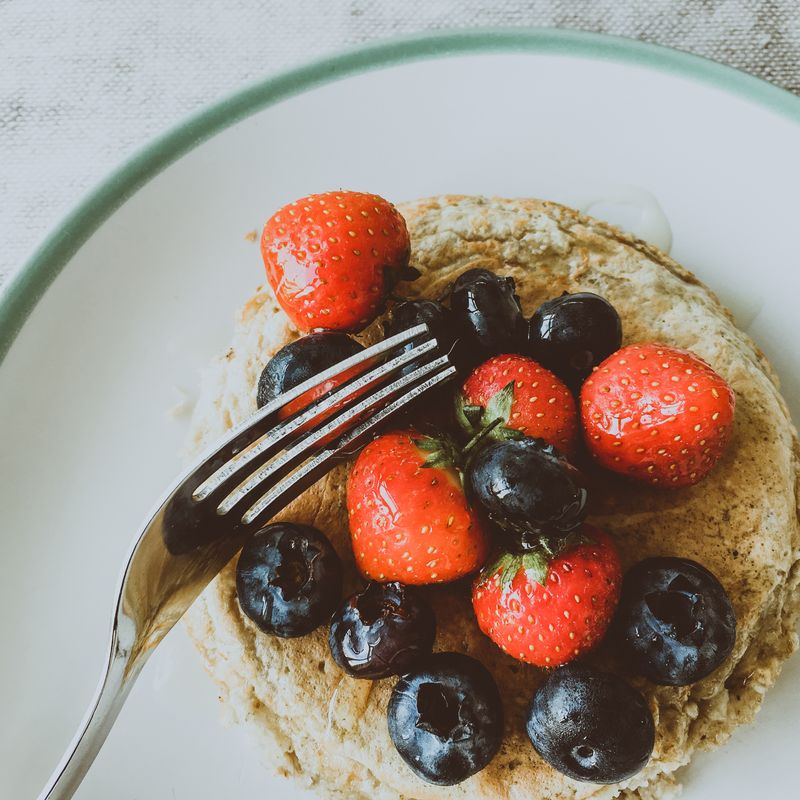
Fluffy Gluten-Free Pancakes
Tall, tender, golden pancakes made with a gluten-free flour blend. A short rest for the batter and a little melted butter give soft, fluffy centers with no gritty texture.
- Prep
- 15 min
- Cook
- 18 min
- Wait
- 15 min
- Total
- 48 min
- Makes
- About 12 pancakes (4-inch / 10 cm), serving 4
Steps
Before you start
- Use a cup-for-cup style gluten-free blend that already contains xanthan gum. If yours doesn't, add ½ teaspoon xanthan gum to the dry ingredients.
- Take the eggs and milk out of the fridge 20 minutes ahead. Cold milk can make the melted butter clump.
- Check that your baking powder is fresh and labeled gluten-free. Old baking powder is the top cause of flat pancakes.
- The batter needs a 15-minute rest. Use that time to heat the griddle.
Mix dry ingredients
- In a large bowl, whisk the gluten-free flour blend, sugar, baking powder and salt for 30 seconds until evenly combined and no clumps of baking powder remain.
+ Show details− Hide details
Ready when: Mixture looks uniform with no lumps.
Tip: Whisking well matters because gluten-free blends can settle and clump.
Whisk wet ingredients
- In a medium bowl, whisk the eggs until the yolks and whites are fully blended.
- Whisk in the milk and vanilla, then slowly whisk in the melted butter in a thin stream.
+ Show details− Hide details
Ready when: Liquid is smooth with no visible streaks of egg or pools of butter.
Tip: If the butter is hot it can scramble the eggs, so let it cool for a minute first.
Combine the batter
- Pour the wet mixture into the dry ingredients.
- Stir with a whisk or spatula for about 20 seconds, just until no dry flour remains.
- The batter will be thick and slightly lumpy, and should slowly fall from a spoon in a ribbon.
+ Show details− Hide details
Ready when: No dry pockets of flour; a few small lumps are fine.
Tip: Don't overmix. It knocks out air and makes the pancakes dense.
Rest the batter
- Let the batter sit at room temperature for 15 minutes.
- Gluten-free flours absorb liquid slowly, so the batter will thicken and bubble slightly as it rests.
+ Show details− Hide details
Ready when: Batter is noticeably thicker and has a few small bubbles on the surface.
Tip: If it becomes too thick to spoon, stir in 1–2 tablespoons of milk.
Heat the griddleOven 200°F / 95°C
- While the batter rests, set the griddle or skillet over medium heat for 3–4 minutes.
- Brush lightly with a little of the griddle butter.
- Preheat a 200°F (95°C) oven with a rack set over a baking sheet if you want to keep the finished pancakes warm.
+ Show details− Hide details
Ready when: A drop of water sizzles and skitters before evaporating (about 350°F / 175°C surface).
Tip: Too hot browns the outside before the center cooks. Adjust the heat after the first pancake.
Pour the pancakes
- Scoop ¼ cup (60 ml) batter per pancake onto the griddle, leaving 2 inches (5 cm) between them.
- Cook 2–3 minutes, until the edges look set and dry and bubbles form and pop in the center, leaving small holes that stay open.
+ Show details− Hide details
Ready when: Edges look matte and set, and bubbles on top stay open when they pop.
Tip: Don't press down on the pancakes. It squeezes out the air.
Flip and finish
- Slide the spatula fully under each pancake and flip in one motion.
- Cook 1½–2 minutes more until the second side is golden brown and the pancake feels springy when lightly touched in the center.
+ Show details− Hide details
Ready when: Both sides are golden brown and the center springs back; a pancake about ½ inch thick reaches about 205°F (96°C) inside.
Tip: If the center looks wet after flipping, lower the heat a notch and give it another minute.
Cook the rest and serveOven 200°F / 95°C
- Transfer finished pancakes to the rack in the warm oven in a single layer.
- Repeat with the remaining batter, brushing the griddle with a little more butter between batches, for about 12 pancakes total.
- Serve hot with warm maple syrup.
+ Show details− Hide details
Ready when: All pancakes are evenly golden and fluffy.
Tip: Keep them in a single layer on the rack. Stacking makes them steam and turn soggy.
Good to know
Tips
- Different gluten-free blends absorb different amounts of liquid. If the first pancake spreads thin, add 1–2 tablespoons more flour; if it's very thick, add a splash of milk.
- Make the first pancake a test: adjust the heat and batter thickness before cooking the rest.
- Add ½ cup (85 g) blueberries or chocolate chips by sprinkling them onto each pancake right after pouring, not by stirring them into the batter.
- Check that all ingredients, including baking powder and vanilla, are labeled gluten-free if serving someone with celiac disease.
Make ahead
"Whisk the dry ingredients together up to 1 week ahead and store airtight. The batter is best used within 1 hour of resting, but can be refrigerated up to 12 hours; stir in a splash of milk and expect slightly less lift. Cooked pancakes can be made ahead and frozen."
Storage & reheating
"Room temperature: up to 2 hours. Refrigerator: cool completely, store airtight up to 3 days. Freezer: freeze in a single layer on a tray, then bag, up to 2 months. Reheat from frozen in a toaster or in a 350°F (175°C) oven for 8–10 minutes, or microwave 30–45 seconds."
Substitutions
- whole milk → unsweetened almond or oat milk. Works 1:1 for a dairy-free version; pancakes may brown slightly less.
- unsalted butter → melted coconut oil or neutral oil. Use the same amount for a dairy-free option.
- whole milk → buttermilk plus ½ teaspoon baking soda. Replace the milk 1:1 and reduce the baking powder to 2 teaspoons for a tangier, extra-fluffy pancake.
- granulated sugar → light brown sugar. Same amount; adds a mild caramel flavor.