Fluffy Japanese Soufflé Pancakes
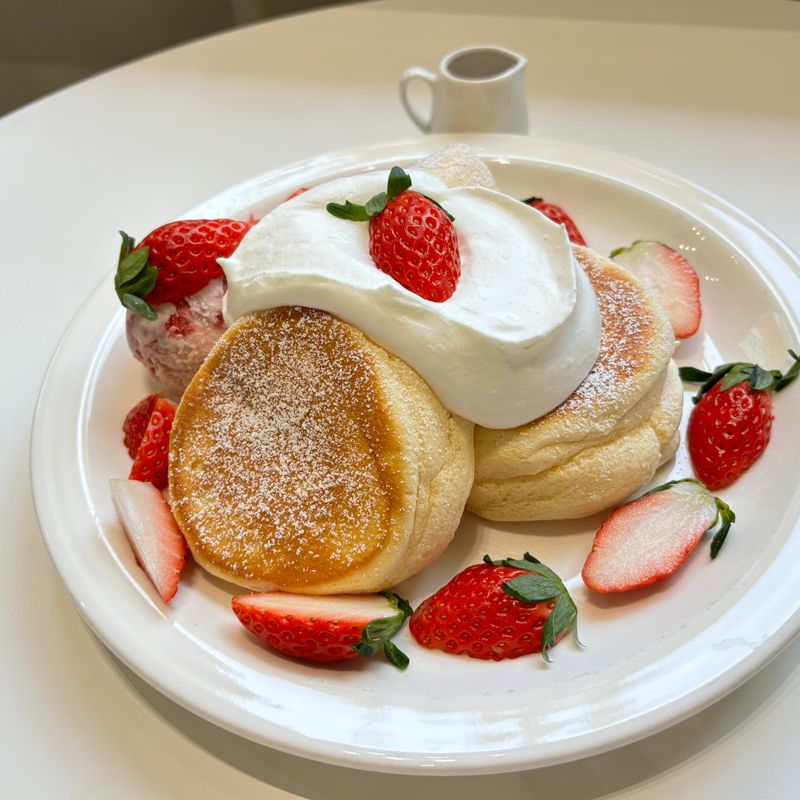
Tall, jiggly, cloud-like pancakes made by folding a stable meringue into a rich yolk batter, then cooking them slowly on a covered griddle so they steam as they rise. Serve warm with butter, maple syrup and fruit.
- Prep
- 25 min
- Cook
- 18 min
- Total
- 43 min
- Makes
- 3 large pancakes (2 servings)
Steps
Before you start
- Separate the eggs while cold (easier), then let the whites sit 15 minutes while you make the batter. Make sure no yolk gets into the whites.
- Wipe your mixing bowl and whisk or beaters with a little vinegar and dry them, so there is no grease to deflate the meringue.
- Have everything ready before whipping: the meringue must be cooked right away or it will deflate.
- You need a nonstick skillet with a tight lid and a very low flame. Test your lowest heat setting; the pan surface should be about 300°F (150°C), not sizzling hot.
- Plan on cooking in two batches of pancakes if your skillet is under 10 inches (25 cm).
Prepare pan and rings
- Wipe the inside of the 3-inch (7.5 cm) ring molds, if using, with a thin film of oil and set them in the skillet.
- Set the skillet over the lowest heat for 2 minutes just to take the chill off, then turn it off until the batter is ready.
- Cut a piece of parchment if you want to line the lid-free area; otherwise leave bare.
+ Show details− Hide details
Ready when: Pan is just warm to the hand held 2 inches above the surface.
Tip: A pan that is too hot browns the outside before the inside sets, and the pancakes collapse.
Make yolk batter
- In the medium bowl, whisk the egg yolks, milk and vanilla until smooth and pale yellow, about 30 seconds.
- Sift the cake flour and baking powder over the top and whisk gently until no dry streaks remain and the batter is smooth and thick like heavy cream.
+ Show details− Hide details
Ready when: Batter is smooth with no lumps or dry flour.
Tip: Do not overmix after the flour goes in or the pancakes turn chewy.
Whip meringue base
- Put the egg whites and cream of tartar in the large clean bowl.
- Beat with the mixer on medium speed for 1½–2 minutes until foamy and opaque with small, even bubbles.
+ Show details− Hide details
Ready when: Whites look like white bubble bath, with no visible liquid pooling.
Tip: Any grease or yolk in the bowl will stop the whites from whipping.
Add sugar, whip stiff
- With the mixer on medium-high, add the sugar 1 tablespoon at a time, waiting 20 seconds between additions.
- Once all the sugar is in, beat 2–3 minutes more until the meringue is glossy, smooth and forms stiff peaks that stand straight up when the beaters are lifted, with no sugar grit when rubbed between your fingers.
+ Show details− Hide details
Ready when: Stiff, glossy peaks; the bowl can be tilted without the meringue sliding.
Tip: Stop as soon as peaks are stiff. Over-whipped meringue turns grainy and won't fold smoothly.
Fold in meringue
- Stir one-third of the meringue into the yolk batter with a whisk to loosen it.
- Add the remaining meringue in two additions, folding with the silicone spatula: cut down the middle, sweep along the bottom and up the side, turning the bowl a quarter turn each time.
- Stop when no white streaks remain, about 25–30 folds.
- The batter should be airy, thick and hold a ribbon on its surface.
+ Show details− Hide details
Ready when: Batter is uniformly pale, billowy and holds its shape on the spatula.
Tip: Fold gently and quickly; stirring pushes out the air that makes these rise.
Pipe or scoop batter
- Return the skillet to the lowest heat.
- Working fast, scoop or pipe the batter into three mounds of about ⅔ cup (about 1 cup of batter per pair if using rings, filling each ring two-thirds full).
- Make each mound about 3 inches (7.5 cm) wide and 2 inches (5 cm) tall, leaving 1 inch (2.5 cm) between them.
- Then add a second smaller scoop on top of each to make them taller.
- Cook in two batches if the pan is crowded.
+ Show details− Hide details
Ready when: Mounds stand tall and hold their shape without spreading.
Tip: If mounds spread flat, the meringue was under-whipped or over-folded.
Steam first side
- Add 1 tablespoon of water to the empty areas of the pan (not on the batter), immediately cover with the lid and cook on the lowest heat for 6–7 minutes without lifting the lid.
- The pancakes should rise and the undersides should turn golden brown.
+ Show details− Hide details
Ready when: Tops look set around the edges and the bottoms are light golden when peeked at with a spatula.
Tip: Do not raise the heat; if you smell browning in the first 3 minutes, take the pan off the burner for 30 seconds.
Add water and top up
- Lift the lid, add another 1 tablespoon of water to the pan, and gently spoon a little extra batter on any low-spots if you saved some.
- Cover again at once.
+ Show details− Hide details
Ready when: Steam is gently rising from the pan when the lid comes off.
Tip: Keep the lid off for as short a time as possible so the heat does not drop.
Flip carefully
- Run a thin spatula around the rings (if used) to release, then slide the spatula fully under each pancake and flip with a confident, quick turn, supporting the top with a second spatula or the lid's edge.
- Add the last tablespoon of water, cover, and cook 5–6 minutes more.
+ Show details− Hide details
Ready when: Both sides are golden brown, the pancake springs back when pressed lightly, and the center reads 160°F (71°C) if checked with a thermometer.
Tip: If a pancake wobbles badly and feels wet in the middle, cook 1–2 minutes more.
Plate and serve
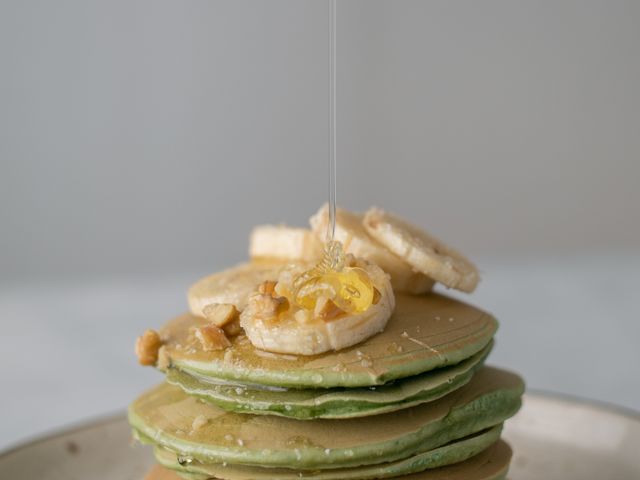
- Slide the pancakes onto plates immediately, stacking if you like.
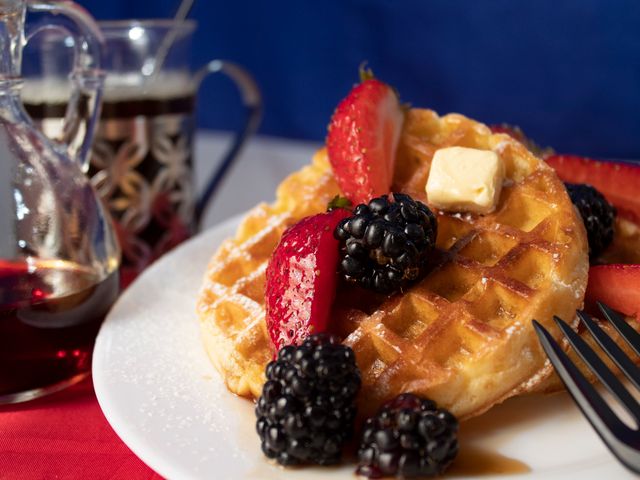
- Top with the softened butter, drizzle with the warmed maple syrup, and dust with powdered sugar if using.
- Serve at once while they are tall and jiggly.
+ Show details− Hide details
Ready when: Pancakes jiggle gently when the plate is moved.
Tip: They deflate within 5 minutes, so serve right away.
Good to know
Tips
- Stiff, but not dry, meringue is the most important step; stop beating as soon as peaks stand straight and the surface is still glossy.
- Use the lowest flame and a tight lid; high heat makes the exterior burn before the center sets.
- Do not open the lid in the first 6 minutes; steam is what lifts and sets the pancakes.
- Use a wide spatula and flip in one confident motion; hesitating tears the delicate crust.
Make ahead
Not recommended; the meringue must be cooked right after folding. You can separate the eggs and measure the dry ingredients up to 1 day ahead.
Storage & reheating
Best eaten immediately. Cool leftovers completely, then refrigerate in an airtight container up to 2 days; they will deflate. Freeze in a single layer, then bag, up to 1 month. Reheat in a 300°F (150°C) oven for 8–10 minutes or microwave 30–40 seconds; texture will be denser.
Substitutions
- cake flour → All-purpose flour plus cornstarch. Measure 32 g (about ¼ cup) all-purpose flour plus 8 g (1 tablespoon) cornstarch, and sift together twice.
- cream of tartar → Lemon juice or white vinegar. Use ½ teaspoon (2.5 ml) to stabilize the whites.
- whole milk → Unsweetened soy or oat milk. Works at the same quantity; the pancakes may brown slightly faster.
- maple syrup → Honey or whipped cream with berries. Use the same amount of honey, or serve with fresh fruit instead.