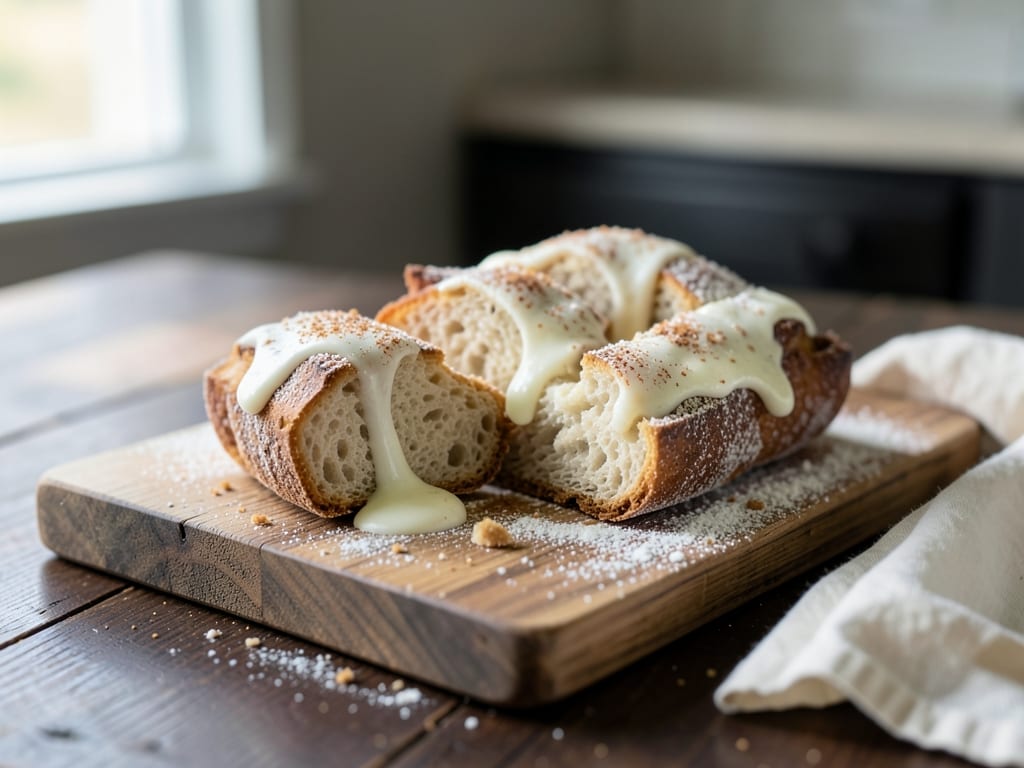
Spanish Torrijas with Honey and Orange Blossom Glaze
Torrijas are a luxurious Spanish fried bread dessert, traditionally enjoyed during Easter. Thick slices of day-old bread are briefly dipped in sweetened milk, coated in beaten egg, then fried until golden and crispy. This version is finished with a warm honey glaze infused with orange blossom water and cinnamon, bringing a subtle floral elegance to the classic. Serve warm while the exterior is still crunchy and the honey glaze is pourable.
- Prep
- 12 min
- Cook
- 15 min
- Wait
- 2 min
- Total
- 29 min
- Makes
- 10 torrijas, serves 3–4
Steps
Before you start
- Use day-old or stale bread—fresh bread will become soggy and fall apart when soaked and fried
- Measure and assemble all ingredients before you start (mise en place)
- Use a thermometer to heat oil to exactly 350°F (175°C); this prevents greasy or burnt torrijas
- Line a plate with paper towels for draining fried torrijas
Mix milk and spices
- In a shallow bowl or wide, flat-bottomed plate, combine the whole milk, ½ teaspoon (1.5 g) of the ground cinnamon, and a small pinch of salt.
- Stir well until the cinnamon and salt are fully dissolved.
- This soaking mixture will flavor and soften the bread.
- Set the bowl aside within arm's reach of where you'll work.
+ Show details− Hide details
Ready when: Cinnamon and salt are fully dissolved
Soak bread slices quickly
- Working swiftly to avoid over-soaking, dip each bread slice into the milk mixture, coating both sides with a quick motion—no more than 1–2 seconds per side.
- The bread should feel slightly softened but still hold its shape.
- Do not submerge or soak too long, or the bread will become mushy and disintegrate when fried.
- Place each soaked slice on a clean plate as you finish dipping.
+ Show details− Hide details
Tip: Speed is essential—quick dips, not long soaks. Oversodden bread will fall apart and won't fry properly.
Prepare egg coating
- In another shallow bowl, crack the 3 large eggs and beat them vigorously with a pinch of salt until the mixture is uniform and frothy.
- This beaten egg will coat the soaked bread slices and create a crispy, golden exterior when fried.
- Set the bowl near your frying station.
+ Show details− Hide details
Ready when: Eggs are fully combined and slightly frothy
Heat oil to frying temperatureOven 350°F / 175°C
- Pour 1.5 cups (360 ml) of vegetable or sunflower oil into your large skillet (10–12 inches / 25–30 cm) and place it over medium-high heat.
- Allow the oil to heat for about 4–5 minutes.
- Check the temperature with an instant-read or deep-fry thermometer—it should reach 350°F (175°C).
- Alternatively, test by dropping a small piece of bread into the oil; it should sizzle immediately and turn golden in about 30 seconds.
- Do not let the oil smoke, as this indicates it's too hot.
+ Show details− Hide details
Ready when: Oil reaches 350°F (175°C); test breadcrumb sizzles and browns in 30 seconds
Tip: Oil temperature is critical. Too cool and the torrijas absorb oil and become greasy; too hot and they brown before cooking through. Use a thermometer for accuracy.
Coat and fry torrijas in batches
- Working in batches to avoid overcrowding the pan, take one soaked bread slice and coat both sides thoroughly in the beaten egg mixture, ensuring full coverage.
- Carefully place 3–4 coated slices into the hot oil (avoid crowding, which lowers oil temperature).
- Fry for 2–3 minutes until the bottom is deep golden brown and crispy.
- Using a slotted spoon or tongs, flip each torrija gently and fry the other side for another 2–3 minutes until equally golden and crispy.
- Transfer the fried torrijas to a paper-towel-lined plate to drain excess oil.
- Repeat with remaining bread slices (typically 2–3 batches total).
- The entire frying process takes about 12 minutes.
+ Show details− Hide details
Ready when: Both sides are deep golden brown and crispy; oil stops bubbling around the edges when fully cooked
Tip: Never crowd the pan. Overcrowding cools the oil and prevents proper browning. Fry in batches so each torrija has room and equal heat exposure.
Warm honey-orange blossom glaze
- While the last batch of torrijas finishes frying, warm the honey in a small saucepan over low heat for 1–2 minutes, stirring occasionally.
- Alternatively, microwave the honey for 20–30 seconds until warm and pourable.
- Stir in the 1.5 teaspoons (7.5 ml) of orange blossom water and the remaining ½ teaspoon (1.5 g) of ground cinnamon.
- Mix until fully combined into a smooth, fragrant glaze.
- The glaze should be warm but not boiling.
+ Show details− Hide details
Ready when: Honey is warm and pourable; orange blossom water and cinnamon are fully incorporated
Glaze and serve warm
- Arrange the warm fried torrijas on a serving platter or individual plates.
- Drizzle or spoon the warm honey-orange blossom glaze generously over each torrija.
- If desired, sprinkle the optional 2 tablespoons (25 g) of granulated sugar and a light dusting of additional ground cinnamon over the top for extra sweetness and visual appeal.
- Serve immediately while the torrijas are still warm and the exterior is at its crispiest.
- The honey glaze will begin to set slightly as it cools.
+ Show details− Hide details
Tip: Serve immediately—torrijas are best enjoyed fresh and warm. Once they cool, the exterior loses its crispness and the glaze hardens.
Good to know
Tips
- Never over-soak the bread. A quick 1–2 second dip is all you need. Over-soaked bread will become mushy, lose its structural integrity, and disintegrate when you try to coat it in egg or fry it.
- Oil temperature is non-negotiable. If the oil is too cool (below 340°F), the torrijas will absorb oil and become greasy. If it's too hot (above 360°F), they'll brown too quickly before the inside cooks. Use a thermometer for best results.
- Fry in batches without crowding. Each torrija needs space in the pan so the oil maintains its temperature and heat distributes evenly. Crowded pans result in uneven browning and greasy torrijas.
- Serve immediately after glazing. Torrijas are at their absolute best when the exterior is still crispy and hot, and the honey glaze is warm and pourable. They deteriorate quickly as they cool.
Make ahead
Torrijas are best served fresh and warm. However, you can soak the bread slices up to 1 hour ahead of frying. Keep the soaked slices on a plate, covered loosely with plastic wrap, at room temperature. Fry just before serving for the best texture and crispness.
Storage & reheating
Leftover torrijas can be refrigerated in an airtight container for up to 2 days. Reheat gently in a 300°F (150°C) oven for 4–5 minutes to restore some crispness. Do not microwave, as this softens the exterior. Torrijas are not ideal for freezing, as the fried bread texture deteriorates and becomes less crispy upon thawing, though they can be frozen for up to 1 month if necessary. Thaw at room temperature and reheat in a low oven.
Substitutions
- Orange blossom water → Rose water. Use the same amount (1.5 teaspoons). Rose water adds a deeper, slightly more earthy floral note instead of the bright orange aroma.
- Honey → Maple syrup or agave nectar. Use the same amount (3 tablespoons). Maple syrup brings a rich, earthy sweetness; agave is milder and more delicate.
- Whole milk → Coconut milk or oat milk. Use the same amount (1 cup). Coconut milk creates a richer, more tropical flavor; add 1 tablespoon of sugar to the soaking mixture to compensate for less natural sweetness.
- Ground cinnamon → Ground cardamom. Use half the amount (0.5 teaspoon total). Cardamom is more aromatic, floral, and complex; it complements orange blossom beautifully.