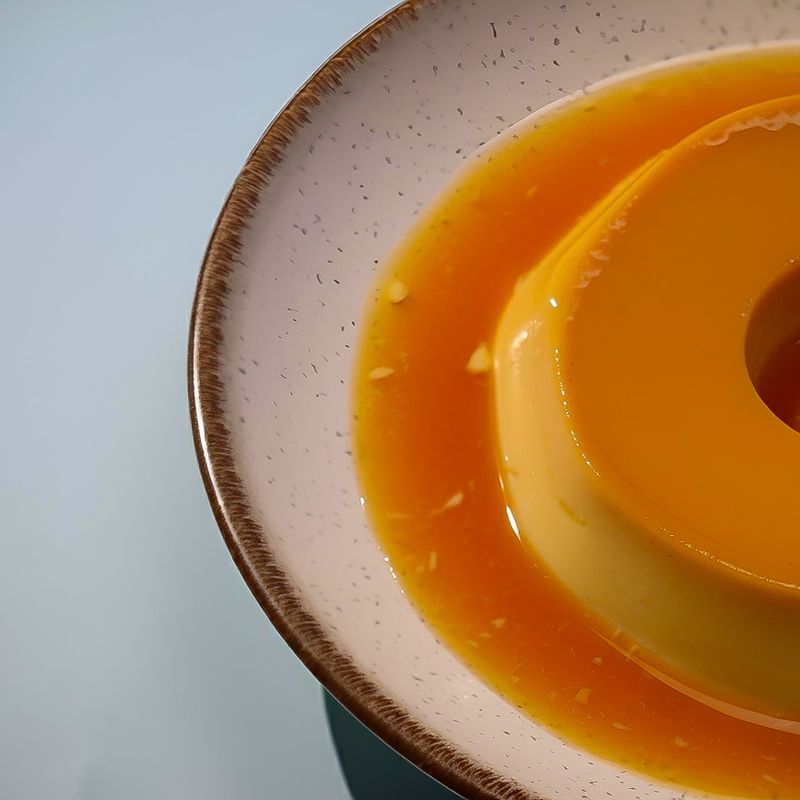
Spanish Tocino de Cielo with Caramelized Lemon
A luscious Spanish custard from Andalusia, made by baking egg yolks with hot sugar syrup into a creamy, flan-like confection. This version is brightened with candied lemon slices and a hint of cinnamon, creating a sophisticated, bittersweet topping that beautifully complements the rich, silky custard. A small slice of this traditional dessert goes a long way.
- Prep
- 20 min
- Cook
- 40 min
- Wait
- 4 hr 55 min
- Total
- 5 hr 55 min
- Makes
- 1 cake (8 slices)
Steps
Before you start
- Separate 12 eggs and reserve yolks only (save whites for another recipe)
- Preheat oven to 325°F (163°C)
- Fill a kettle with water and set to boil for the water bath
- Have all ingredients at room temperature except the water for the bath
Candy lemon slices and make caramelOven 350°F / 175°C
- Wash and pat the lemons dry.
- Using a sharp knife, slice them into ⅛-inch-thick rounds, removing any large seeds as you go.
- In a small heavy-bottomed saucepan, combine ¼ cup water and ½ cup sugar.
- Place over medium heat and stir occasionally until the sugar dissolves completely.
- Add the lemon slices to the syrup, then reduce the heat to medium-low.
- Simmer very gently for 15–20 minutes, stirring occasionally, until the lemon slices become translucent and candied.
- Using a slotted spoon, carefully transfer the lemon slices to parchment paper, spacing them apart to cool.
- Return the pan with the syrup to medium-high heat and cook the remaining syrup for 5–7 minutes, until it darkens to a deep amber color (about 350°F / 175°C if using a thermometer).
- Remove from heat—it will continue to cook slightly.
- Quickly whisk in the butter until combined; the syrup will bubble and foam slightly.
- Pour the caramel into a small bowl or spoon it over the cooled lemon slices.
- Set aside to cool completely.
+ Show details− Hide details
Ready when: Lemon slices translucent; caramel deep amber (about 350°F)
Tip: Be careful when whisking butter into hot caramel—it will bubble and steam. Have your pan off heat first to avoid splattering.
Prepare the baking pan
- Brush the 8-inch round cake pan thoroughly with softened butter, coating the bottom and sides evenly.
- Sprinkle the 2 tbsp sugar inside and coat the bottom and sides completely, tapping out any excess.
- Wrap the outside bottom and sides of the pan tightly with aluminum foil to prevent water from seeping in during the water bath.
- Place the foil-wrapped pan inside the roasting pan, ensuring at least 1 inch of space on all sides.
+ Show details− Hide details
Ready when: Pan fully coated with butter and sugar, outside completely wrapped with foil
Tip: The foil wrap on the outside is crucial—it prevents hot water from seeping into the custard and diluting it during baking.
Make the sugar syrupOven 230°F / 110°C
- In a large saucepan, combine 1 cup sugar and ½ cup water.
- Place over medium heat and stir with a whisk until the sugar is completely dissolved.
- Once the mixture reaches a gentle boil and becomes clear, stop stirring and let it cook for 1–2 minutes until it reaches about 230°F (110°C) on a thermometer, or until it's a light, clear syrup.
- Remove from heat and set aside.
- The syrup should be hot when added to the yolks.
+ Show details− Hide details
Ready when: Sugar fully dissolved; mixture reaches gentle boil and becomes clear
Tip: Stop stirring once the syrup is clear to avoid re-crystallizing the sugar. The syrup should be hot when it goes into the yolks.
Whisk the egg yolks
- Carefully separate the 12 eggs, placing the yolks in a large mixing bowl and reserving the whites for another recipe.
- Add a small pinch of salt and the finely grated lemon zest (about 1 tbsp).
- Using a whisk, beat vigorously for 2–3 minutes until the yolks lighten in color, thicken slightly, and become a distinctly pale yellow.
- The mixture should look noticeably lighter than raw yolks, and a ribbon of batter should trail from the whisk when it's lifted.
+ Show details− Hide details
Ready when: Yolks pale yellow and noticeably thickened; ribbon forms when whisk is lifted
Tip: Room-temperature eggs incorporate more smoothly and evenly with the hot syrup, reducing the risk of scrambling.
Make the custard
- While whisking the pale egg yolks constantly, pour the hot sugar syrup in a very slow, steady stream into the yolks.
- This slow addition is crucial to prevent the yolks from scrambling.
- Continue whisking for 2–3 minutes after all the syrup is added, until the mixture is very smooth, pale, and homogenous.
- Whisk in the vanilla extract (1 tsp), fresh lemon juice (1 tbsp), and ground cinnamon (¼ tsp) until fully combined.
- The custard should be smooth, glossy, pale yellow, and ribbon beautifully when drizzled from the whisk.
+ Show details− Hide details
Ready when: Custard smooth, pale yellow, ribbon forms when whisk is lifted
Tip: Pour syrup slowly to avoid scrambling the yolks. If syrup is added too quickly, the eggs will cook and the custard will be grainy.
Arrange custard and lemon in pan
- Pour the custard mixture into the sugar-coated baking pan.
- Arrange the cooled caramelized lemon slices decoratively on the surface of the custard, overlapping them slightly if desired for an attractive presentation.
- If you made a caramel syrup separately, you can drizzle a little over the lemon slices for extra richness and visual appeal.
- Reserve any remaining caramel to serve alongside the finished custard.
+ Show details− Hide details
Ready when: Custard poured; lemon slices arranged on top
Tip: Work with the lemon slices while they're still slightly warm so they adhere gently to the custard's surface.
Set up water bath and bakeOven 325°F / 165°C
- Boil water in a kettle.
- Carefully place the roasting pan (containing the foil-wrapped cake pan) on the oven rack at 325°F (163°C).
- Pour the boiled water into the roasting pan around the cake pan until the water level reaches about halfway up the sides of the cake pan (roughly 1–1.5 inches of water).
- Be careful not to splash water into the custard.
- Place the roasting pan in the preheated 325°F (163°C) oven and bake for 35–40 minutes.
- The custard is done when the edges are set and opaque, but the very center still jiggles slightly when you gently shake the pan side to side.
- The top should be light golden.
- An instant-read thermometer inserted near the edge (not the very center) should read about 165–170°F (74–76°C).
- Do not overbake.
+ Show details− Hide details
Ready when: Edges set and opaque; center jiggles slightly; top light golden; internal temp 165–170°F (74–76°C)
Tip: Avoid overbaking—the custard continues to set as it cools. Slight jiggle in the center is correct and results in the best creamy texture.
Cool to room temperature
- Carefully remove the roasting pan from the oven.
- Using tongs or a folded towel, lift the cake pan out of the hot water bath and place it on a wire rack.
- Let it cool to room temperature, about 1–1.5 hours.
- This crucial cooling period allows the custard to set further and develop its characteristic creamy, silky texture as it rests undisturbed.
+ Show details− Hide details
Ready when: Custard cooled to room temperature
Tip: Cooling at room temperature is crucial for the custard to develop the proper texture. Do not skip this step.
Chill and serve
- Once cooled to room temperature, cover the pan loosely with plastic wrap and refrigerate for at least 4 hours, or preferably overnight, until the custard is fully chilled and set with a creamy texture throughout.
- To serve, you have two options: (a) Run a thin, warm knife around the inside edge of the pan and carefully invert the Tocino onto a serving plate, allowing the caramelized lemon to become a glossy glaze on top (traditional presentation), or (b) serve directly from the pan, spooning out portions.
- Either way, slice into 8 wedges using a warm, wet knife wiped between cuts for clean, neat slices.
+ Show details− Hide details
Ready when: Fully chilled and set; creamy texture throughout
Tip: A warm, wet knife makes clean cuts and also helps if you choose to invert the dessert. Warming the knife under hot water and wiping it dry between cuts prevents the custard from sticking.
Good to know
Tips
- Slow syrup addition is critical: Always add the hot sugar syrup to the whisked yolks slowly and while whisking constantly. Adding it too quickly will scramble the eggs and create a grainy custard rather than a silky one.
- Use room-temperature eggs: Cold eggs are harder to incorporate smoothly and evenly. Separate your eggs at least 1 hour before baking, or remove them from the fridge 30 minutes ahead.
- The water bath is essential: The gentle, even heat of the water bath prevents the custard from curdling or developing air holes. The foil wrap on the outside of the pan is crucial to keep water from seeping in.
- Don't overbake: The custard continues to set as it cools. It should still have a slight jiggle in the very center when you remove it from the oven—this results in the best creamy texture. Overcooked custard becomes rubbery.
Make ahead
The Tocino de Cielo can be made up to 2 days ahead and stored covered in the refrigerator. The caramelized lemon slices can be made a day in advance and stored in an airtight container at room temperature, then arranged on top just before serving for the most visual appeal.
Storage & reheating
Room temperature: Not recommended; custard must be kept cool. Refrigerator: Up to 4 days, loosely covered or wrapped in plastic wrap. Freezer: Up to 2 months, wrapped tightly; thaw overnight in the refrigerator before serving. To reheat: Serve chilled, or remove from fridge 30 minutes before serving for a softer, room-temperature texture (more traditional).
Substitutions
- lemon zest → Finely grated orange zest. Substitute both the lemon zest and fresh lemon juice with orange zest and fresh orange juice, and candy orange slices the same way. This creates a beautiful citrus variation with a different flavor profile.
- ground cinnamon → Ground anise or a pinch of fennel seeds. Omit cinnamon and add ¼ tsp ground anise or crush a few fennel seeds into the custard for a more traditional Andalusian flavor. Anise is common in Spanish pastries.
- granulated sugar → Honey. Replace the sugar and water syrup with ½ cup warmed honey (about 170g) instead. This creates a richer, more amber-colored custard with deeper flavor. Heat honey gently; do not boil.
- medium lemons → Candied citron peel or candied orange peel. Use store-bought candied lemon or citron peel, chopped, if you prefer not to candy fresh lemons. Fold it into the custard before baking or arrange on top for a quicker version.
More puddings & custards
See all →



Find more like this
- Meal
- Dessert
- Cuisine
- Spanish
- Quick & Easy
- Make Ahead