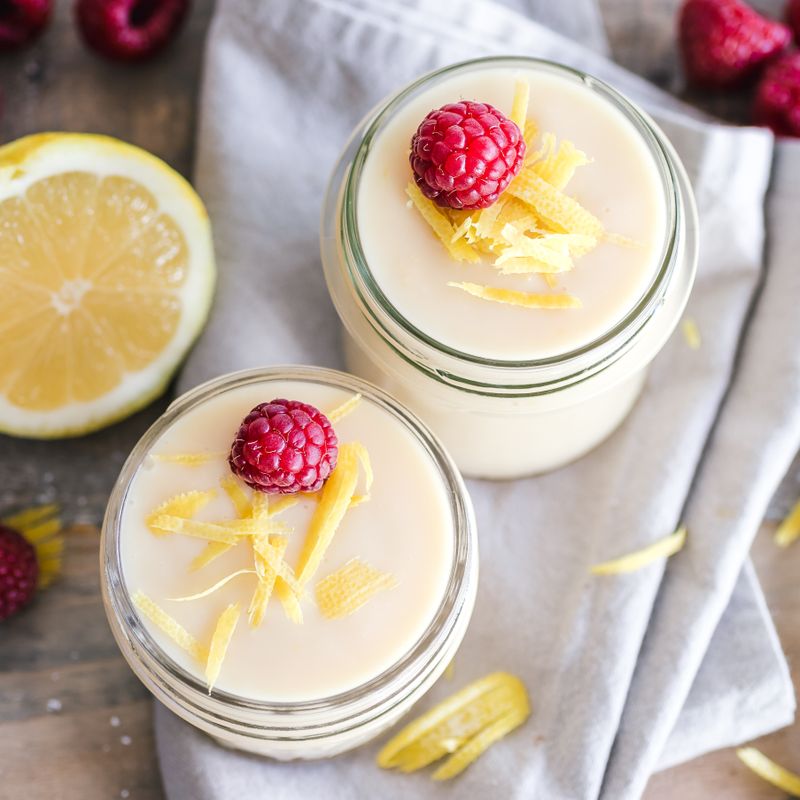
Lemon Pudding Cake
A bright, old-fashioned dessert that separates in the oven into a light, tender sponge on top and a silky lemon custard sauce underneath. Folded whipped egg whites make the top airy, and a water bath keeps the pudding layer smooth.
- Prep
- 25 min
- Cook
- 40 min
- Wait
- 30 min
- Total
- 1 hr 35 min
- Makes
- 1 8-inch square cake (6 servings)
Steps
Before you start
- Set the eggs and milk out 30 minutes ahead so they come to room temperature. Cold milk can deflate the whites and slow the bake.
- Wipe your bowl and whisk or beaters clean with a little lemon juice or vinegar. Any grease will keep the egg whites from whipping.
- Boil about 4 cups (950 ml) of water in a kettle before you start. It needs to be hot when the cake goes into the oven.
- Position an oven rack in the center. Find a roasting pan or large baking dish that holds the 8-inch dish with at least 1 inch (2.5 cm) of space on every side.
Heat oven, prep panOven 350°F / 175°C
- Position a rack in the center and heat the oven to 350°F (175°C).
- Boil about 4 cups (950 ml) of water in a kettle.
- Rub the softened butter over the bottom and sides of the 8×8-inch (20 cm) baking dish, then set the dish inside the roasting pan.
+ Show details− Hide details
Ready when: The dish is evenly coated with a thin film of butter.
Tip: Keep the water hot but off the boil until you need it.
Zest and juice lemons
- Finely grate the zest from the lemons first, then cut them in half and squeeze.
- Measure 1 tbsp (6 g) zest and ⅓ cup (80 ml) juice.
- Strain the juice to remove seeds and pulp.
+ Show details− Hide details
Ready when: You have 1 tbsp zest and ⅓ cup juice.
Tip: Zest before juicing. A whole lemon is far easier to grate.
Make lemon batter
- In a large bowl, whisk the 3 egg yolks with ½ cup (100 g) sugar for about 1 minute, until pale and thick.
- Whisk in the melted butter, zest and lemon juice.
- Sprinkle the flour and salt over the top and whisk until no dry streaks remain.
- Slowly whisk in the milk until the batter is thin and smooth.
- It will look like thin pancake batter and may look slightly curdled from the lemon, which is normal.
+ Show details− Hide details
Ready when: The batter is smooth, thin and pourable, with no flour lumps.
Tip: Add the milk slowly so the batter stays smooth.
Whip egg whites
- In a clean, dry mixing bowl, beat the 3 egg whites with the cream of tartar on medium speed for 1 to 2 minutes, until foamy and opaque with soft peaks.
- With the mixer running, add ¼ cup (50 g) sugar 1 tablespoon at a time.
- Increase to medium-high and beat for 1 to 2 minutes more, until the whites are glossy and hold stiff peaks when you lift the beaters.
+ Show details− Hide details
Ready when: Stiff, glossy peaks stand upright with only a slight curl at the tip, and the whites don't slide when the bowl is tilted.
Tip: Stop beating as soon as peaks are stiff. Over-beaten whites turn grainy and won't fold in smoothly.
Fold in whites
- Stir about one-third of the whites into the lemon batter to lighten it.
- Add the remaining whites and gently fold with a spatula, scraping down the sides and up through the middle, until just combined.
- A few small floating puffs of white are fine.
- The batter will remain quite liquid.
+ Show details− Hide details
Ready when: There are no large streaks of white or big white clumps remaining.
Tip: Fold gently. Stirring hard knocks out the air that creates the sponge layer.
Set up water bathOven 350°F / 175°C
- Pour the batter into the prepared baking dish.
- Set the roasting pan on the oven rack, pulled partway out, then carefully pour hot water into the roasting pan until it comes halfway up the sides of the baking dish.
- Slide the rack back in gently.
+ Show details− Hide details
Ready when: Water reaches about halfway up the baking dish, with no water splashed into the batter.
Tip: Filling the pan on the oven rack avoids spilling hot water while carrying it.
Bake until setOven 350°F / 175°C
- Bake at 350°F (175°C) for 35 to 40 minutes.
- The cake is done when the top is puffed, golden brown in spots and springs back when lightly touched in the center.
- The edges should be set, and the whole cake should shake only slightly when nudged.
- The sauce stays underneath.
+ Show details− Hide details
Ready when: The top is golden and springs back lightly; the edges are set and the center barely jiggles.
Tip: Don't open the oven door during the first 30 minutes, since a draft can make the top fall.
Cool in water
- Carefully lift the roasting pan out of the oven and set it on a heat-safe surface.
- Leave the baking dish in the water for 10 minutes, then lift it out with oven mitts onto a wire rack.
- Let it cool another 20 minutes so the sauce thickens slightly.
+ Show details− Hide details
Ready when: The sauce layer thickens to a spoonable custard and the dish is warm, not hot.
Tip: Take care with the hot water. Remove the roasting pan before lifting out the dish, or let the water cool.
Serve
- Dust the top with powdered sugar if using.
- Spoon the cake into shallow bowls, scooping down to the bottom so each serving gets both the sponge top and the lemon pudding.
- Serve warm or at room temperature.
+ Show details− Hide details
Ready when: Each portion shows a golden sponge layer over a creamy lemon sauce.
Tip: Use a large spoon, not a knife, for portions. The sauce is soft and runs.
Good to know
Tips
- Use fresh lemons. Bottled juice tastes flat and the zest gives the cake its real fragrance.
- The batter looks very thin before baking. That is correct, and the liquid portion settles to become the sauce.
- Make sure the water in the bath stays halfway up the dish. If it evaporates and falls too low, add more hot water carefully.
- For the cleanest scoops, let the cake cool a full 30 minutes. Cutting it too soon gives a runnier sauce.
Make ahead
"Bake up to 1 day ahead, cool completely, cover and refrigerate. Serve chilled or warm briefly. You can also zest and juice the lemons up to 1 day ahead and refrigerate them in a covered container. Do not whip the egg whites ahead."
Storage & reheating
"Room temperature: up to 2 hours after baking. Refrigerator: covered, up to 3 days; the sponge will soften into the sauce. Freezer: not recommended, as the custard layer becomes watery. Reheat individual portions in the microwave for 20 to 30 seconds, or warm covered in a 300°F (150°C) oven for 10 minutes, or enjoy cold."
Substitutions
- whole milk → 2% milk or unsweetened oat milk. 2% works with a slightly thinner sauce; oat milk works for dairy-free if you also swap the butter for a neutral oil.
- fresh lemon juice → fresh lime or Meyer lemon juice. Use the same amount. Meyer lemons give a softer, sweeter flavor; limes are sharper.
- cream of tartar → ½ tsp lemon juice or white vinegar. Add it when the whites turn foamy to help them hold stiff peaks.
- all-purpose flour → 1:1 gluten-free baking flour. The sponge will be slightly more delicate but works well.
More puddings & custards
See all →


Find more like this
- Meal
- Dessert
- Cuisine
- American
- Diet
- VegetarianHalal
- Method
- Oven