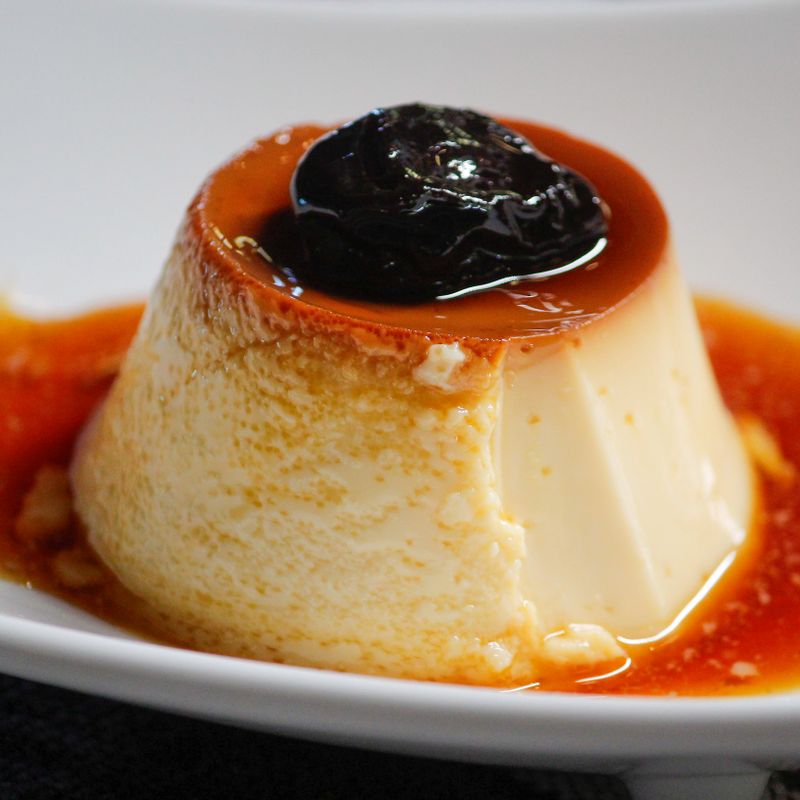
Classic Bread Pudding with Vanilla Sauce
A cozy American baked pudding with a custardy center, golden crisp edges, cinnamon and plump raisins, served warm under a silky stovetop vanilla sauce.
- Prep
- 48 min
- Cook
- 1 hr 16 min
- Wait
- 35 min
- Total
- 2 hr 39 min
- Makes
- 1 9×13-inch pudding (12 squares) with about 1½ cups (360 ml) sauce
Steps
Before you start
- Use bread that is a day or two old (challah, brioche, or a sturdy white loaf). If it is fresh, the drying step in the oven handles it.
- Take the eggs out 30 minutes ahead so they blend smoothly into the custard.
- Have a fine-mesh strainer and a clean bowl ready before you start the sauce.
- Plan on about 2 hours 40 minutes total; the sauce is made while the pudding rests.
Dry bread, soak raisinsOven 300°F / 150°C
- Arrange a rack in the middle of the oven and heat to 300°F (150°C).
- Spread the 1-inch bread cubes on a large rimmed baking sheet and bake for 15 minutes, stirring once halfway, until the cubes feel dry and slightly crisp on the outside but are not browned.
- While they bake, put the raisins in a small bowl and cover with the hot tap water.
+ Show details− Hide details
Ready when: Cubes feel dry and firm when squeezed, with no soft, doughy centers
Tip: If your bread is truly stale and hard, skip the oven and just let the raisins soak 10 minutes.
Prep dish, raise ovenOven 350°F / 175°C
- Increase the oven temperature to 350°F (175°C).
- Rub the 1 tablespoon softened butter over the bottom and sides of a 9×13-inch (23×33 cm) baking dish.
- Drain the raisins well in a sieve and pat them with a paper towel.
- Tip the bread cubes and raisins into a large bowl (at least 4 quarts / 4 L).
+ Show details− Hide details
Ready when: Raisins are drained and no standing water remains in the sieve
Tip: Wet raisins would thin the custard, so drain them thoroughly.
Whisk the custard
- In a separate large bowl or pitcher, whisk the eggs, granulated sugar, brown sugar, cinnamon, nutmeg, and salt for about 1 minute until no streaks of egg remain and the brown sugar clumps are broken up.
- Whisk in the milk, cream, vanilla, and melted butter until the mixture is smooth and uniform.
+ Show details− Hide details
Ready when: Custard is smooth, pale tan, and has no visible egg strands or sugar lumps
Tip: Let the melted butter cool a few minutes first so it does not start to cook the eggs.
Soak the bread
- Pour the custard evenly over the bread and raisins.
- Fold gently with a spatula 8 to 10 times so every cube is coated.
- Let stand for 20 minutes, pressing the cubes down gently and folding once or twice, until most of the liquid has been absorbed.
- Scrape into the buttered dish and spread level.
+ Show details− Hide details
Ready when: Only a thin layer of custard pools at the bottom of the bowl, and the cubes feel soft when pressed
Tip: Don't mash the bread; keeping some cubes intact gives you a better texture.
Top and bakeOven 350°F / 175°C
- Sprinkle the turbinado sugar evenly over the surface.
- Bake the pudding in the 350°F (175°C) oven for 50 minutes, rotating the dish front to back after 30 minutes, until the top is deep golden brown, the edges are slightly puffed, and a knife inserted in the center comes out clean with no liquid egg.
+ Show details− Hide details
Ready when: Center registers 160°F (71°C) and the top is deep golden brown
Tip: If the top browns too quickly before the center sets, tent loosely with foil for the remaining time.
Rest the pudding
- Set the dish on a wire rack and let the pudding rest for 15 minutes.
- It will deflate slightly and finish setting.
- Make the vanilla sauce during this time.
+ Show details− Hide details
Ready when: Surface is no longer steaming heavily and the pudding looks set when the dish is gently nudged
Heat milk and cream
- Combine the sauce milk and sauce cream in a medium saucepan.
- Warm over medium heat for about 4 to 5 minutes, stirring occasionally, until small bubbles form at the edges and steam rises.
- Do not let it boil.
- Remove from heat.
+ Show details− Hide details
Ready when: Tiny bubbles around the edge and steam rising
Tip: Set a fine-mesh strainer over a clean bowl now so it is ready.
Temper the yolks
- In a medium bowl, whisk the egg yolks, sauce sugar, and sauce salt for about 1 minute until thick and pale yellow.
- While whisking constantly, drizzle in about ½ cup (120 ml) of the hot milk mixture in a thin stream.
- Then slowly whisk in the rest.
+ Show details− Hide details
Ready when: Mixture is smooth, pale yellow, and warm to the touch
Tip: Pouring the hot liquid in too fast will scramble the yolks. Start with a thin stream.
Cook the sauce
- Pour the mixture back into the saucepan.
- Cook over medium-low heat for 4 to 6 minutes, stirring constantly with a heatproof spatula and scraping the bottom and corners, until the sauce thickens enough to coat the back of the spatula and a finger drawn through it leaves a clean line.
- It should read 175°F (80°C) on an instant-read thermometer.
+ Show details− Hide details
Ready when: Coats the back of a spatula and holds a clean line when you draw a finger through it; 175°F (80°C)
Tip: Don't go above 180°F (82°C) or the yolks will curdle. If the sauce looks grainy, remove it from the heat and whisk hard.
Strain and finish
- Immediately pour the sauce through the fine-mesh strainer into the bowl.
- Whisk in the vanilla extract and the cold butter, one piece at a time, until melted and the sauce looks glossy.
- Keep warm, covered, until serving; it thickens as it cools.
+ Show details− Hide details
Ready when: Sauce is smooth, glossy, and pourable like thin cream
Tip: Press plastic wrap against the surface to prevent a skin from forming.
Cut and serve
- Cut the pudding into 12 squares (3 rows by 4).
- Place each in a shallow bowl and spoon about 2 tablespoons (30 ml) of warm vanilla sauce over the top.
- Serve warm.
+ Show details− Hide details
Tip: Pass extra sauce at the table; it disappears quickly.
Good to know
Tips
- Don't skip drying the bread; fresh bread turns mushy instead of custardy.
- Pull the pudding when the center reaches 160°F (71°C); overbaking makes it dry and rubbery.
- Stir the sauce constantly and keep the heat at medium-low for a smooth, curdle-free result.
- For extra crunch on top, broil for 1 to 2 minutes at the end, watching closely.
Make ahead
Assemble the soaked, unbaked pudding in the dish, cover, and refrigerate up to 12 hours; bake straight from the fridge, adding 5 to 10 minutes. The sauce can be made up to 2 days ahead and rewarmed gently.
Storage & reheating
Room temperature: up to 2 hours after baking. Refrigerator: pudding and sauce in separate airtight containers up to 4 days. Freezer: wrap pudding squares tightly and freeze up to 2 months (sauce does not freeze well). Reheat squares, covered with foil, at 325°F (165°C) for 15 to 20 minutes, or microwave a portion 45 to 60 seconds. Rewarm sauce over low heat, stirring, or in the microwave in 15-second bursts.
Substitutions
- day-old challah or brioche → French bread, sturdy white sandwich bread, or croissants. Lean bread gives a firmer texture; croissants make it richer and softer.
- raisins → dried cranberries, chopped dried apricots, or semisweet chocolate chunks. Use the same weight; skip the soak for chocolate.
- heavy cream → additional whole milk. Gives a lighter, less rich custard; use 1 cup (240 ml) extra milk.
- pure vanilla extract → 1 vanilla bean or 1 tbsp bourbon. For a vanilla bean, scrape the seeds into the milk and cream when heating.
More puddings & custards
See all →
Find more like this
- Meal
- Dessert
- Cuisine
- American
- Main ingredient
- Eggs
- Diet
- VegetarianHalal
- Quick & Easy
- EasyMake Ahead
- Season
- Winter Comfort Food