Sourdough Torrijas
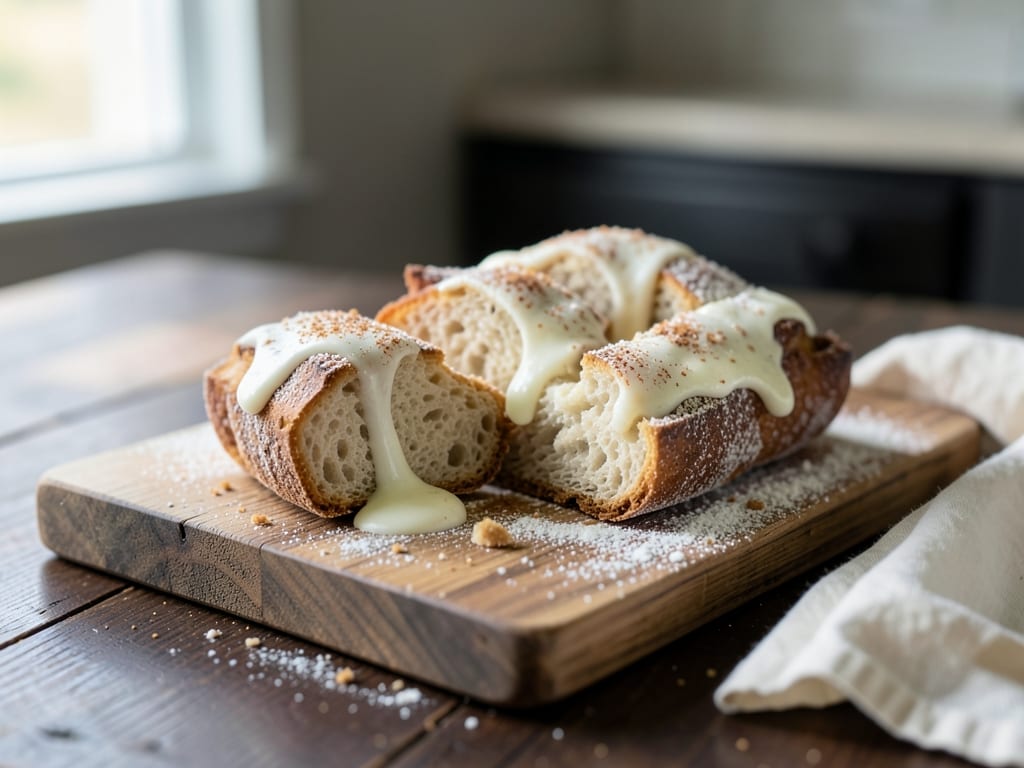
These Spanish fried bread desserts transform day-old sourdough into a crispy-outside, creamy-inside treat. Slices are dipped in spiced milk, coated in beaten egg, fried until golden, and finished with cinnamon sugar. A traditional recipe often served during Easter (Semana Santa) in Spain and Spanish-speaking countries, torrijas are simple to make but offer show-stopping results.
- Prep
- 16 min
- Cook
- 17 min
- Wait
- 7 min
- Total
- 40 min
- Makes
- 8–12 torrijas (3 per person)
Steps
Before you start
- Have day-old sourdough ready (stale is essential—fresh bread falls apart when dipped)
- Arrange all bowls, ingredients, and tools before you turn on heat
- Have paper towels ready for draining the fried torrijas
- Preheat your oven to 300°F if you plan to reheat any leftovers later
Slice the bread
- Using a serrated knife, slice the day-old sourdough loaf into 1/2- to 3/4-inch-thick slices.
- You should get 8–12 slices depending on thickness.
- Arrange the slices on a plate and set aside.
- If your bread is very fresh and soft, let the slices sit cut-side up uncovered at room temperature for 1–2 hours to dry slightly—stale bread is essential to prevent it from falling apart when dipped.
+ Show details− Hide details
Ready when: Slices are uniform in thickness and ready for use
Tip: Stale bread is non-negotiable. Fresh bread will disintegrate in the milk. If you only have fresh bread, let the slices dry for 2–4 hours uncovered.
Mix the dipping milk
- In a shallow bowl, whisk together the milk, cinnamon, sugar, and vanilla extract (if using).
- Stir for about 30 seconds until the sugar dissolves completely.
- The mixture should be smooth with no sugar grains.
- Set aside.
+ Show details− Hide details
Ready when: Mixture is smooth with no visible sugar crystals
Prepare the egg coating
- In another shallow bowl, beat the 3 eggs with a pinch of salt until well combined and slightly frothy, about 30 seconds.
- Don't overbeat—you just want them uniform in color.
+ Show details− Hide details
Ready when: Eggs are uniform in color and lightly frothy
Mix cinnamon sugar topping
- In a shallow dish, combine the sugar and cinnamon.
- Stir well for about 20 seconds to distribute the spice evenly—you want no cinnamon streaks visible.
+ Show details− Hide details
Ready when: Sugar and cinnamon are evenly combined throughout
Heat the oilOven 350°F / 175°C
- Pour the vegetable oil into a large skillet and heat over medium-high heat for 3–5 minutes until it reaches 350°F (175°C).
- You can test readiness without a thermometer by dropping a small breadcrumb into the oil—it should sizzle immediately and turn golden brown in about 1 minute.
- If using a thermometer, check frequently to confirm temperature.
+ Show details− Hide details
Ready when: Oil reaches 350°F (175°C); a breadcrumb sizzles immediately and browns in ~1 minute
Tip: Oil that's too cool will make the torrijas greasy; too hot and the outside will burn before the inside warms. Maintain 325–350°F throughout frying.
Dip and coat the bread
- Working quickly and one slice at a time, dip both sides of a bread slice into the spiced milk for 1–2 seconds per side—don't soak or the bread will fall apart.
- Immediately dip the milk-covered slice into the beaten egg, coating both sides completely, and place on a clean plate.
- Repeat with the remaining bread slices, working as quickly as possible so the coatings don't dry out.
- You can do this while the oil is finishing heating.
+ Show details− Hide details
Ready when: All bread slices are dipped and evenly coated with milk and egg; no dry spots visible
Tip: Work fast; let each slice drip slightly for 1–2 seconds before moving to the next. If the egg mixture starts to clump, whisk it again briefly with a fork.
Fry the torrijasOven 350°F / 175°C
- Carefully place 2–3 coated bread slices into the hot oil (don't overcrowd the pan—they need room to cook evenly).
- Fry for 2–3 minutes on the first side until deep golden brown and crispy.
- Using tongs or a slotted spatula, flip each one and fry for another 1–2 minutes on the second side until it matches the first side (the second side cooks faster since the bread is already warm).
- Transfer to a paper-towel-lined plate to drain.
- Wait 1–2 minutes for the oil temperature to recover slightly before adding the next batch, maintaining oil temperature between 325–350°F (160–175°C).
- Repeat with the remaining torrijas.
+ Show details− Hide details
Ready when: Both sides are deep golden brown; bread feels slightly crispy on the outside but soft and warm inside
Tip: Keep oil temperature steady by spacing out batches. If it drops below 325°F, let it recover before adding more bread. Don't flip too early—the crust needs time to set.
Coat with cinnamon sugar
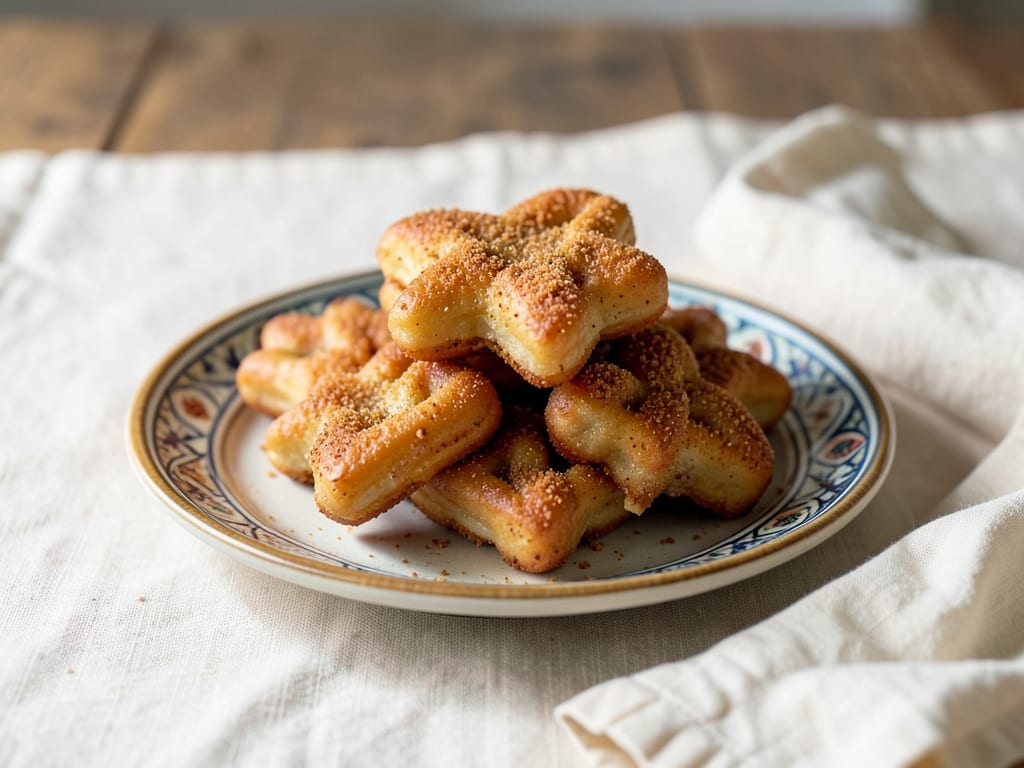
- While still warm (but not piping hot), generously coat both sides of each fried torrija with the cinnamon sugar mixture, pressing gently so it adheres well.
- Place on a clean plate or cooling rack.
- Let cool for 2–3 minutes before serving.
+ Show details− Hide details
Ready when: All torrijas are evenly coated with cinnamon sugar; topping adheres to the warm surface
Tip: The cinnamon sugar sticks best to warm (not hot) torrijas. If they cool completely, the sugar won't adhere as well. Coat them as soon as they finish draining.
Good to know
Tips
- Day-old bread is non-negotiable—fresh bread will disintegrate when dipped in milk. If you only have fresh bread, slice it and leave it uncovered at room temperature for 2–4 hours to stale slightly.
- The milk-dip time is critical: 1–2 seconds per side prevents sogginess. Thicker slices (3/4 inch) can take a hair longer; thinner slices (1/2 inch) should be quicker.
- Use a thermometer to monitor oil temperature—it's the difference between crispy-outside-creamy-inside and greasy-soggy. A $5 instant-read thermometer is worth every penny.
- Torrijas taste best served warm but not piping hot. Let them cool for 2–3 minutes on a rack so the exterior stays crisp as they cool.
Make ahead
You can prepare the dipping milk and cinnamon sugar mixture up to 1 day ahead. Cover and refrigerate the milk mixture; bring it to room temperature before using. Slice and dry the bread 2–4 hours before frying if it's very fresh.
Storage & reheating
Room temperature: Eat within 2–3 hours of frying for the crispiest texture. After that, they become softer and less appealing. Refrigerator: Store in an airtight container for up to 2 days. Reheat in a 300°F (150°C) oven for 5–7 minutes to re-crisp the exterior. Freezer: Not recommended—the texture becomes mushy and disappointing when thawed.
Substitutions
- day-old sourdough loaf → challah, brioche, or thick-cut white bread. Use day-old bread for best results. Any sturdy, slightly stale bread works. Avoid soft sandwich bread.
- whole milk → half-and-half or plant-based milk (oat, almond). Half-and-half adds richness. Use unsweetened plant-based milk to avoid excess sweetness.
- vegetable oil or sunflower oil → olive oil, avocado oil, or canola oil. Avoid extra virgin olive oil (too low smoke point). Use a neutral or light-flavored oil.
- sugar → honey or honey drizzled with crushed almonds. Warm honey can be drizzled over warm torrijas instead of cinnamon sugar for a different traditional finish.